Nine Wallets, $2.4M Profit, 98% Win Rate: Bubblemaps and 60 Minutes Land Polymarket's Insider-Trading Question
Bubblemaps and CBS's 60 Minutes published a joint investigation identifying nine wallets that profited $2.4M with a 98% win rate on Polymarket's US military operations markets — placed hours to days before public announcements. The on-chain evidence is overwhelming; the legal framework is not.

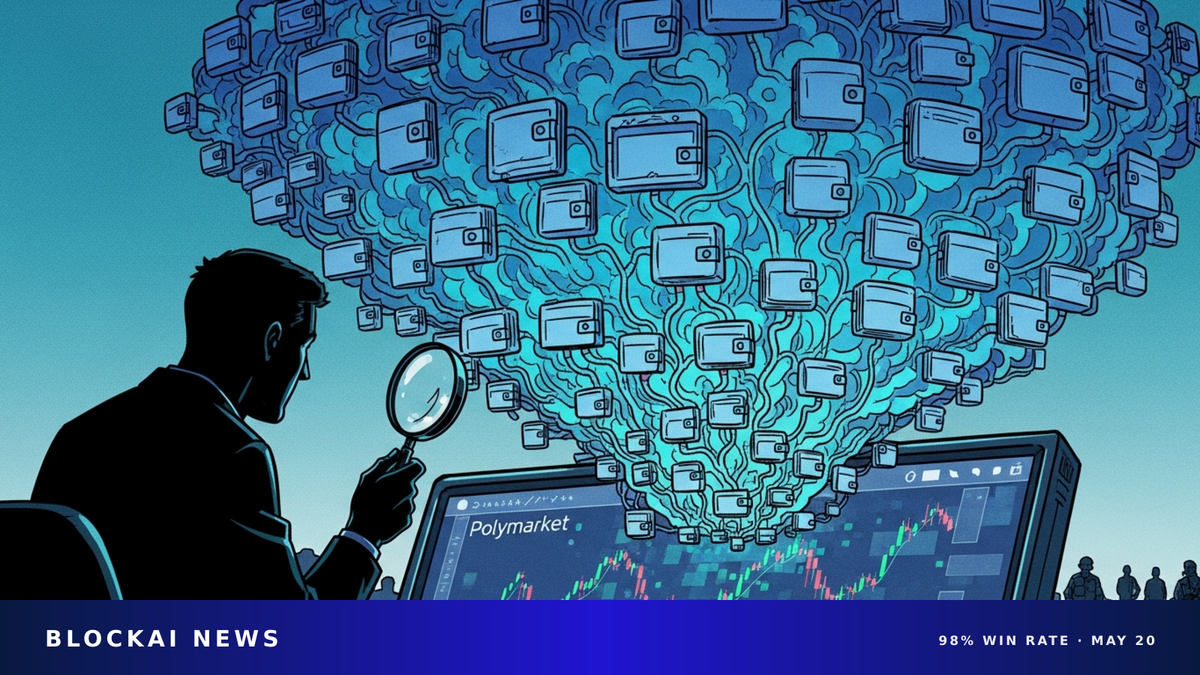
The Bubblemaps report that landed on Sunday — and the 60 Minutes segment it appeared in on the same evening — did three things at once. It demonstrated that an open, public blockchain renders prediction-market activity into the kind of evidence-base that, twenty years ago, would have required a subpoena to assemble. It quantified what observers have suspected for two years: that a small subset of Polymarket wallets are trading on information advantages that look statistically impossible to explain by skill. And it surfaced a question US law is structurally unprepared to answer: if a non-US wallet earns $2.4M trading non-public military information on a non-US event-contract platform, who has jurisdiction, and over what offense? The answer matters for prediction markets, for onchain agents that will increasingly trade them, and for whether the AI-mediated information layer everyone is building can live alongside the regulated information layer it is starting to displace.
TL;DR
- Bubblemaps and CBS's 60 Minutes jointly published an investigation identifying a connected cluster of 9 wallet addresses that profited ~$2.4M on Polymarket markets tied to US military operations against Iran — strikes, the Khamenei killing, the ceasefire — across 2025 and 2026, posting a 98% win rate.
- The pattern that distinguishes the cluster is two-sided: large directional bets placed hours to days before public announcements, paired with small intentionally losing bets on unrelated events that appear designed to mask the cluster's directional skill from platform-monitoring systems. Bubblemaps does not claim to prove insider trading on-chain.
- The legal framework is the uncomfortable piece. Polymarket event contracts are not securities under current US law; the wallets appear to be non-US; the prosecutable offense — if any — turns on whether the source of the information can be identified. The case is the first major test of how US authorities respond when on-chain forensics make information abuse visible without making it legally actionable.
What Bubblemaps actually found
Bubblemaps' methodology — visualizing the connections between wallet addresses by tracing token transfers, gas-fee funders and protocol-interaction overlap — has been used since 2022 to surface insider clusters in token launches, MEV operations and rugpulls. The Polymarket investigation applies the same methodology to event-contract betting. The investigators identified nine wallet addresses with overlapping funding sources (the same upstream wallets supplied initial USDC), overlapping protocol-interaction patterns (the wallets used identical Polymarket-portfolio-management settings) and statistically correlated betting timing. Treated as a single cluster — which the connection graph strongly suggests they are — the wallets' aggregate P&L across military-event markets is $2.4M, almost entirely from a small number of large, directionally correct bets.
The 98% win rate is the specific number that makes the story uncomfortable. Even the most skilled prediction-market traders post win rates in the low-to-mid 60% range over a meaningful sample of bets, because the markets are sufficiently efficient that consistently beating 70% requires either material informational advantage or systematic mispricing by the order book. A 98% rate over a sample of double-digit bets, with the losses concentrated in small, unrelated event types, is the kind of distribution that statisticians describe as "consistent with the hypothesis that the trader knew the answer in advance, and inconsistent with most other hypotheses."
The 60 Minutes segment adds the off-chain texture: interviews with prediction-market participants, with on-the-record commentary from former intelligence officials about the kinds of information classification regimes that would, in principle, be sensitive enough to produce a 98% trading edge. The segment does not name the wallet operators. CBS's investigation could not establish their identities, and Bubblemaps does not claim to know them. The strongest editorial inference the joint report makes is that the wallets exhibit "the on-chain pattern of an actor with access to non-public US government information about military operations." It leaves the legal interpretation to viewers and regulators.
Why this only became visible because the chain is open
The investigative twist worth pausing on is that an equivalent pattern in traditional event-trading or sports-betting markets would be effectively invisible to outside investigators. Bookmakers do not publish their order books with wallet-resolved trade histories. The IRS does not publish counterparty data for tax-reporting purposes. The SEC investigates suspicious activity in equities markets through subpoenas of brokerage records, which take months to obtain and are not public. Onchain prediction markets — by virtue of running on Polygon and other public chains — produce a trade history that any analyst with a wallet-graph tool can read in an afternoon.
That openness is a double-edged feature for the prediction-markets category. On one hand, it makes the kind of forensic work Bubblemaps did possible in the first place, which is good for market integrity over the long run. On the other hand, it makes prediction markets uniquely legible to regulators, investigators and competitors — and creates the political pressure that drove the CFTC's 2025 enforcement action against Polymarket. The platform settled and stopped serving US persons, but the underlying contracts continue to trade and continue to be the subject of forensic investigation, because the chain itself does not change behavior when the platform's legal posture does. The same Polymarket book that priced the CLARITY Act probability with leading-indicator accuracy is, in this case, the subject of the leading-indicator accuracy that looks like information abuse.
It's our wildest finding on Polymarket so far
— Bubblemaps (@bubblemaps) May 18, 2026
Potentially another big military insider
And yet, we do not blame Polymarket
In fact we APPLAUD them
The only reason investigations like this are possible is because @Polymarket chose radical transparency
Everything is onchain:… https://t.co/uvG9ijNVZI
The legal puzzle is harder than it looks
US insider-trading law is built around securities transactions and the misappropriation of material non-public information about securities. Event-contract trading on non-securities outcomes — military operations, election results, weather — does not fit cleanly into that framework. The CFTC has authority over commodities and futures markets, but its existing case law on event contracts is narrow and was the basis for the 2025 settlement that restricted Polymarket from US persons. The wallets in the Bubblemaps cluster appear to be outside US jurisdiction; the platform is outside US jurisdiction; the contracts are not securities. Under existing law, none of the standard insider-trading provisions clearly apply.
The prosecutable offense, if there is one, is therefore upstream: on the source of the information rather than on the trading. If a US government contractor with security clearances disclosed planned military operations — directly or through intermediaries — to a wallet operator, the contractor's offense (under espionage statutes, the Atomic Energy Act, or wire fraud provisions covering theft of government information) is squarely within US jurisdiction regardless of where the trading happens. That is the thread DOJ would have to follow. Whether DOJ chooses to follow it depends on whether the IP-address forensics, custody-of-funds tracing, and counterparty-interaction analysis can identify a specific source — which is the question Bubblemaps' analysis does not resolve and 60 Minutes' off-chain reporting does not resolve either.
The structural consequence is that prediction markets, AI-agent-mediated trading, and on-chain forensics are now in a triangle the existing US regulatory framework was not designed for. The CLARITY Act's AI-sandbox amendment creates a registration regime for autonomous agents but does not address event-contract markets. The AP2 agentic-payments framework assumes agents will increasingly transact in event contracts but does not address the information-asymmetry problem. The Bubblemaps case forces the question that those frameworks have, so far, sidestepped: what does fair information access look like when an AI agent — or a human cluster — can extract a 98% edge from a public order book?
When the market is the truth signal, who polices the inputs?
The deeper systemic point is that prediction-market prices are increasingly being used as inputs into other systems. AI agents reading the news can be configured to weight Polymarket odds. Hedge funds quote them in research notes. Bloomberg and the Economist have published columns citing Polymarket as a forecast source. Bitget's AI Trading product integrates onchain probability signals into automated strategies. If the market is the truth signal, the integrity of the inputs becomes a non-trivial systemic question. A 98% win rate cluster that is consistently early on military operations is, at scale, a leak of national security information into the consumer information layer — whether or not it is prosecutable.
The prediction-market category therefore faces a credibility question more than a legal one. The same on-chain transparency that makes the market trustworthy in normal cases makes it vulnerable in cases where the trade looks like information abuse. Polymarket's response — citing platform compliance procedures, noting that the wallets are not US-based, emphasizing the absence of a regulatory definition for prediction-market insider trading — is technically correct and, in the court of public opinion, will not be sufficient. The category needs a credible answer to "what do we do when the on-chain pattern looks like this?" before the next administration-level decision is litigated in front of a Senate committee that is not friendly to prediction markets.
What to watch. Three signals matter. First, whether the Department of Justice takes interest in the source-of-information question. A grand jury subpoena to any US contractor with relevant clearances would be the first visible sign. Second, whether Polymarket and competitor platforms (Kalshi, Drift Predict, Limitless) publish updated monitoring frameworks for cluster-pattern detection. The category needs to demonstrate self-policing capacity before the regulatory framework forces it. Third, whether the CFTC or a future regulatory framework (under CLARITY or a parallel bill) addresses event-contract information asymmetry explicitly. The category's long-run viability depends on the answer.
Frequently Asked Questions
What did Bubblemaps actually find?
Bubblemaps — a blockchain-analytics firm that specializes in wallet-cluster visualization — published a report identifying a connected cluster of nine wallet addresses that collectively profited approximately $2.4 million on Polymarket prediction markets tied to US military operations against Iran during 2025-2026. Specifically: the wallets bet on the timing of the February 28 strike, on the killing of Iranian Supreme Leader Ayatollah Ali Khamenei, and on the conditions of the US-Iran ceasefire agreement. Across the major military-event bets, the cluster posted a 98% win rate, with the few losing bets being intentionally small wagers on unrelated outcomes — a pattern Bubblemaps argues is designed to mask the cluster's directional accuracy from platform-monitoring systems. The investigation was published in collaboration with CBS News and aired on 60 Minutes.
Does the on-chain evidence prove insider trading?
On-chain evidence cannot, by itself, prove insider trading. What Bubblemaps' analysis demonstrates is a statistically improbable pattern of correctness — 98% across multiple distinct event types is far outside the win rates of even the most skilled prediction-market traders — and a pattern of small losing bets that match common information-laundering tactics. What it does not demonstrate is the source of the information. To establish insider trading in the traditional securities-law sense, prosecutors would need off-chain evidence: communications, employment records, government clearances, or testimony showing that the wallet operators had access to non-public information about US military operations. Bubblemaps explicitly notes this limit. The firm's framing is 'suggestive of unfair informational advantage,' not 'proof of insider trading.'
Is Polymarket prediction-market insider trading actually illegal?
The legal answer is uncomfortably ambiguous. US securities law's insider-trading prohibitions apply to securities transactions, and Polymarket markets on event outcomes — military operations, election results, weather — have not been categorized as securities under current US law. The CFTC has previously challenged Polymarket on grounds that it operates an unlicensed event-contract platform; that proceeding settled in late 2025 with Polymarket restricted from serving US persons. The wallets in the Bubblemaps cluster appear to be non-US. If the information used to make the bets was misappropriated from a US government source — for example, by a contractor with clearances — the prosecutable offense in US law would more likely be the misappropriation (espionage statutes, wire fraud, theft of government information) than the trading itself. The Department of Justice's interest, if any, will turn on whether the information source can be identified.
Reviewed by Jason Lee, Founder & Editor-in-Chief, BlockAI News.
Sources
Primary sources
- Bubblemaps — Polymarket military-bet wallet cluster investigation
- CBS News / 60 Minutes — Online prediction market traders make millions betting on US military operations
- Polymarket — US military operations on Iran (event markets)
- @bubblemaps — "Wildest finding on Polymarket" wallet cluster investigation
- @bubblemaps — Exclusive investigation shared with @60Minutes
- @60Minutes — Nine connected Polymarket accounts $2.4M thread
- CFTC — Statement on Polymarket settlement (2025)
How we report: This article cites primary sources, regulatory filings, and on-chain data where available. BlockAI News uses AI tools to assist with research and first-draft generation; every article is reviewed and edited by a human editor before publication. Read our full How We Report page, Editorial Policy, AI Use Policy, and Corrections Policy.