Trump Orders the Fed to Open Payment Rails to Crypto Firms — With a 90-Day Clock
Trump's May 19 executive order directs the Fed to review whether crypto firms, uninsured depositories and non-bank fintechs can access Fed payment accounts — and orders a 90-day report plus a 90-day application clock once the rule changes land. The agentic-payments rail question is no longer hypo...

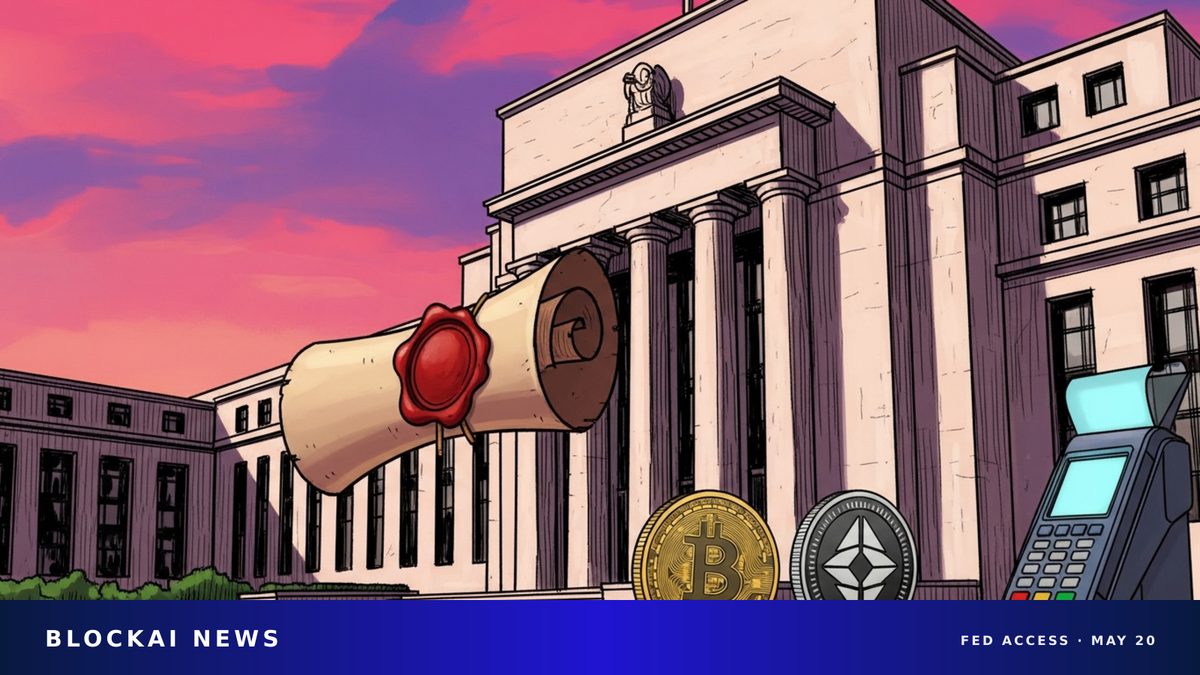
The most consequential US crypto-policy document of the week was not the latest Senate Banking markup or the next Polymarket spike on the CLARITY Act. It was a one-paragraph clause inside the executive order Donald Trump signed on May 19. The clause instructs the Federal Reserve to evaluate whether uninsured depository institutions and non-bank financial firms — language deliberately drafted to include digital-asset firms and stablecoin issuers — should be granted access to Fed payment accounts and services. The order does not grant access. It compels the agency to put in writing where it can move administratively, where it cannot, and on what timeline. For the stablecoin and agentic-payments stack, that is the precondition the past five years of policy lobbying have been engineered to reach.
TL;DR
- President Trump's May 19 executive order directs the Federal Reserve, OCC, FDIC and Treasury to review rules governing non-bank financial firms', uninsured depositories' and digital-asset companies' access to Federal Reserve payment accounts and services. The Fed must report on legal authorities, risk-management requirements and impediments within 90 days.
- Where existing law already permits access, the Fed must establish transparent application procedures and rule on complete applications within an additional 90 days — a hard clock that did not exist before. The combined window is six months from May 19, putting first decisions in mid-November.
- The order does not unilaterally grant Fed access — that requires Congress — but it formalizes the path for regulated stablecoin issuers, OCC-chartered crypto banks (Anchorage), and tokenization firms to be evaluated on commercial-banking terms. The implication is fewer middlemen, faster settlement and a closer bridge between AI-agent-initiated transactions and central-bank-final settlement.
What the order actually compels
Read narrowly, the May 19 executive order is a sequence of review instructions, not a deregulation. It does not change a statute. It does not override Fed independence. What it does — read inside the executive-order vocabulary — is force regulators to produce a written, public record of where they can move administratively, on what timeline, and under what risk-management constraints. That is a specific, narrow action; it is also the action that has been the obstacle for crypto firms seeking direct Fed access since at least 2022. The agencies named in the order — Federal Reserve, OCC, FDIC, Treasury — are now on a 90-day clock to produce a joint report identifying legal authorities for expanding access, expansion options that would be subject to existing risk management frameworks, and any "impediments" that currently hinder direct access for non-bank financial firms and uninsured depositories.
Two specific operational requirements inside the order matter more than the report. First, where existing law already permits access, the Fed must establish transparent application procedures — a fixed-shape application, public criteria, and predictable decision intervals — rather than the discretionary, opaque review process that today produces multi-year master-account waits and no published reasons for denial. Second, the order imposes a 90-day decision clock on the Fed for "complete applications." That second clock is the one that re-prices the cost of being a regulated digital-asset firm in the United States. Once a deadline is on the books, it is far harder for the agency to maintain a pocket-veto by simply not deciding.
The ABA Banking Journal's read on the order, in line with most administrative-law commentary published Tuesday, is that the practical effect is to compress what has been a 24-to-36-month timeline for crypto-adjacent firms into a sub-12-month window. Critics inside Fed leadership — sources cited in the ABA's coverage — argue that the move is procedural, not substantive, and that the Fed retains broad statutory discretion to deny applications on safety-and-soundness grounds. That is true. It is also beside the point: a denial that must be put in writing within 90 days, on transparent criteria, is a denial that can be litigated, lobbied against, and revised on appeal. The Fed's most powerful tool against crypto firms — silence — is the tool the order is built to remove.
Who benefits and who loses
The clearest beneficiaries are firms that have been openly arguing for direct Fed access. Circle, the issuer of USDC, has been the loudest public voice; its public-policy posture for two years has assumed that USDC would eventually settle through a Fed master account rather than through commercial-bank partners. Anchorage Digital — the only OCC-chartered crypto bank — is structurally positioned to be one of the first firms with a transparent application path. Paxos, Gemini's GUSD desk, the Kraken banking subsidiary in Wyoming, and a handful of tokenization platforms (Token X, Securitize, Ondo's institutional layer) all sit one regulatory step away from this regime.
The relative losers, in commercial terms, are the partner-bank middlemen. Customers Bank, Cross River, BMO Harris and the small group of regional banks that today route crypto firms' settlement traffic through their own master accounts charge a settlement premium for doing so. That premium is a real, measurable line on the operating cost of every major US stablecoin issuer. A path to direct Fed access compresses that line. It does not eliminate the partner-bank category — many smaller crypto firms will still prefer the relationship-banking model — but it changes the marginal cost structure for the largest players. SoFi's recent SoFiUSD launch on Solana is the kind of product whose unit economics improve materially under the new regime.
The larger second-order winner is the agentic-payments stack. PayPal and Google's AP2 protocol assumed crypto rails as the only viable settlement layer for agent-to-agent commerce, because the speed and programmability of stablecoin transfers do not exist on ACH or wires. AWS, Coinbase and Stripe's AgentCore launch built the consumer-facing wallet stack on the same assumption. None of that infrastructure has been able to claim central-bank-final settlement, because none of the relevant stablecoin issuers can settle directly at the Fed. The May 19 order is the policy precondition for closing that loop. If Circle wins a master account in 2026 or 2027, an AP2-style transaction can in principle settle in central-bank money at the speed of an onchain transfer. That has never been true before.
Why this order, and why now
The political read of the timing is straightforward: the executive order landed five days after the Senate Banking Committee's 15-to-9 vote on the CLARITY Act, and the order's design assumes that CLARITY or a similar statute will pass within months. CLARITY's AI-sandbox amendment would create the statutory framework under which agentic onchain transactions are explicitly contemplated; this executive order builds the corresponding payment-rail framework administratively, so that when CLARITY is signed, the operational infrastructure already exists to receive it. Galaxy Research's Alex Thorn has put CLARITY at a 75% probability of becoming law in 2026, with a Trump signing forecast for the week of August 3 — a date that lines up almost exactly with the 90-day report deadline embedded in this order.
The administrative read is that the Fed has been a structural bottleneck inside an otherwise-coordinated US crypto policy effort. Treasury has been receptive to stablecoin frameworks since the 2024 election cycle. The OCC, under acting comptroller Rodney Hood, has loosened guidance on bank custody of digital assets. The SEC under Paul Atkins has issued draft tokenized-securities frameworks. Only the Fed has held the line, and only the Fed controls master-account access. The executive order is, in operational terms, the administration's mechanism to align the Fed with the rest of the federal regulatory stack on a deadline.
What to watch in the next six months
Three signals matter most. First, the contents of the 90-day report (due August 17). A report that identifies broad legal authority for extending master-account access without further statutory action would be the maximum-impact outcome; one that requires Congress would push the timeline into 2027. Second, the identity of the first crypto firm to file a "complete application" under the new transparent procedure. The order's 90-day decision clock only runs from the moment that procedure is published, but the first applicant sets the precedent for everyone after. Third, the Fed's coordinated statement on monetary-policy implications. Vice Chair for Supervision Michelle Bowman's recent speeches have hinted that the Fed is preparing language framing direct stablecoin-issuer access as consistent with monetary-policy implementation rather than disruptive to it. Watch for that framing to appear in the formal response.
The bigger picture. The cliché framing of this executive order is "Trump opens Fed to crypto." The substantive framing is narrower and more interesting: the order does not change the Fed's authority. It changes the Fed's ability to delay using it. Once the central bank is on a written deadline, with a transparent application path, every other layer of the US digital-asset stack — stablecoin issuance, tokenized treasuries, agentic payments, AI-mediated settlement — re-prices upward, because the central-bank bottleneck that was assumed to remain in place for another decade is now on a six-month clock. The right way to read May 19 is not as a deregulation. It is as a deadline.
Frequently Asked Questions
What does Trump's May 19 executive order actually do?
It directs federal financial regulators — the Federal Reserve, the OCC, the FDIC and Treasury — to review the rules that currently restrict non-bank financial firms, uninsured depository institutions and digital asset companies from accessing Federal Reserve payment accounts and services, including the master account system that anchors USD settlement. Within 90 days, regulators must produce a report on legal authorities, risk-management requirements and any 'impediments' to broader access. Where existing law already permits access, the Fed must establish transparent application procedures and rule on complete applications within an additional 90 days. The order does not unilaterally grant access — Congress would need to act to expand it beyond current statutory limits — but it forces a written record of where the agency can move administratively and where it cannot.
Why does this matter for stablecoins and AI agents?
Two reasons. First, stablecoin issuers and digital-asset banks have spent five years operating in a parallel rail because they could not get a Fed master account on commercial-banking terms. A formal procedure with a 90-day decision clock changes the cost structure of being a regulated stablecoin issuer overnight: faster, cheaper, more legible to institutional partners. Second, agentic payments — the AP2-style architecture in which an AI agent transacts with another agent on behalf of a user — assume a settlement rail that is fast, programmable and 24/7. Fed access for a domestically-regulated stablecoin closes the loop between agent execution and central-bank-final settlement. That is the bridge crypto teams have been engineering toward; the executive order shortens its construction time.
Who benefits and who loses if this rule loosens?
Beneficiaries: USDC issuer Circle (which has been the most public about wanting Fed access), Anchorage Digital (the only OCC-chartered crypto bank), Paxos, GUSD-issuer Gemini, Kraken's banking subsidiary, and any tokenization or AI-payments firm that today must route through a partner bank to touch USD settlement. Losers, in relative terms: the partner-bank middlemen (Customers Bank, Cross River, BMO Harris and similar institutions) who currently sit between crypto firms and the Fed and charge a settlement premium for doing so. Larger losers, eventually: foreign stablecoin issuers without a comparable rail in their home jurisdiction. The macro effect is a re-anchoring of digital-dollar liquidity inside US-regulated venues, which is the same outcome Genius Act backers have been arguing toward for two years.
Reviewed by Jason Lee, Founder & Editor-in-Chief, BlockAI News.
Sources
Primary sources
- White House — Executive Order on Expanding Access to Federal Reserve Payment Services (May 19, 2026)
- Federal Reserve — Statement on the Executive Order (May 19, 2026)
- ABA Banking Journal — Executive Orders Target Banks and Nonbank Access to Fed Services
- OCC — Statement on review of crypto firms' access to payment services
- Semafor — Exclusive on the same-day executive order text (May 19, 2026)
- Court closes Custodia fight with Federal Reserve as master-account door opens
How we report: This article cites primary sources, regulatory filings, and on-chain data where available. BlockAI News uses AI tools to assist with research and first-draft generation; every article is reviewed and edited by a human editor before publication. Read our full How We Report page, Editorial Policy, AI Use Policy, and Corrections Policy.