Prediction Markets Reach $25.7B Monthly Volume — Retail Behavior Is Reshaping a $240B Industry
Polymarket + Bitget Wallet Q1 2026 report: $25.7B monthly volume in March, 1.29M active wallets, annualized run-rate $240B. Retail users are returning 4x more often and trading across more categories — the 'casino' label is losing accuracy.


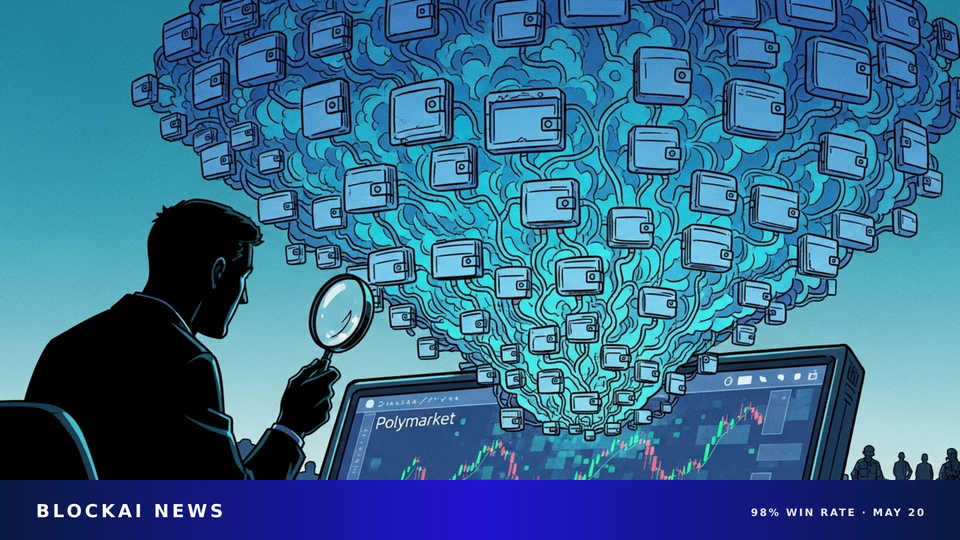
Polymarket and Bitget Wallet jointly released a Q1 2026 research report on April 30 documenting a structural behavioral shift in prediction markets. The sector recorded $25.7 billion in monthly trading volume in March 2026, generated by 1.29 million active wallets in Q1. Industry projections based on current run-rates put the sector on course for $240 billion in annualized volume in 2026, with longer-term five-year models pointing toward $1 trillion. The more significant finding is not the headline number but what it reveals about how users are engaging: retail participants are not treating prediction markets as a casino. They are using them as a continuous news-tracking infrastructure.
Who Is Trading — and What Changed
The report's demographic data challenges the dominant industry narrative about prediction market users. 82.8% of active traders in Q1 2026 traded less than $10,000 — the user base is overwhelmingly small retail, not institutional arbitrageurs or professional market-makers. The strategic sophistication assumption that underpins the "smart money exploiting retail" critique does not match the data: most traders are individual participants engaging with relatively small positions across multiple event categories.
More striking are the behavioral engagement metrics. Average active trading days per user rose from 2.5 to 9.9 between Q4 2025 and Q1 2026 — users are returning to the platform nearly four times as frequently. Average category participation rose from 1.45 to 2.34 — users are no longer specializing in one vertical (politics, crypto, sports) but spreading positions across multiple categories. This combination — higher frequency, broader diversification — is characteristic of a user treating a platform as a regular tool rather than a novelty destination.
Sports emerged as the dominant category: $10.1 billion in Q1 volume, driven by the constant cadence of global events (NBA playoffs, UEFA Champions League, Indian Premier League). Political and current-events markets — tariff probability, Fed rate decision odds, geopolitical event resolution — have shifted from one-off "election specials" to persistent open-market positions that update in real time as data releases and news events move probability estimates. That real-time update behavior is what gives prediction markets their news-tracking character.
Why the "Casino" Label No Longer Fits
The original critique of prediction markets rested on two premises: that they are structurally similar to gambling (the house wins, retail loses), and that they generate no information value that couldn't be extracted more cleanly from polls, futures markets, or expert surveys. Both premises are weakening.
On the information value front: when a Polymarket contract on "Will the Fed cut rates in May 2026?" updates instantaneously as non-farm payroll data releases, it is functionally a real-time market for probabilistic belief about a macroeconomic fact — closer in kind to Treasury futures than to roulette. Financial media and political analysts are now openly citing Polymarket odds alongside bond yields and poll averages; the Wall Street Journal, Bloomberg, and major TV networks began embedding prediction market probability graphics in their election and Fed-decision coverage in 2025, a normalization that drives additional user inflow.
On the structural fairness argument: the move to broader retail participation with diversified category exposure suggests that markets are not simply concentrating gains in sophisticated traders at retail's expense. Users who participate across sports, politics, and economics — the equivalent of a diversified portfolio — are engaging in a different risk profile than a single-event bettor. Whether long-run returns for retail participants are positive remains an open research question, but the behavioral pattern is no longer consistent with the addiction-and-loss model that drives the "casino" critique.
Institutional validation accelerated this shift. Kalshi's CFTC derivatives license, granted May 1, 2026, classifies prediction-market contracts as regulated financial instruments under U.S. law for the first time. Gemini is pursuing a similar license. When a U.S. federal regulator treats a prediction contract as a derivative rather than a wager, the legal and cultural classification follows.
BlockAI News' View
The $240 billion annualized figure is not a forecast — it is the current run-rate. The sector is already there; the question is whether it stays there or accelerates. The structural growth driver is the media flywheel: the more that mainstream outlets quote Polymarket odds, the more users come to Polymarket for news context, the more volume those users generate, the more credible the odds become for the next mainstream outlet citation. This flywheel is why prediction market growth looks structurally different from the 2021 crypto bull run — it is information-utility-driven, not speculative.
The genuine uncertainty is regulatory, not commercial. The CFTC is simultaneously granting licenses to Kalshi and Gemini while suing New York state over sports-event contracts. Thirty-eight state attorneys general backed Massachusetts in the Kalshi case; Wisconsin filed three simultaneous suits. The legal framework for prediction markets operating across state lines in the U.S. is still contested even as volume grows. A favorable federal court ruling on the preemption question — establishing that CFTC-regulated prediction markets supersede state gambling prohibitions — would double the addressable U.S. market overnight. That ruling, or its opposite, is the single largest near-term variable in the sector's trajectory.
Daily Web3 × AI intel, straight to your inbox. Subscribe to BlockAI News.
How we report: This article cites primary sources, regulatory filings, and on-chain data where available. BlockAI News uses AI tools to assist with research and first-draft generation; every article is reviewed and edited by a human editor before publication. Read our full How We Report page, Editorial Policy, AI Use Policy, and Corrections Policy.