Google I/O 2026: Spark, Omni and Antigravity 2.0 Make 'Agent' the Default Search Surface
Google's I/O 2026 keynote put four product names on the same slide — Gemini 3.5, Gemini 3.5 Flash, Gemini Omni and Gemini Spark — and one architectural claim behind all of them: Search, Workspace and Android are no longer apps you use. They are surfaces your agent uses on your behalf.

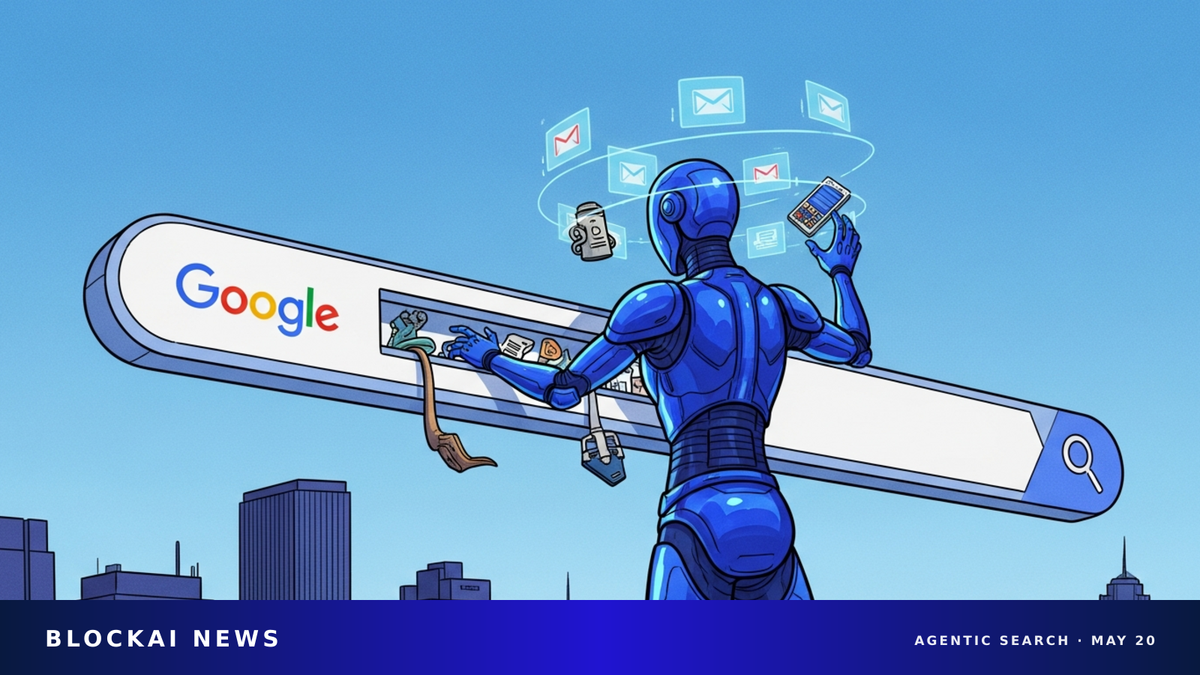
Google's I/O 2026 keynote on May 19 ran for the longest the conference has used in five years, and the longest stretch of it was not a model demo. It was a sequence of product names — Gemini 3.5, Gemini 3.5 Flash, Gemini Omni, Gemini Spark, Antigravity 2.0, AI Mode in Search, Spark for Android — that together restate the company's product thesis. Software is no longer something the user opens. It is something an agent opens for them. The model is the work. The interface is the agent. And Google is shipping that idea across every consumer surface it owns, in the same week that Anthropic is shipping it into banks and Sygnum is shipping it into trades. For Web3 publishers and protocols, the implication is the one we have been calling for two months and that became hard data this week: discovery is now agent-mediated, and the SEO playbook is being quietly replaced by a sourcing-and-citations playbook.
TL;DR
- Google announced Gemini 3.5 and Gemini 3.5 Flash (4x faster than 2.5 Flash) as the new default models powering Search, Workspace and the Gemini app, plus Gemini Omni — a real-time multimodal architecture that pre-generates likely next outputs in a streaming session — and Antigravity 2.0, an agent-first coding IDE.
- Gemini Spark is the headline: a general-purpose personal agent that runs continuously on virtual machines in Google Cloud, holds state across hours or days, and acts across Gmail, Drive, Calendar, Docs, YouTube, Shopping and third-party MCP servers. Beta starts the week of May 26 for Google AI Ultra subscribers and trusted testers.
- The product implication for publishers and Web3 protocols is structural: Search now composes a generative-UI answer per query, including video and inline tasks, which means the unit of distribution is the citation, not the click. Agent Answer Visibility — being the source the model quotes — is replacing classical SEO as the top-of-funnel discipline.
Four products, one thesis
Google announced four model-tier products in one keynote: Gemini 3.5 (the high-capability tier), Gemini 3.5 Flash (the cheaper-and-faster distillation tier, ~4x faster than 2.5 Flash), Gemini Omni (the always-on real-time multimodal architecture that fuses DeepMind's Nano Banana for image gen, Veo for video, and Genie for interactive worlds) and Gemini Spark (the personal agent). On the developer surface, Antigravity 2.0 — the agent-first IDE — moved from preview to general availability, with multi-agent parallel coding sessions, voice support, native Android and Firebase integration and a CLI that ships SDK-level access. Inside Search, AI Mode was extended to compose video responses, render dynamic UI per query and run multi-step task agents on the user's behalf without leaving the result page.
The thesis under those announcements is the one Demis Hassabis and Sundar Pichai have been edging toward since the December 2024 Gemini 2.0 launch. The model is no longer the bottleneck. The bottleneck is the interface, and the interface is becoming an agent. Where Gemini 2.5 added thinking, Gemini 3.5 adds action. Where Gemini Live added real-time multimodal input, Gemini Omni adds real-time multimodal generation. Where Project Astra and Project Mariner were demos, Gemini Spark is the productized version: continuously running on a Google Cloud virtual machine, accessing the user's connected accounts, completing tasks across applications without prompting per step. The keynote framed this transition in plain terms. Pichai's line — that AI is "moving from a tool you use to a teammate that works for you" — is corporate phrasing for the same arc Anthropic's 10 finance agent templates and Notion's agent runtime are pursuing inside enterprises.
Why Spark is the real headline
Of the four product names, Gemini Spark is the one whose downstream implications are the largest. Spark is not a chat app. It is a personal agent that runs on virtual machines inside Google Cloud, continuously, on behalf of a user. The product description includes a list that — read carefully — is the most aggressive consumer-agent capability set any major platform has shipped to date: connected access to Gmail, Drive, Calendar, Docs, YouTube and Shopping by default, plus third-party MCP servers for arbitrary other apps the user grants permission to, plus a memory layer that holds state across sessions, plus the ability to schedule itself to act at future times without user re-prompt.
That spec is the consumer-side counterpart to what Anthropic has been shipping into enterprise: agents that operate over a session length measured in days, not minutes, and that act on resources owned by the user without continuous human approval per action. Initial Spark availability is limited to Google AI Ultra subscribers ($249/mo) and a trusted-tester group, with rollout starting the week of May 26 and broader release scheduled for Q3 2026. The pricing tier matters. By gating Spark behind the highest-priced consumer tier, Google is implicitly defining the agent-economy reference price for power users: somewhere between $200 and $250 a month is what an always-on personal agent costs to operate. That number — once it is anchored by the market leader — sets the price ceiling for every consumer agent product that follows.
For Web3, the structural reading is that Spark is the consumer-side equivalent of what PayPal and Google's AP2 protocol built for agent-to-agent commerce. AP2 made stablecoins the only viable settlement layer for agent transactions; Spark makes the consumer agent that initiates those transactions a real, billable Google product. The loop closes faster than the timeline most onchain stablecoin teams were planning around.
We’re dropping Gemini Omni: our first step towards a model that can create anything from anything - starting with video.
— Google DeepMind (@GoogleDeepMind) May 19, 2026
It combines Gemini’s intelligence with our generative media systems - representing a leap forward in world understanding, multimodality, and editing 🧵 pic.twitter.com/GAtqzr0VIV
When Search itself becomes the agent
The most economically consequential announcement of the keynote was probably not the product everyone is quoting. It was the Search update. Google extended AI Mode — the conversational, multi-source answer experience first launched in 2025 — into a fully generative-UI surface: each query produces a custom layout (text, video clips generated inline by Omni, comparison tables, interactive task buttons), drawn from multiple sources at once, with the answer composed rather than ranked. The product surface that used to take 10 blue links and a featured snippet now renders, per query, an interface the user has never seen before.
For publishers, the metric that matters has quietly shifted. Ranking for the query is no longer the prize. Being the source the agent quotes is. Schema.org structured data, FAQ markup, primary-source attribution, citation-friendly summaries and a verifiable byline trail are now the highest-leverage SEO inputs — because those are the signals that determine whether an LLM treats a page as a citable authority in its generated answer. The classic playbook — backlink velocity, exact-match anchor text, density of secondary keywords — is rapidly losing leverage. The new playbook is closer to academic citation hygiene than to keyword optimization. As Coinbase's engineer argued at Consensus Miami, the second-order effect is that programmatic display advertising — the revenue engine of the consumer web for two decades — is structurally degraded by agent-mediated answers, because the agent never lands on the publisher page that would have shown the ad.
The publishers most exposed to this shift are the ones whose strategy was "rank for high-volume informational queries." The ones least exposed are the ones whose work is regularly cited in primary sourcing for breaking events. For Web3 media specifically, the change is sharp: the next twelve months will compress the long tail of recycled press-release coverage and concentrate visibility on outlets whose work is structured and cited well enough to be picked up by Spark and AI Mode at the moment of query.
Antigravity 2.0 and what the developer stack tells us about onchain
Antigravity 2.0 — the agent-first development platform Google graduated to general availability this week — is a worth a separate read for protocol teams. It runs multiple autonomous coding agents in parallel against the same repo, with a desktop app, a CLI, voice support, SDK access, and native integration into Android and Firebase. The architectural cue is the parallelism: Antigravity 2.0 assumes that "the agent" is plural, that multiple agents collaborate or compete on the same task, and that the human role is to set goals and arbitrate between agent outputs rather than to write code.
That assumption travels directly to onchain protocol design. Sygnum's first regulated-bank AI-agent transaction demonstrated the single-agent custody case. The Antigravity 2.0 design implies the next case: multiple agents coordinating on a single user's onchain activity — one routing yield, one managing risk, one paying counterparties — with the protocol layer needing to mediate among them. Account abstraction (ERC-4337), MCP-style agent interfaces, and multi-agent signing schemes are about to get a usage spike, because the consumer agent stack just established that "one user, many agents" is the default.
What to watch. The next four weeks are the highest-signal period of the year for the agent thesis. Spark's first beta usage data will determine how aggressively Google rolls out the consumer agent in Q3. The CLARITY Act's AI-sandbox amendment is moving toward Senate floor consideration in the same window. Stablecoin volume routed through agent-initiated transactions is the metric to track — it is the cleanest single signal that the surface shift Google described this week is monetizable, not aspirational. Public infrastructure follows when the unit economics of the agent stack are visible. After I/O 2026, that visibility is unmistakably real.
Frequently Asked Questions
What is Gemini Spark and how is it different from previous Gemini agents?
Gemini Spark is Google's first general-purpose personal AI agent, announced at Google I/O 2026 on May 19. Unlike earlier task-specific tools like Astra and Project Mariner, Spark runs continuously on virtual machines inside Google Cloud, can act across a user's connected apps (Gmail, Drive, Calendar, Docs, YouTube, Shopping, third-party MCP servers) and is designed to maintain state and complete multi-step workflows over hours or days rather than within a single chat turn. Initial availability is limited: Google AI Ultra subscribers and a trusted-tester group will get access starting the week of May 26, with broader rollout over Q3 2026.
How is Gemini Omni different from Gemini 3.5 Flash?
Gemini 3.5 and 3.5 Flash are the new generation of Google's core text-and-multimodal models — 3.5 is the high-capability tier, 3.5 Flash is the faster, cheaper, distillation-style tier that's now ~4x faster than 2.5 Flash and which Google says is the default model behind upgraded Search, Workspace and Gemini app features. Gemini Omni is a separate architecture: an always-on, real-time multimodal stack that fuses DeepMind's Nano Banana for image generation, Veo for video, and Genie for interactive world generation. Omni's distinguishing feature is anticipatory generation — it predicts and pre-generates the next likely visual or audio output during a streaming session, which is what enables the conversational video editing demos.
What does 'agentic Search' actually mean for publishers and SEO?
The new Search experience can compose video and image responses inline, run multi-step task agents (book the table, file the rebate, compile the comparison) and quote across multiple sources without sending the user to any single page. For publishers, the metric that matters has quietly shifted from 'rank for the query' to 'be the source the agent quotes' — Google's own framing is that AI Mode now generates dynamic UI per query. The downstream implication is that on-page structured data (Schema.org, FAQ markup, citation-friendly summaries) plus topical authority across primary sources is replacing classic ranking-factor SEO as the lever that determines visibility. Independent media is going to win or lose on the quality of its sourcing in 2026, not on link-building.
Reviewed by Jason Lee, Founder & Editor-in-Chief, BlockAI News.
Sources
Primary sources
- Google Blog — Google I/O 2026 keynote recap
- Google Blog — Introducing Gemini Spark
- DeepMind — Gemini 3.5 model card and capabilities
- Google Blog — AI Mode in Search, generative UI per query
- @GoogleDeepMind — Gemini Omni announcement thread
- @GeminiApp — I/O 2026 Gemini updates thread
How we report: This article cites primary sources, regulatory filings, and on-chain data where available. BlockAI News uses AI tools to assist with research and first-draft generation; every article is reviewed and edited by a human editor before publication. Read our full How We Report page, Editorial Policy, AI Use Policy, and Corrections Policy.