What Is an Agent Wallet?
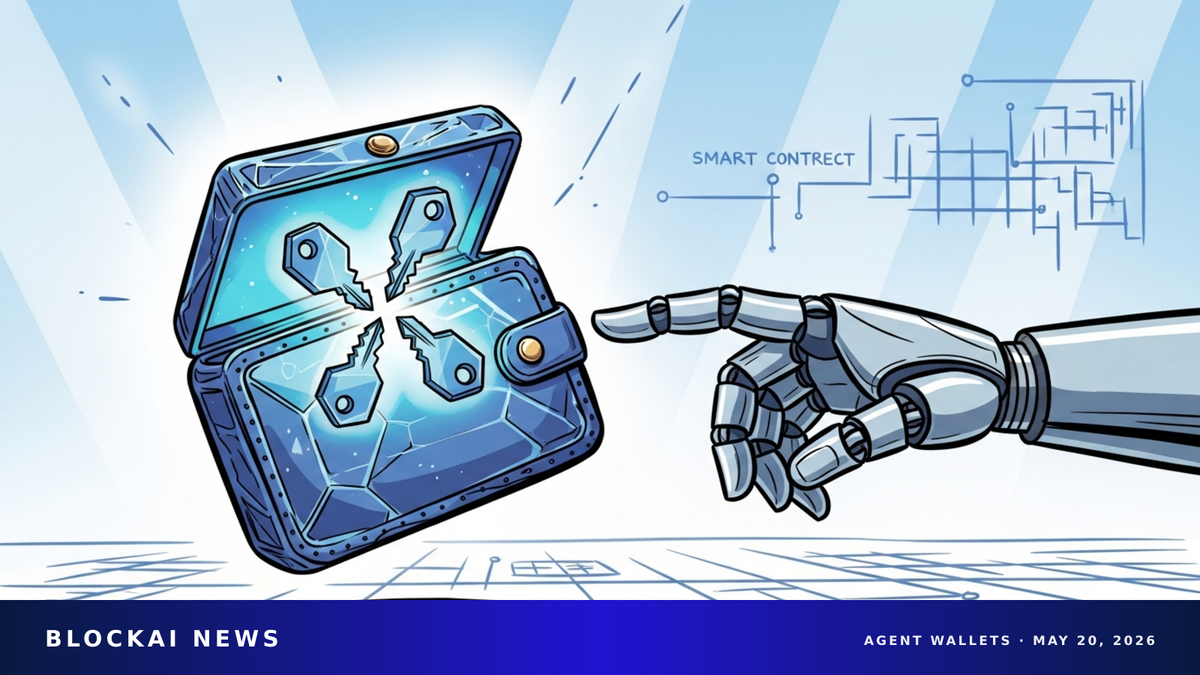
An agent wallet is a crypto wallet engineered to be operated by an autonomous AI agent — with spending caps, contract allowlists, and split-key custody baked in. Here is how the three architecture families (smart accounts, MPC, TEE) actually differ.

TL;DR
- An agent wallet is a crypto wallet engineered to be operated by autonomous AI software, with spending caps, contract allowlists, and split-key custody baked in at the wallet layer — not patched on by the app.
- The three architecture families you will see in 2026 are smart-account wallets (such as ERC-4337 smart accounts), policy-controlled embedded and custody wallets using MPC or secure enclaves, and TEE-backed signers that keep keys inside attested execution environments. The labels often overlap in practice.
- The biggest unsolved problem is not technical — it is liability: if an agent's wallet drains itself after a prompt injection, who pays? Sygnum's May 2026 transaction is the first high-profile regulated-bank template for this problem — the AI agent prepares the transaction, the client signs every action, and private keys never leave the client's device.
A regular crypto wallet was designed around one assumption: a human is sitting at a screen and will click "Confirm" before any transaction goes through. Every safety mechanism — the confirm modal, the gas estimate, the address checksum, the "are you sure?" dialog — exists because the signer is presumed to be a person who can hesitate.
An AI agent does not hesitate. Once you point it at a wallet and give it a goal, it will sign whatever its reasoning loop produces — including transactions a human would have caught in two seconds. That mismatch is the entire reason agent wallets exist as a distinct category.
The One-Line Definition
An agent wallet is a crypto wallet whose signing authority is intentionally split, capped, or constrained so that an autonomous software agent — not a human — can hold operational control without being able to drain or misuse the funds beyond what its principal authorized.
That definition does a lot of work. It implies the agent is not the owner of the wallet; it is the operator. It implies the wallet enforces guardrails before the signer's intent reaches the blockchain. And it implies there is a principal — usually a person or institution — whose authorization the wallet can cryptographically prove.
Why a Regular Wallet Will Not Cut It
Three concrete failures happen the moment you hand a normal hot wallet to an AI agent.
1. No spending cap. A normal EOA (externally owned account) signs anything its key signs. If your agent's runtime gets compromised — through prompt injection, a malicious dependency, or a buggy tool call — the entire balance is reachable in a single transaction. There is no protocol-level brake.
2. No authorization scope. A normal wallet does not know what its user "meant." If you asked your agent to rebalance into ETH and it instead approves an arbitrary token spender, the on-chain signature looks identical to what it would for any other action. There is no cryptographic record of intent.
3. No graceful failure. Hot wallets are binary — either you hold the key or you do not. There is no "pause" button you can press from your phone when your agent starts behaving weirdly. The only emergency stop is migrating funds to a different address, which the agent itself might race you to.
Agent wallets bake the answers to all three problems into the wallet primitive itself, so the application layer does not have to — and cannot — bypass them.
The Anatomy of an Agent Wallet
A production agent wallet has four parts most explainers skip past.
Signer model. The single biggest design choice. Three architecture families dominate, and the labels often overlap in practice: a smart account where signing logic lives in a contract (ERC-4337-style smart accounts on Ethereum and EVM chains; other ecosystems like Solana and Sui implement similar control through their own account, object, or program models); an MPC or policy-controlled custody wallet where the signing key is split, held inside a secure enclave, or gated by a policy engine, and any signature requires the wallet infrastructure to co-approve; or a TEE-backed signer where the key only exists inside an attested execution environment and never touches the agent's normal runtime. Each has different trust assumptions, latency, and gas profiles.
Permission layer. This is where caps and allowlists live. A modern agent wallet can enforce: maximum spend per day, maximum spend per transaction, list of allowed contract addresses, list of allowed token contracts, and time windows in which signing is permitted. With session keys (ERC-4337 modules or equivalents), you can grant a one-hour key that can only swap USDC for ETH on Uniswap — and nothing else.
Mandate / intent layer. Newer designs — including Google's Agent Payments Protocol (AP2) — separate what the user authorized from what the agent did. The wallet checks an off-chain signed mandate before producing an on-chain signature. If a regulator or insurer ever asks "did the user authorize this action?", there is a cryptographic answer.
Recovery and emergency stop. Smart accounts can implement social recovery (M-of-N trusted parties can rotate the signer key) or time-locked withdrawals to a known backup address. MPC wallets can have the human party simply refuse to sign. TEE wallets typically rely on an external policy attestation. The recovery model is what stops a successful prompt-injection attack from being a total loss.
Three Agent Wallets You Can Look at Right Now
Coinbase Smart Wallet + AgentKit. Coinbase AgentKit is a framework-agnostic toolkit that lets developers connect AI agents to on-chain actions through CDP wallet providers. In the smart-wallet path, agents can use ERC-4337-style smart accounts on Base, with gas sponsorship and spend-permission controls such as token, time period, and amount limits. The important point is that the agent does not need to hold an unrestricted raw private key — the wallet infrastructure can enforce constraints before any transaction is signed. The same stack appears in Coinbase's joint launch with AWS and Stripe.
Sygnum's regulated agent execution. The Swiss bank Sygnum executed the first regulated-bank AI-agent transaction in May 2026 using Anthropic's Claude over an MCP server. The structural point is not autonomy: in Sygnum's model the AI agent prepares the transaction, the client signs every action, and private keys never leave the client's device. This is a high-profile template for how regulated institutions can let agents act on a client's behalf while preserving audit trail, client consent, and clear liability boundaries — a model other custody banks are likely to study.
Policy-controlled embedded wallet and custody runtimes. Privy, Dynamic, Fireblocks, Turnkey, and similar providers approach the problem from different architectures — MPC, secure enclaves, policy engines, or institutional custody controls. What unifies them is the operating model: an agent can request transactions, but the wallet infrastructure enforces limits, policies, audit trails, and in some cases compliance checks before anything is signed. This is the most common production architecture for consumer-facing agents because it does not require the user to trust the agent runtime alone.
The Five Risks Every Agent Wallet Has to Solve
Key exfiltration through the LLM. If a raw private key ever appears in the agent's prompt, memory, or a tool response, a successful prompt injection can leak it. The defense is structural: smart accounts and policy-controlled wallets ensure the key is never inside the LLM's accessible context to begin with.
Approval drift. Even a well-constrained agent accumulates approve() calls over time. Each approval is a long-lived authorization for a contract to spend tokens. A year-old agent can end up with a dozen unlimited approvals across protocols that have since been exploited. Agent wallets need automated approval expiry — most do not have it yet.
Off-chain mandate forgery. Mandate signatures are only as strong as the channel they travel through. If the principal signs an Intent Mandate on a phishing site, the agent will execute the malicious instruction faithfully. The wallet may not know whether the user signed the mandate in a legitimate interface or on a spoofed one.
Custody model side effects. TEEs assume hardware vendors are trustworthy. MPC assumes no collusion between key holders. Smart accounts assume the contract code itself is bug-free. There is no risk-free option — only different attack surfaces. Picking the wrong one for your threat model is its own category of failure.
Liability ambiguity. If an agent's wallet drains itself, who is responsible? The agent vendor? The MPC custodian? The user who deployed it? The protocol the agent interacted with? Most jurisdictions do not have a clear answer, which is why Sygnum's regulated transaction is so significant — it is the first high-profile attempt to put real-world legal infrastructure under this question.
Key Takeaways
- Agent wallets are not a new wallet UI — they are a different signer architecture with permissions and intent verification baked in below the application layer.
- The three architecture families are smart accounts (ERC-4337-style), policy-controlled embedded/custody wallets using MPC or secure enclaves, and TEE-backed signers. The labels overlap in practice, and each makes different trust trade-offs; none is universally correct.
- The biggest unresolved question is liability — and Sygnum's May 2026 transaction is the first high-profile regulated-bank template, with the client signing every action and private keys never leaving the client's device.
Where Agent Wallets Sit in the BlockAI News Stack
Agent wallets are the load-bearing primitive across all four verticals BlockAI News covers.
AI Agents & Autonomous Finance. The wallet is the "hands" of every agent. Without a real, constrained on-chain wallet, an AI is just a recommender — not an operator. Read the broader category in our guide to AI agents in crypto.
AI × DeFi. Every agent that swaps on Uniswap, lends on Aave, or trades on Hyperliquid does it through an agent wallet. The wallet's permission layer is what makes consumer-facing AI trading assistants safe enough to ship at all.
Tokenization & RWA. Sygnum's regulated agent transaction is the bridge model: an institutional client can let an AI agent prepare transactions involving tokenized treasuries or money market fund shares, while the client retains signing authority and the audit trail remains within a regulated framework. The wallet design and the regulatory framework become two sides of the same primitive.
AI Infra & DePIN. TEE networks (Phala, Marlin) and MPC node operators (Lit Protocol, Threshold) are the decentralized infrastructure layer that makes agent wallets trust-minimized rather than dependent on one runtime operator. As DePIN networks mature, expect to see wallet signing offered as a metered, decentralized service.
Related Concepts
- What Are AI Agents in Crypto? — the broader category an agent wallet serves
- What Is an Agentic Payment? AP2 and Crypto Rails Explained — how agent wallets settle commerce
- How AI Agents Pay With USDC: x402 and EIP-3009 — the developer-level view of agent payments
- AWS, Coinbase & Stripe Launch AI Agent Stablecoin Payment Rails — production examples of agent wallet stacks
- Sygnum's First Regulated Agent Transaction — the institutional execution template
- Anthropic's Wall Street Agent Templates — how agent wallets enter regulated workflows
- Stablecoin's Second Wave: the AI Agent Engine — why every agent wallet's settlement asset is a stablecoin
Frequently Asked Questions
Can I just use my regular MetaMask wallet to run an AI agent?
Technically yes; in practice no. Pointing an agent at a normal hot wallet means handing over an uncapped, un-scoped private key. If the agent gets prompt-injected or its runtime is compromised, the entire balance is reachable in one transaction. The right answer is a smart-account wallet with a session key — and most agent SDKs in 2026 ship this by default.
Who actually holds the private key in an agent wallet?
It depends on the design. In a smart-account wallet, the account is a contract, so authorization does not have to come from a single raw EOA private key — the wallet can verify passkeys, session keys, multisigs, or other modular rules before allowing an action. In an MPC wallet, no single party holds the key; it is split across two or three holders (the user, the runtime, and sometimes a third-party custodian). In a TEE wallet, the key exists only inside a hardware-isolated enclave and is never touchable by the agent's normal software.
Is an agent wallet the same as a smart contract wallet?
A smart contract wallet is one implementation of an agent wallet — probably the most common in 2026. But the category is broader. MPC custody and TEE-backed signers are also agent wallets, and they do not use smart contracts at all. What unifies them is the design intent: signing authority is split, capped, or constrained at the wallet layer.
What happens if my agent gets prompt-injected and tries to drain its own wallet?
If you have designed the wallet correctly, the drain fails because the spending cap, allowed-contract list, or co-signer policy blocks it. The agent will produce a transaction; the wallet will refuse to broadcast it; you will get an alert. If you have designed it poorly — a raw hot key with no constraints — the funds are gone. This is the entire reason agent wallets are a distinct category, not just a marketing label.
Do agent wallets only work with stablecoins?
No, but stablecoins are the dominant settlement asset. Agents operate on a time horizon (seconds to minutes) where volatility is operational risk, not opportunity. Spending caps denominated in USDC are easier to reason about than caps in ETH. Most production agent wallets default to USDC for transactions and let the user opt in to volatile assets explicitly.
What to Watch in 2026
The wallet layer is moving fast on three fronts. First, ERC-7715 and related permission standards are still draft-level, but wallet teams are increasingly building toward scoped, time-bounded permissions — a shared language for the kind of constraints agent wallets need. Second, regulated custody frameworks are moving from theory into live demonstrations after Sygnum's May 2026 transaction, and other custody banks and digital-asset institutions are likely to study the model as AI agents move from advisory workflows into execution workflows. Third, embedded-wallet and custody providers — Privy, Dynamic, Fireblocks, Turnkey, and peers — are integrating more directly with agent SDKs, payment protocols, and policy engines. By the end of 2026, "agent wallet" may become a default category in consumer and institutional wallet UX — but the architecture will not be uniform.
The bottom line. The wallet is no longer just where you store funds — it is the policy engine that decides whether your AI agent can act. If you are building anything in this space, the wallet design decision is upstream of the agent design decision. Pick wrong here and everything downstream inherits the wrong trust model.
Sources
Primary sources and prior BlockAI News coverage referenced in this article.
Primary sources
- ERC-4337: Account Abstraction Using Alt Mempool (Ethereum specification)
- ERC-7715: Request Permissions From Wallets (draft permission standard)
- Coinbase AgentKit — Developer Platform Documentation
- Agent Payments Protocol (AP2) — Specification and SDK
- Anthropic — Model Context Protocol
From BlockAI News
- What Are AI Agents in Crypto? Virtuals, ElizaOS, AIXBT, and the On-Chain Agent Economy
- The First Regulated Bank AI-Agent Transaction Is Not About Autonomy — It Is About Liability
- AWS, Coinbase & Stripe Launch AI Agent Stablecoin Payment Rails
- PayPal & Google Say Crypto Rails Are the Only Option for AI Agents
- How AI Agents Pay With USDC: x402, EIP-3009, and Agentic Commerce
- What Is an Agentic Payment? AP2 and Crypto Rails Explained
Stay close to BlockAI News.
The wallet is the upstream design decision — every other agent choice inherits its trust model. Get this right and the rest of the agent stack falls into place.
How we report: This article cites primary sources, regulatory filings, and on-chain data where available. BlockAI News uses AI tools to assist with research and first-draft generation; every article is reviewed and edited by a human editor before publication. Read our full How We Report page, Editorial Policy, AI Use Policy, and Corrections Policy.