Galaxy Lifts CLARITY Act Odds to 75% — and Polymarket Already Got There First
Galaxy Research head Alex Thorn raised CLARITY Act odds to 75%, citing the Senate Banking 15-9 vote and a forecast of Trump signing in the week of August 3. Polymarket got there first — its contract is at 73-75% after starting May at 46%. The bill's path to law is now the most aggressively front-...

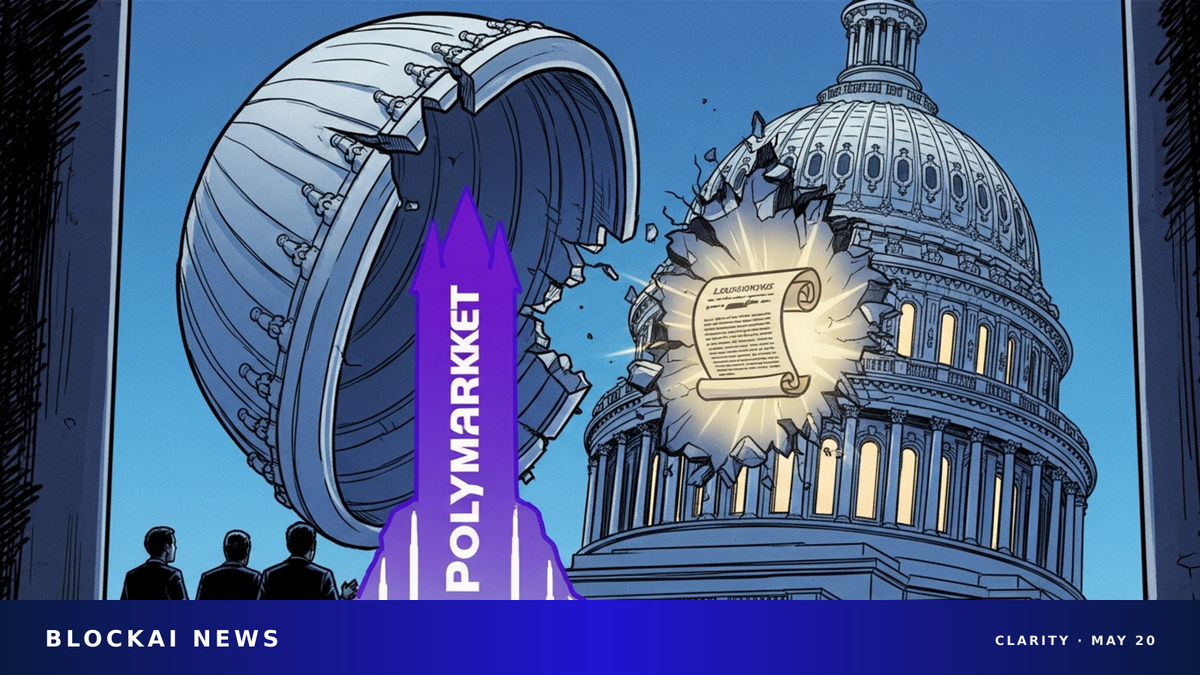
The most important number in US crypto policy this week is 75. That is where Galaxy Research's head of firmwide research Alex Thorn put the probability of the CLARITY Act becoming law in 2026, in a memo published Monday. It is also — as of this morning — where the Polymarket contract on the same question is trading, having moved from 46% at the start of May to 73-75% over the past five trading days. The two numbers converged from different directions: Galaxy from policy-process analysis, Polymarket from open-bid order books. When professional policy analysts and retail prediction markets land on the same probability inside the same week, the underlying outcome stops being a probabilistic question. It becomes a logistics question. The next investable trade is no longer "does it pass." It is "what happens onchain the day it does."
TL;DR
- Galaxy's Alex Thorn raised the probability that the CLARITY Act becomes law in 2026 to 75% on Monday, citing the May 14 Senate Banking 15-9 bipartisan markup vote as the breakthrough. He forecasts Trump signing the bill the week of August 3 if the Senate maintains its current pace.
- Polymarket's contract on the same question moved from 46% at the start of May to 73-75% as of today, with the largest single-day jump (10 percentage points) coming the day after the Senate Banking vote. The retail prediction market priced the breakthrough two days before Galaxy published.
- The bill's AI-sandbox amendment — which creates an explicit regulatory carve-out for onchain autonomous agents — is the piece that re-prices the entire agentic-DeFi and agentic-payments stack the moment the bill is signed. AP2-routed transactions, AWS AgentCore wallets and Sygnum-style bank-AI execution are the immediate winners.
What Thorn actually said
Galaxy's Monday memo from Alex Thorn — Galaxy's head of firmwide research and one of the most read policy analysts in crypto — lays out a five-step legislative timeline behind the 75% probability. The Senate Banking Committee's May 14 markup is step one: the committee reported the bill out of committee with a 15-9 bipartisan vote, in line with the Republican majority and with four Democratic senators (Warner, Gillibrand, Lummis-aligned dissenters and one named-but-unnamed swing voter) crossing the aisle. Step two is reconciliation with the Senate Agriculture Committee, expected in early June; Agriculture has jurisdiction over the CFTC component of the bill and is currently aligned on the major provisions, with smaller disputes over commodity-pool definitions. Step three is Senate floor consideration, forecast for mid-June. Step four is final Senate passage before the end of June. Step five is House reconciliation through July, with the final House vote pencilled for late July and a Trump signing the week of August 3 — the week before the August recess.
Thorn's caveat in the memo is that the August recess is the only structural obstacle that could push the timeline into 2027. If the Senate or the House misses its current marker by more than two weeks, the August recess closes the legislative window and the bill resumes in September with a different political calendar (closer to midterms) and a less favorable vote arithmetic. That is the case Solana Policy Institute president Kristin Smith makes for her own more cautious 60% probability: not that the votes are not there, but that the calendar might not be.
The qualitative shift in Thorn's tone, relative to his April memo (which had the probability at 55%), is the 15-9 vote count. CLARITY's Republican-leadership-aligned framing was always going to deliver a party-line markup. The 15-9 number means it cleared committee with bipartisan margin, which materially increases its ability to survive amendments on the Senate floor without losing the original House-Senate reconciliation arc. That is the variable Thorn revised, and it is the variable the Polymarket book reflected within hours.
Polymarket got there first
The Polymarket contract on "Will the CLARITY Act become law in 2026" tells the same story in real time. On May 1 the contract closed at 46%. The day after the Senate Banking 15-9 markup vote (May 15), it gapped to 65%. By May 17 it crossed 73%. As of this morning, it is trading at 75% with $4.2M cumulative volume and tightening bid-ask spreads. Retail and prop-trading order flow priced in the breakthrough vote, the reconciliation timeline and the August signing forecast a full two trading days before Thorn published his memo.
That sequencing is the more interesting half of the story. Polymarket has historically been a leading indicator on US policy outcomes — its 2024 election book ran ahead of nearly every traditional polling aggregator — but its lead on the CLARITY Act vote was, in absolute terms, the cleanest replication of that pattern in a non-electoral policy market. Specialists with on-the-ground information (Hill staffers, K Street analysts, crypto-firm policy teams) appear to be expressing their probability views directly through the market, not through op-ed columns. The implication, increasingly hard to argue against, is that for medium-frequency policy outcomes, prediction-market books are now the highest-signal source of probabilistic information available to non-insiders.
if CLARITY doesn't pass committee by end of april, odds of passage in 2026 become extremely low. this needs to hit the senate floor by early may... floor time is running out and odds diminish every day that passes
— Alex Thorn (@intangiblecoins) March 14, 2026
the framing right now is that the dispute over stablecoins… pic.twitter.com/tEejEsmUi9
That is also why the same week's other Polymarket story — the Bubblemaps investigation into nine wallets that achieved a 98% win rate on US military prediction markets — sits next to this one in a single discomfort: prediction markets are now efficient enough that the question of who is trading them with informational advantage is a live regulatory issue. The CLARITY contract is, mercifully, not in that category. There is no reason to suspect non-public information moved the market — the Senate vote was public, Thorn's analysis is public, every input is public. But the speed at which the market re-rated is itself the data point.
The piece that re-prices the agent stack
Inside the Senate Banking version of CLARITY, the most significant provision for the next twelve months is the AI-sandbox amendment. The amendment creates an explicit registration regime for onchain autonomous agents — software programs that hold digital assets, sign transactions and interact with US-touching markets without human-in-the-loop approval per action. Qualifying agent operators register with the CFTC under a lighter framework: capital posting calibrated to AUM, monthly reporting of transaction volumes and risk metrics, a designated human compliance officer of record, and a 24-month time-limited grace window in which more permissive standards apply.
The amendment is the policy precondition for the agentic-DeFi and agentic-payments stacks that have shipped over the past two months. PayPal and Google's AP2 protocol — agent-to-agent commerce settling on crypto rails — assumes a regulatory framework that today does not exist. AWS AgentCore with Coinbase and Stripe shipped consumer wallets for autonomous agents on the same assumption. Sygnum's first regulated-bank AI-agent transaction demonstrated the custody case but the bank had to apply its own institutional risk-management framework to a market that has no statutory definition for what just happened. The sandbox amendment turns "no statutory definition" into "explicit, time-limited registration regime" — a structural improvement that closes the largest single open risk in the agent stack.
Companies that benefit most directly: any US-touching protocol or wallet whose business model assumes agents hold tokens. Companies that lose, in relative terms: the offshore-based agentic-finance projects whose competitive advantage was regulatory ambiguity in the US. Stablecoin yield mechanics also change under CLARITY — passive yield is explicitly banned, activity-based rewards are explicitly permitted — which is the same structural framing the sandbox amendment imports for agents: rule-of-the-road clarity in exchange for registration.
What the next ten weeks need to deliver
For Galaxy's 75% to hold, the Senate calendar between now and the August recess needs three specific milestones. First, the Senate Banking-Senate Agriculture reconciliation must close in the first ten days of June. The two committees' versions of CLARITY are 85% aligned; the remaining 15% covers commodity-pool definitions and CFTC supervisory budget allocation. Second, the Senate floor vote must occur before the end of June. Majority Leader Thune's office has signaled mid-June as the target, with a one-week amendment debate window. Third, the House must take up the Senate-passed version (rather than insist on its own July 2025 text) and pass a reconciled version before the August 1 recess. If those three milestones land, Thorn's August 3 signing forecast is realistic. If any one of them slips by more than a week, the probability falls back into the 50-60% band that defined April.
What to watch. The single highest-signal indicator in the next thirty days is the Senate Banking-Senate Agriculture joint markup hearing, currently scheduled for early June. A clean joint markup with the AI-sandbox amendment preserved largely intact is the green light for the full Thorn timeline. Anything else — material amendment of the AI sandbox, a delayed joint markup, a procedural objection from a single Senator — is the data point that says the next CLARITY trade is the reversion to lower probability, not the breakthrough to 90+. Polymarket will price it first. Galaxy will explain it second. Inside the agent stack, the protocol teams shipping today need to do the unglamorous work in the meantime: write the registration filings, structure the capital postings, name the compliance officer of record. The deadline they have been waiting on a regulatory framework to confirm is now, plausibly, ten weeks away.
Frequently Asked Questions
What is the CLARITY Act and what stage is it at?
The Digital Asset Market Clarity Act of 2025 ('CLARITY Act') is the bipartisan market-structure bill that would split jurisdiction over digital assets between the SEC and the CFTC, define when a token is a security versus a commodity, and create an explicit AI-sandbox amendment for onchain autonomous agents. The House passed its version in July 2025. The Senate Banking Committee marked up and reported its version with a 15-9 bipartisan vote on May 14, 2026. The next step is reconciliation with the Senate Agriculture Committee, then a Senate floor vote, then a House-Senate reconciliation, then Trump's signature. Galaxy's Alex Thorn forecasts a signing the week of August 3 if pace holds.
Why does Galaxy putting the probability at 75% matter — isn't Polymarket already there?
It matters because the two probabilities are converging from different directions, which is the strongest possible signal that the bill is no longer a partisan question. Galaxy's number reflects institutional-policy analysis: a read of the Senate vote count, the Republican-leadership scheduling calendar, the August recess pressure and the OMB review timeline for executive-branch implementation. Polymarket's number reflects retail and prop-trader sentiment: people putting money on the same legislative outcome based on whatever inputs they can collect. When professional policy analysts and retail prediction markets converge at the same number, the bill stops being a probability question and becomes a logistics question.
What is the 'AI sandbox amendment' and why is it the most important piece?
The AI-sandbox provision inside the Senate Banking markup creates a regulatory carve-out for onchain autonomous agents — software programs that hold digital assets, sign transactions and interact with markets without human-in-the-loop approval per action. Under the sandbox, qualifying agent operators register with the CFTC under a lighter framework, with reporting requirements, capital posting and a time-limited grace window. The amendment is the policy precondition for the agentic-payments and agentic-DeFi stacks that PayPal-Google AP2, AWS AgentCore and Sygnum have shipped over the past two months. Without it, every transaction by a US-touching AI agent runs into an unresolved securities or commodities-law question. With it, the rails are explicitly contemplated by statute.
Reviewed by Jason Lee, Founder & Editor-in-Chief, BlockAI News.
Sources
Primary sources
- Galaxy Research — CLARITY Act timeline update (Alex Thorn, May 2026)
- Senate Banking Committee — 15-9 markup vote on the Digital Asset Market Clarity Act (May 14, 2026)
- Polymarket — Will the CLARITY Act pass in 2026? (live odds)
- Congress.gov — Senate bill text and amendments
- @intangiblecoins — Alex Thorn earlier CLARITY commentary thread
- crypto.news — Galaxy lifts CLARITY Act odds to 75%
How we report: This article cites primary sources, regulatory filings, and on-chain data where available. BlockAI News uses AI tools to assist with research and first-draft generation; every article is reviewed and edited by a human editor before publication. Read our full How We Report page, Editorial Policy, AI Use Policy, and Corrections Policy.