IREN Says AI's Real Bottleneck Is Infrastructure, Not Chips — Vertical Stack Thesis
IREN co-founder Dan Roberts laid out a three-layer thesis on May 22: AI's bottleneck is power, land and data centers — not GPUs. With 5GW of grid capacity, a $3.4B NVIDIA deal and the $625M Mirantis buy, the bitcoin-miner-turned-AI-landlord pitch goes full stack.

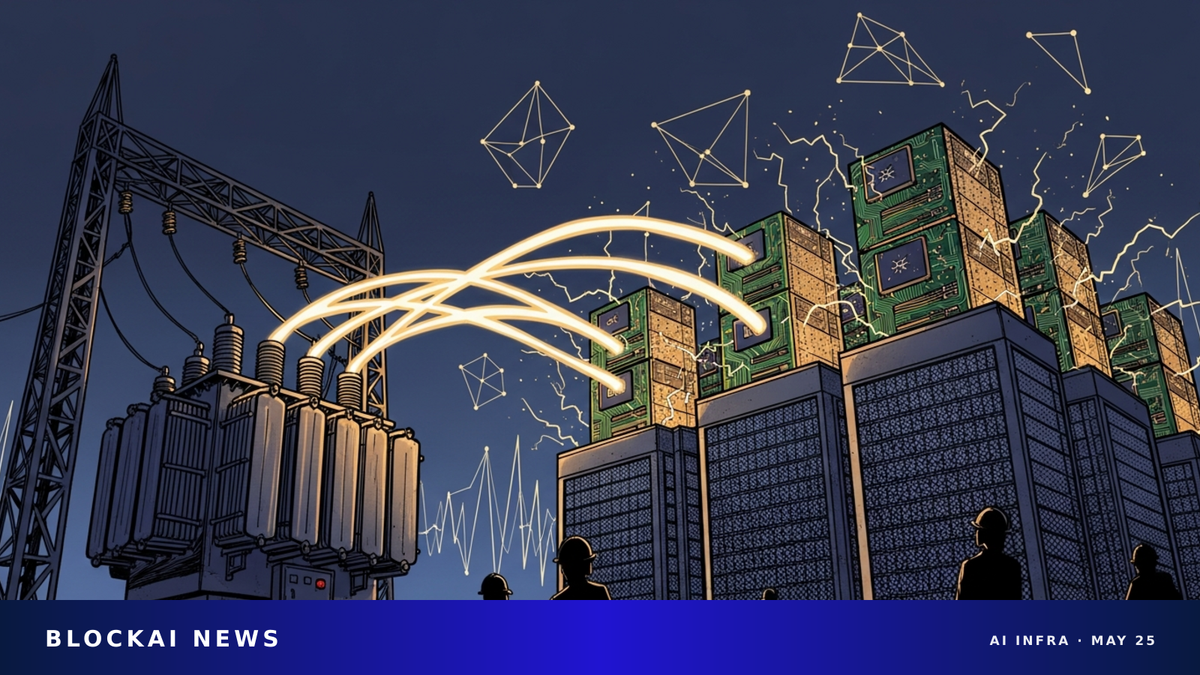
IREN co-founder Dan Roberts spent the back half of last week making a single argument: the constraint on artificial intelligence has moved. It is no longer the silicon. It is the substation feeding the silicon, the dirt the substation sits on, and the cooling loop that keeps the racks from melting. In a May 22 X thread that landed two weeks after the company's $3.4B NVIDIA cloud contract and three weeks after the $625M Mirantis acquisition, Roberts laid out a three-layer thesis that doubles as a roadmap for what the bitcoin-miner-to-AI-landlord transition actually looks like at scale.
TL;DR
- IREN's Dan Roberts argues AI's real bottleneck is now power, land and data centers — not GPUs — and pitches IREN as a vertically integrated platform across all three.
- The math: 5GW of grid-connected capacity, a $3.4B five-year NVIDIA cloud contract, a $625M Mirantis acquisition for orchestration software, and $3.1B in contracted ARR as of Q3 FY26.
- For DePIN comps, IREN is the cleanest public-equity benchmark for the kilowatt-as-yield thesis — and the closest thing to a control case for what tokenized compute networks have to clear.
Why IREN Says Power Is the New GPU
Roberts opened the May 22 thread with a line that is going to get cross-stitched into a lot of slide decks: "AI demand grows exponentially. Infrastructure doesn't." The implication is uncomfortable for anyone whose mental model still treats Blackwell allocation as the gating step. Foundries can be tuned. Wafer starts can be added on the margin. Substations cannot. A 500MW interconnect study in ERCOT runs eighteen to thirty-six months on a good day; in PJM it can be longer. Cooling tower steel, switchgear, transformers — every line item in the bill of materials for a hyperscale AI campus is now on allocation, and most of it carries lead times measured in years rather than quarters.
That is the macro Roberts is writing into. The corollary, which Jensen Huang has been making in the same words on every earnings call this year, is that compute capacity that actually exists — energized, cooled, fibered, ready to power on — is the scarce factor. We unpacked the demand side of that argument in our Nvidia Q1 FY27 preview, where the Blackwell and Vera Rubin backlog already pushes past a trillion dollars of committed demand. Roberts's thread is essentially the supply-side mirror of that note: the chips will show up, but only as fast as the kilowatts do.
The numbers IREN now has on the board make the pitch easier to defend than it would have been a year ago. Roberts said on X that IREN has secured roughly 5 gigawatts of grid-connected capacity globally, anchored by the 2GW Sweetwater campus in Texas. Q3 FY26 results, filed May 13, put AI cloud revenue at $33.6M for the March quarter — nearly double the prior quarter — and contracted ARR at $3.1B with a stated target of $3.7B by year-end. Bitcoin mining revenue dropped from $167.4M to $111.2M in the same quarter, partly because management is actively decommissioning miners to free up footprint for GPU installs. The transition is no longer a slide; it is showing up in the segment line.
𝐓𝐡𝐫𝐞𝐞 𝐋𝐚𝐲𝐞𝐫𝐬. 𝐎𝐧𝐞 𝐂𝐨𝐦𝐩𝐨𝐮𝐧𝐝𝐢𝐧𝐠 𝐀𝐝𝐯𝐚𝐧𝐭𝐚𝐠𝐞. 𝐓𝐡𝐞 𝐈𝐑𝐄𝐍 𝐓𝐡𝐞𝐬𝐢𝐬.
— Daniel Roberts (@danroberts0101) May 22, 2026
There's been a lot happening at IREN recently.
Expansion across North America, Europe and Asia-Pacific.
The NVIDIA partnership.
The Mirantis acquisition.
New GPU…
The Vertical-Integration Map: Power, DC, GPU, Software
The structure Roberts walked through in the May 22 thread is a clean three-layer cake. Layer one is the physical substrate — energized land, substations, water rights, fiber entries, the carcass of a data center shell. Layer two is the compute itself — GPUs, networking, the storage and rack architecture that NVIDIA's DSX reference designs codify. Layer three is the operating system on top of that hardware: orchestration, multi-tenant scheduling, observability, enterprise support. "Layers 1 and 2 are where the overwhelming majority of IREN's value is being created today," Roberts wrote. "Layer 3 is where that advantage compounds further over time."
Each layer now has a marquee receipt. Layer one is the 5GW pipeline and the Sweetwater Hub, where the first 1.4GW comes online this year. Layer two is the NVIDIA partnership — the May 7 strategic agreement and the five-year, $3.4B AI cloud contract that uses NVIDIA itself as the anchor tenant for Blackwell deployments in Texas. We broke that deal down in detail in our IREN-NVIDIA explainer, including the $2.1B equity option that ties the two companies together at the cap table.
Layer three is the piece the market hasn't fully repriced yet. On May 4, IREN announced the acquisition of Mirantis in a $625M all-stock deal. Mirantis is not a brand most generalist investors recognize, but it is one of the few independent orchestration vendors with a meaningful enterprise footprint — over 1,500 customers, a founding ISV slot in the NVIDIA AI Cloud Ready program, and a Kubernetes-native platform called k0rdent designed for managing mixed estates of bare metal, VMs and GPU clusters. The strategic logic is straightforward: the colocation business is a margin-compressed commodity over a long enough timeline. The software layer that sits between a Fortune 500 tenant and a row of H200s is where the durable economics live.
That is the same playbook hyperscalers ran a decade ago — sell the rack, then sell the orchestration on top, then sell the managed service on top of that, with each layer thicker than the one below. IREN is trying to compress all three into one P&L. Whether public markets will pay a software multiple for any of it is the open question. So far, the answer looks like cautious yes: IREN shares gained 10% on Thursday around the announcement.
What This Means for DePIN Comps
The harder, more interesting question is what IREN's pitch implies for the tokenized compute thesis. DePIN networks — Render, Akash, Aethir, io.net, the long tail of GPU and bandwidth markets — pitch the same fundamental insight Roberts is monetizing: that the bottleneck has moved to physical infrastructure, and that whoever ends up holding the kilowatts will collect the rent. The difference is that DePIN promises to do it with a token, a permissionless supply side, and a cap table that pays in emissions rather than equity.
IREN is the cleanest public-equity control case for that bet. The company is doing all the unglamorous work — utility-grade interconnect studies, multi-year ERCOT queue management, NVIDIA reference architecture qualification, enterprise SOC 2 audits, regulated capex — that DePIN networks generally hand-wave past. And IREN is doing it at $3.1B contracted ARR, with a counterparty list that includes NVIDIA and Microsoft. For any tokenized network claiming to occupy the same niche, IREN sets a high water mark for what the cash-flow profile is supposed to look like once the buildout is real.
It also clarifies who actually owns the rents. In a vertically integrated stack, the substation, the shell, the GPU lease, the orchestration layer and the enterprise support contract all consolidate into one equity holder. In a DePIN stack, those layers are split across a token, a foundation, a hardware operator, and end users — with leakage at every boundary. The DePIN argument has to be that token-coordinated supply expands faster than capex-coordinated supply. Roberts's counter, implicit in the thread, is that physical infrastructure on this scale is not a coordination problem; it is a permitting and capital problem, and the entities that solve those have NYSE tickers.
The bitcoin miners pivoting to AI hosting are a separate read on the same trend. We covered the broader shift in our miner-to-landlord roundup, and HIVE's $3.5B Canadian gigafactory announcement last week showed that IREN is no longer the only listed name with a credible AI infra pipeline — see our HIVE / Buzz HPC deep dive. What separates IREN at this point is layer three: nobody else in the listed mining cohort has bought a software company, signed an NVIDIA anchor tenant, and published $3.1B of contracted ARR in the same calendar quarter. The same labor-market pattern Cloudflare's 1,100 layoffs at record revenue exposed on the demand side has its supply-side mirror here: capital concentrates with operators who own the physical layer.
Key Takeaways
- Roberts's thesis: chips are no longer the binding constraint; power, land and data center capacity are. IREN's pitch is to own the full stack.
- Receipts on the board: 5GW grid-connected pipeline, $3.4B NVIDIA cloud contract, $625M Mirantis acquisition, $3.1B contracted ARR.
- IREN is now the public-equity benchmark for what DePIN compute networks have to clear on cash flow, counterparties and audit.
The Bottom Line. Roberts's thread is not a one-off CEO X riff; it is the clearest articulation yet of how a former bitcoin miner intends to capture the rent on the buildout that NVIDIA and the hyperscalers are funding. The vertically integrated pitch is ambitious — historically, owning power, real estate, hardware and software in one entity is the kind of plan that breaks somewhere — but for now the numbers are moving in the direction of the narrative. The next read will come when Q4 FY26 lands: how fast does AI cloud revenue compound, how much of Mirantis shows up in the operating line, and how much of the 5GW pipeline gets energized on the published schedule. Until then, IREN is the cleanest single equity expression of the thesis that power, not silicon, is what AI now costs.
Frequently Asked Questions
What did IREN's co-founder say about AI infrastructure?
On May 22, 2026, Dan Roberts argued in a long X thread that AI's biggest bottleneck is no longer GPUs but the physical layer behind them — power capacity, permitted land, cooling, and data center construction. He framed IREN as a vertically integrated AI platform spanning all three layers: layer 1 the substrate (substation, land, fiber, shell), layer 2 the compute itself (GPUs, networking, reference architecture), and layer 3 the operating system on top (orchestration, multi-tenant scheduling, enterprise support).
How much grid-connected capacity does IREN control?
Roberts said IREN has secured roughly 5 gigawatts of grid-connected capacity globally. NVIDIA's May 7 partnership agreement targets deployment of up to 5GW of DSX-aligned AI infrastructure across IREN's pipeline, anchored by the 2GW Sweetwater campus in Texas. The first 1.4GW of Sweetwater comes online this year. Q3 FY26 AI cloud revenue hit $33.6M against $3.1B in contracted ARR with a $3.7B year-end target.
Why does IREN matter to the DePIN narrative?
IREN is the cleanest public-equity comp for the kilowatt-as-asset thesis underpinning DePIN. Tokenized compute networks (Render, Akash, Aethir, io.net) promise the same economics — turning power and rack space into yield — but IREN is doing it with audited financials, $3.1B in contracted ARR, NVIDIA as anchor tenant, and a five-year cloud contract. For any tokenized network claiming to occupy the same niche, IREN sets a high water mark for what the cash-flow profile is supposed to look like once the buildout is real.
Reviewed by Jason Lee, Founder & Editor-in-Chief, BlockAI News.
Sources
Primary sources
- Dan Roberts on X — IREN three-layer thesis (May 22, 2026)
- NVIDIA Newsroom — NVIDIA × IREN strategic partnership
- IREN IR — Mirantis acquisition announcement
- IREN Q3 FY26 results — SEC 8-K
From BlockAI News
- IREN-NVIDIA $3.4B AI cloud deal + $2.1B equity option
- HIVE / Buzz HPC $3.5B Toronto AI gigafactory
- Bitcoin miners as AI infrastructure landlords
- Nvidia Q1 FY27 preview — Blackwell + Vera Rubin backlog
- Cloudflare 1,100 layoffs at record revenue
How we report: This article cites primary sources, regulatory filings, and on-chain data where available. BlockAI News uses AI tools to assist with research and first-draft generation; every article is reviewed and edited by a human editor before publication. Read our full How We Report page, Editorial Policy, AI Use Policy, and Corrections Policy.