HIVE's $3.5B Ontario Gigafactory Is the Loudest Signal Yet That Bitcoin Miners Are Done Being Bitcoin Miners
HIVE Digital's BUZZ HPC unveiled a 320 MW, CAD$3.5B AI gigafactory near Toronto — 100,000+ GPUs at full build, online H2 2027. The stock jumped 40%. The bigger story: Bitcoin's first-cycle miners are rebranding into Canada's sovereign AI infrastructure.

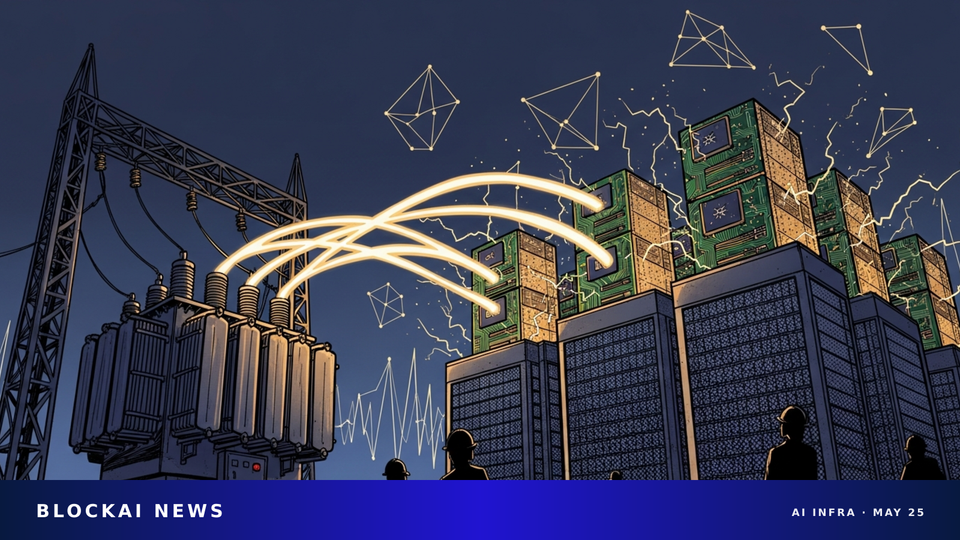
The press release dropped late on May 17. By the Monday open in Toronto, HIVE Digital (TSX/NASDAQ: HIVE) was up nearly 40%. The number that drove the move was not the CAD$3.5 billion price tag and not the 100,000-GPU build target. It was 320 megawatts: a contiguous, pre-substation, utility-allocated block of power in the Greater Toronto Area that HIVE's subsidiary BUZZ High Performance Computing has just locked down. Power, not silicon, is the binding constraint on the next twelve months of frontier AI compute. The miners that figured this out earliest are the ones rerating fastest.
TL;DR
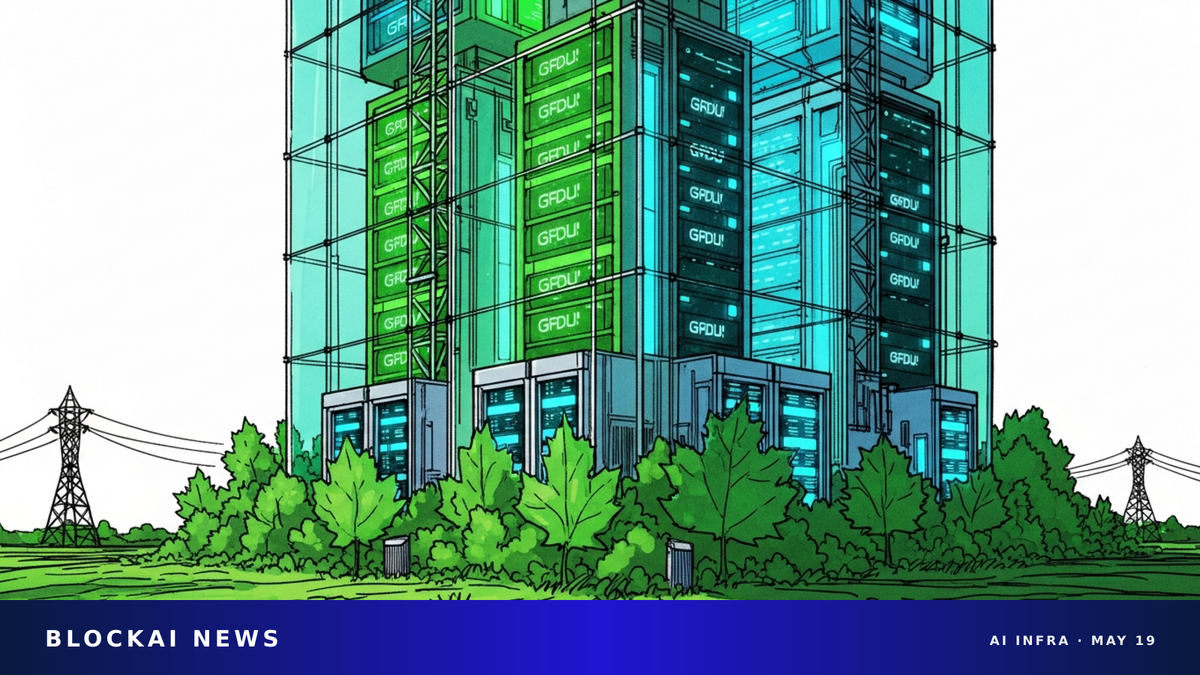
- HIVE's BUZZ HPC unveiled a 320 MW, CAD$3.5B AI gigafactory in the Greater Toronto Area, on a 25-acre site assembled from two adjacent parcels, targeted to come online in the second half of 2027. At full build it will host 100,000+ GPUs and be one of Canada's largest AI compute facilities.
- HIVE shares jumped nearly 40% intraday. The market is repricing the company from a Bitcoin miner sitting on stranded power to a sovereign AI infrastructure operator with a 400 MW pipeline on top of an existing 450 MW base — over 850 MW in total.
- This is now the loudest data point in a year-long trend: the 2017-cycle Bitcoin miners (HIVE, Core Scientific, IREN, Cipher, TeraWulf) are rebranding into AI/HPC landlords. The thesis: power purchase agreements next to substations, not ASICs, were the asset all along.
What HIVE is actually building
The GTA project is anchored on what President & CEO Aydin Kilic called a "strategically land-banked" position next to regional substations — a 21-acre Main Parcel purchased for CAD$46 million and a 4-acre Additional Parcel for CAD$12 million, both bundled with a 320 MW utility allocation. The total CAD$3.5 billion figure is full-build capital expenditure, including the buildings, mechanical-electrical fit-out, cooling stack, networking fabric and the cost of bringing the first tranche of GPUs online. The design is fully vertically integrated AI supercomputers — meaning HIVE intends to own and operate the racks, not just lease the shell to a third-party hyperscaler. That distinction matters for margin and is the same model BUZZ HPC has been deploying in British Columbia and New Brunswick.
The build sequence is staged for second half of 2027. That window is later than the most-aggressive US miner-to-AI conversions, but it is the realistic timeline for a greenfield 320 MW facility in Ontario where the constraints are transmission interconnection studies, planning permission and water-free closed-loop cooling at scale (HIVE is committing to a no-potable-water design with a target PUE below 1.3). The combination — Ontario's clean hydro-and-nuclear grid, sub-1.3 PUE, and no-water cooling — is exactly the package sovereign AI tenants and Canadian federal procurement programs have been asking for.
The deal also has to be read against HIVE's existing footprint. Per Kilic's statement, HIVE's global power book now sits at "over 850 MW" — 450 MW of operating data centers plus a 400 MW pipeline of capacity expected to come online in 2027. With 5,500 GPUs currently doing AI compute and the 70 MW Grand Falls site in New Brunswick coming alongside the 320 MW GTA build, the pipeline supports roughly 130,000 GPUs at full deployment. That is GPU count comparable to a mid-tier hyperscaler region.
BUZZ HPC is redefining the AI frontier by building sovereign, sustainable cloud infrastructure powered entirely by 100% renewable energy.
— HIVE Digital Technologies (@HIVEDigitalTech) April 23, 2025
President & COO Craig Tavares unpacks the rise of decentralized AI, green data centers, and the game-changing fusion of blockchain and AI. 👇 pic.twitter.com/i8F2SJn7wE
Why 320 MW of substation-adjacent power is the real story
The 2024-2026 GPU shortage is now a power shortage. NVIDIA's roughly $1 trillion Blackwell-and-beyond backlog assumes customers can plug those chips into the wall. They mostly cannot, fast enough. Permitting a new substation in a major US market is a three-to-seven-year process. Building transmission upgrades, longer. The fastest path to AI compute capacity in 2026 is not buying GPUs — it is acquiring a brownfield site that already has a multi-hundred-megawatt utility commitment with substation interconnection, then doing the building work in parallel with whatever supply chain you can negotiate.
That is the asset class first-cycle Bitcoin miners spent the past decade quietly accumulating. They located mining sites near hydro, geothermal and natural-gas generation precisely because cheap electricity was the only way to keep ASIC margins viable. Now the same connection — 100, 200, 320 megawatts of pre-cleared substation capacity — is the most valuable single line item on an AI infrastructure balance sheet. The market is repricing those balance sheets accordingly. HIVE was trading near the low end of mining-cycle valuations 18 months ago. Today's 40% surge is the market acknowledging that the underlying business is no longer well-described by "Bitcoin hash."
The argument generalizes. Core Scientific, IREN, Cipher, TeraWulf and Riot have all been pulling the same playbook with varying degrees of conviction. The differentiator now is depth of commitment: are you keeping mining as the dominant revenue line and AI as a hedge, or are you signing multi-year colocation contracts with hyperscalers and AI labs and treating mining as the bridge cash flow? HIVE's GTA announcement places it firmly in the second camp. The CAD$3.5 billion is not a hedge.
Canadian sovereign AI is suddenly a category
The phrasing in the press release is deliberate: "sovereign AI infrastructure." That is not marketing fluff. It is a positioning statement aimed at three buyers — the Canadian federal AI compute strategy (which committed roughly CAD$2 billion in 2024-2025 grants for domestic AI infrastructure), Quebec and Ontario provincial digital-sovereignty programs, and Canadian-headquartered enterprises that for regulatory or trade-reason concerns want their AI workloads to stay on Canadian soil and on the Canadian grid.
BUZZ HPC's existing footprint maps cleanly onto this thesis: facilities in British Columbia, Manitoba, Ontario, Quebec and New Brunswick give it a national presence with redundancy across hydro (BC, Quebec, Manitoba), nuclear (Ontario) and natural-gas (Alberta-adjacent and New Brunswick). For a Canadian financial-services or healthcare enterprise that needs an AI compute partner whose hardware never sits on US-sanctionable cloud regions, this is now the most credible local option. Compare it to the alternatives: AWS Canada, Azure Canada, and a handful of regional colocation operators most of whom are still building their first AI-grade hall.
That positioning also reads into the recent regulatory build-out for AI-and-finance, including the OCC's conditional charter for Augustus Bank in the US. As AI agents become a regulated category in financial clearing on both sides of the border, the supply of jurisdictionally-clean AI compute becomes a strategic input — not just for cost, but for licensing eligibility. HIVE is making an early bet that Canada's regulatory and grid story will be uniquely attractive to that segment of demand.
The risks the press release does not lead with
Three are worth naming. The first is execution: a CAD$3.5 billion greenfield AI build to 2027 second-half delivery is not a small lift. Construction labor in the GTA is tight, transmission interconnect studies routinely slip by quarters, and the hyperscaler comparables (Microsoft's Quincy, Google's Council Bluffs) have all overrun. HIVE's track record on smaller BUZZ HPC builds (Quebec, New Brunswick) is encouraging but not yet load-tested at this scale.
The second is customer concentration. The financial economics of an AI gigafactory depend on signing one or two anchor tenants with multi-year colocation or capacity contracts before commissioning. HIVE has not yet named one. The pricing model — wholesale per-megawatt versus per-GPU-hour — also remains undisclosed. Both are critical to whether the 100,000 GPU number translates to revenue at hyperscaler-comparable margins or at the lower end of a colocation operator's economics.
The third, more subtle risk is the rate of GPU obsolescence. By the time the GTA site commissions in late 2027, the GPUs that go in first will already be at least one major generation behind whatever NVIDIA has shipped on the Rubin-Ultra and beyond roadmap. The financial model has to bake in fast refresh cycles, which means the construction debt schedule and the GPU depreciation schedule have to be matched carefully. The miners that got into this market quickly are still learning that the AI compute capital cycle is shorter than the mining ASIC cycle they came from.
What to watch. The first anchor-tenant announcement. Capital structure decisions on the CAD$3.5B (equity, debt, hyperscaler prepayment). Whether HIVE consolidates mining further into legacy sites — or starts winding it down explicitly. And, on the macro side, whether Ottawa publishes a procurement preference for sovereign Canadian AI compute that would name builders like BUZZ HPC by category. Each of those is a leg of the rerate. Today was the first 40%. There is a meaningful chance the next legs come in similar size.
Frequently Asked Questions
What did HIVE Digital announce on May 17-18, 2026?
HIVE Digital Technologies (TSX/NASDAQ: HIVE), through its wholly owned subsidiary BUZZ High Performance Computing, announced a planned 320-megawatt AI infrastructure facility in the Greater Toronto Area. The project requires approximately CAD$3.5 billion in capital, sits on a contiguous 25-acre site assembled for CAD$58 million in two parcels, and is targeted to come online in the second half of 2027. At full build it will host more than 100,000 GPUs, making it one of Canada's largest AI gigafactories.
Why did HIVE's stock surge nearly 40% on the announcement?
The market is repricing HIVE from a Bitcoin miner to an AI infrastructure operator. After the announcement HIVE's installed and pipelined power base is over 850 MW (450 MW operating data centers plus a 400 MW pipeline including the new GTA site and the 70 MW New Brunswick Grand Falls expansion). At enterprise AI compute revenue multiples, that footprint is worth meaningfully more than at Bitcoin hash multiples. The 40% move is the gap closing, not a one-day overreaction.
Is HIVE still mining Bitcoin?
Yes, but the proportion is shrinking. The company runs roughly 5,500 GPUs already dedicated to AI compute, alongside its mining fleet, and CEO Aydin Kilic has been explicit that the strategic land bank near regional substations is being deployed for AI rather than hash. The pattern matches other miner-to-AI pivots — Core Scientific, IREN, Cipher and TeraWulf among them — but HIVE is now one of the more aggressive in proportional commitment of new capacity.
Reviewed by Jason Lee, Founder & Editor-in-Chief, BlockAI News.
Sources
Primary sources
- HIVE Digital Technologies — Official press release (May 17, 2026)
- Newsfile Corp — HIVE/BUZZ HPC press release
- Globe and Mail — Markets news coverage
- HPCwire — Industry coverage
- StockTitan — HIVE stock news
- @HIVEDigitalTech — BUZZ HPC sovereign AI thesis (X)
How we report: This article cites primary sources, regulatory filings, and on-chain data where available. BlockAI News uses AI tools to assist with research and first-draft generation; every article is reviewed and edited by a human editor before publication. Read our full How We Report page, Editorial Policy, AI Use Policy, and Corrections Policy.