SEC Hits Pause on Tokenization 'Innovation Exemption' — RWA Industry Left in Limbo
The SEC indefinitely shelved its long-promised innovation exemption for tokenized stocks late last week, after pushback from exchanges and internal debate over third-party issuance. ONDO dropped 6.4% and the broader RWA narrative took a hit.

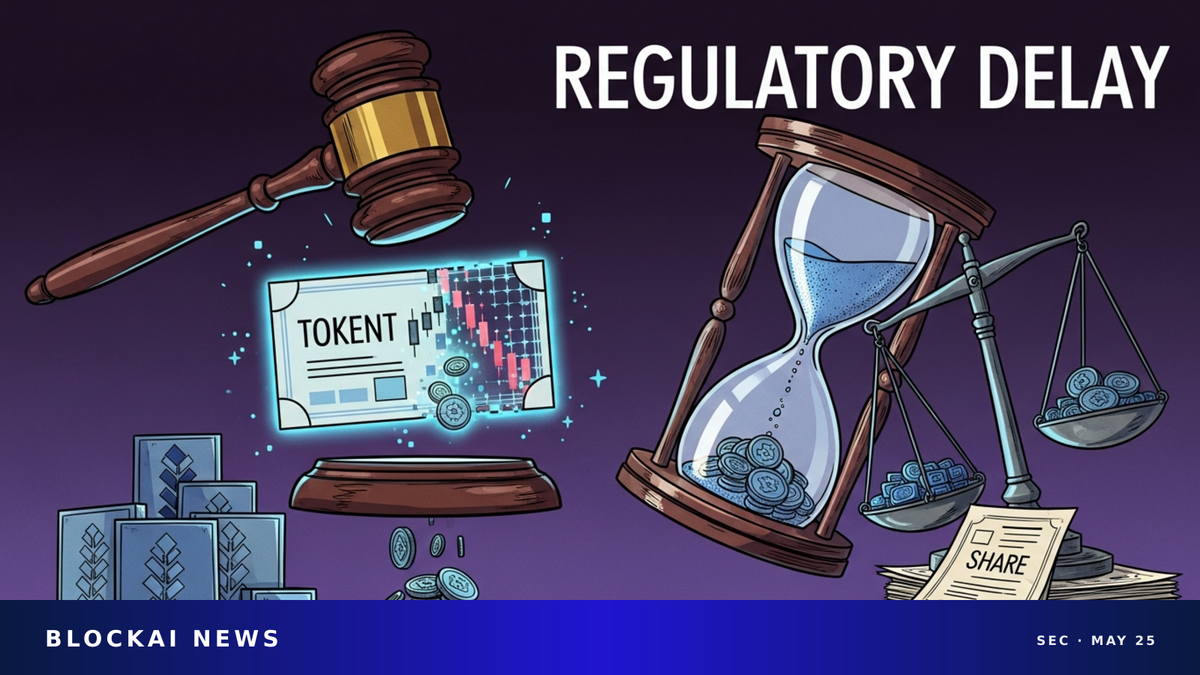
The U.S. Securities and Exchange Commission late last week indefinitely shelved its long-promised "innovation exemption" for tokenized stocks — the rule framework that crypto-native issuers had been pricing in for months as the moment U.S. tokenization went mainstream. The draft was expected the week of May 18. Instead, on or around May 24, staff pulled it back, citing unresolved questions about third-party token issuance and pushback from incumbent exchanges. The RWA industry's biggest near-term regulatory catalyst just slipped from "this week" to "no comment."
TL;DR
- SEC indefinitely delayed its tokenized-stocks innovation exemption around May 24, 2026, after Nasdaq, NYSE and internal commissioners raised objections over third-party tokens, shareholder rights and sanctions gaps.
- ONDO dropped roughly 6.4% in 24 hours on the news; the broader tokenized-equity narrative — which had pushed RWA above $33B and tokenized stocks past $1.43B — lost a near-term catalyst.
- The framework is paused, not killed. Chair Paul Atkins still wants it. But re-drafting around third-party issuance probably pushes any release into Q3 at earliest, and the Clarity Act timeline now matters more than ever.
What Was Supposed to Drop — And Why It Didn't
The innovation exemption was the centerpiece of Chair Paul Atkins's tokenization push. In an April 21 keynote at the Economic Club of Washington, Atkins told the room the SEC was "on the cusp" of releasing an exemption that would "begin facilitating the trading of tokenized securities onchain." Internal staff had been refining the draft since the May 12 Crypto Task Force Roundtable on Tokenization, and several outlets reported the rule could land as soon as the week of May 18.
That release window came and went. By Saturday, May 23 — Asia morning hours — reporting confirmed that SEC staff had paused the rollout to absorb more feedback from stock-exchange officials and market participants. The agency did not issue a formal withdrawal; it simply did not file.
The sticking point, per multiple sources close to the discussions, is the section of the draft covering third-party tokenized stocks — tokens minted by a platform like Ondo or Backed that reference a public company's shares without the company's involvement. That is exactly the mechanic that makes onchain equities composable with DeFi: anyone can wrap, lend, or pool a token tracking AAPL without negotiating with Apple. It is also the mechanic that Nasdaq, NYSE and several broker-dealers told staff they could not abide alongside their own exchange-approved tokenized listings, which were greenlit in March and April respectively under stricter issuer-led models.
The list of unresolved questions is long: how holders receive proxy materials when the underlying company has no record of them, how dividends route through wrapped tokens, whether OFAC sanctions screening can be enforced on a permissionless secondary market, and whether SIPC protection extends to token holders the same way it covers brokerage positions. None of these have clean technical answers. They have political answers, and the SEC is not yet aligned on them.
For context on how the agency previewed the issuer-vs-third-party split last week, see our May 19 breakdown of the SEC's tokenized-stocks Q&A — which now reads less like a roadmap and more like the document that triggered the pushback.
Tokenization has Washington's attention.
— Ondo Finance (@OndoFinance) April 22, 2026
“We are on the cusp of releasing an 'innovation exemption' to begin facilitating the trading of tokenized securities onchain.”
SEC Chairman Paul Atkins, speaking at the Economic Club of Washington, outlining the regulatory framework… pic.twitter.com/txldrIptrb
The Market Reaction: ONDO Drops, RWA Narrative Wobbles
The price response was sharp but contained. ONDO fell roughly 6.4% in the first 24 hours after the delay broke, to about $0.382, giving back most of the gains it had booked the week prior when the rule was thought imminent. Earlier in May, the same token had surged 16% on a single session as reporting first suggested the framework was coming.
The price action tells you exactly how much of the recent RWA rally was priced on regulatory anticipation. Tokenized stocks currently sit at roughly $1.43B in onchain value, per RWA.xyz, a fraction of the broader $33.7B tokenized real-world asset market but the fastest-growing sub-segment. Ondo alone holds about 70% of the tokenized equity issuer share, with 260+ tokenized U.S. stocks and ETFs across Ethereum, Solana and BNB Chain. The company's CEO Nathan Allman and President Justin Schmidt — both Goldman Sachs digital assets alumni — had publicly forecast tokenized stocks reaching $2.5–3B by year-end. That number now requires either international expansion to carry the load or a faster-than-expected U.S. re-draft.
Securitize, the other gravitational center of the U.S. tokenization industry, is less directly exposed. Its model — issuing securities natively onchain, working as a transfer agent and registered broker-dealer — does not depend on the third-party carve-out. If anything, an exemption that legitimizes third-party token issuance would have increased competitive pressure on Securitize's slower, fully-compliant lane. The delay arguably benefits them.
Robinhood and Coinbase, both of which have been signaling tokenized-equity ambitions, lose less than they would have a year ago. Robinhood's EU stock tokens — derivatives carrying counterparty exposure to Robinhood's own balance sheet — already operate in Europe under a different regulatory model. Coinbase has no live U.S. tokenized stock product to delay. For both, the innovation exemption was upside, not core roadmap. For Ondo, Backed, Swarm and the broker-dealer queue waiting to plug into onchain rails, it was the whole roadmap.
What Happens Next — And Why Clarity Act Now Matters More
The SEC has not given a revised timeline. Internally, the most likely path is a redraft that either drops third-party issuance entirely, restricts it to a narrow whitelist of qualified issuers, or pairs it with mandatory disclosures about shareholder rights and SIPC gaps. A redraft of that depth historically takes 6–10 weeks of staff work plus a public comment window, which pushes any usable rule into Q3 2026 at earliest, and more realistically Q4.
That timing collides directly with the Clarity Act, which cleared Senate Banking 15-9 on May 16 and is now headed to the Senate floor. If Clarity passes before the SEC re-drops the exemption, statutory definitions of digital commodities and securities will preempt parts of what the SEC was trying to do administratively. The same point applies to the broader institutional crypto regulatory stack Atkins has been building with the OCC — every week the exemption slips, the legislative track gets more of the agenda.
Atkins himself laid out the philosophical frame for all of this in his May 9 remarks, calling for unified policy across AI and onchain finance. The pause does not contradict that vision; it confirms that even an aligned chair cannot move faster than the incumbents are willing to be moved.
Internationally, the U.S. delay creates a real opening. The UK's FCA and Bank of England launched a tokenisation call-for-input on May 18, and EU MiCA-licensed issuers like Backed already have a 14-month head start in commercial deployment. If U.S. clarity slips into late 2026, expect more of the tokenized equity volume — currently maybe 40% U.S.-referenced — to settle on European-licensed venues rather than wait for American ones.
Key Takeaways
- Cause of delay: Third-party token issuance, shareholder rights ambiguity and exchange pushback — not a withdrawal of intent.
- Most exposed: Ondo Finance (70% issuer share), Backed, Swarm and the broker-dealer queue waiting on U.S. clarity.
- Most insulated: Securitize (registered-broker model), Nasdaq/NYSE (already-approved exchange-led tokenization), Robinhood EU.
Beyond the Headlines. The most important signal from this delay is not regulatory — it is structural. The SEC almost shipped a rule that would have rewired who gets to mint claims on public equities. The incumbents pulled the e-brake the week before launch. That is exactly the kind of late-stage incumbent capture that crypto-native infrastructure was supposed to route around, and the fact that it still works in 2026 is the real story. Ondo, Securitize and every issuer waiting on a U.S. tokenized-stock framework now have a clearer picture of who they actually need to negotiate with — and it is not the SEC.
Frequently Asked Questions
What exactly did the SEC delay on May 24, 2026?
The SEC indefinitely shelved its draft 'innovation exemption' — a targeted carve-out that would have let crypto platforms and third-party issuers offer tokenized versions of U.S.-listed equities without full broker-dealer or exchange registration. The rules were expected to drop the week of May 18; instead, staff pulled them back to absorb pushback from exchange operators and internal commissioners worried about third-party tokens, shareholder rights, dividend mechanics, and sanctions compliance. The framework is not dead — it is paused with no published timeline, while the agency reworks language around who can mint tokens that reference securities they did not issue.
Why are third-party tokenized stocks the sticking point?
Third-party issuance is the part of the framework that lets a platform like Ondo or Backed mint a token tracking, say, Tesla shares without Tesla's involvement. That model unlocks DeFi-native liquidity but creates thorny questions: holders may not receive proxy materials, may have no direct legal recourse against the underlying issuer, and may not be covered by SIPC the way a brokerage position is. Nasdaq, NYSE and several broker-dealers told staff that allowing third-party tokens alongside exchange-approved tokenized listings could fragment liquidity and confuse retail investors about what they actually own. That is the knot the SEC now has to untie before re-proposing.
Who is most affected by the delay?
The clearest losers are RWA-native platforms whose roadmaps assumed U.S. clarity by mid-2026: Ondo Finance, which holds roughly 70% of the tokenized equity issuer market and was eyeing $2.5–3B in tokenized stock TVL by year-end; Backed, Swarm and other European-licensed issuers planning U.S. expansion; and crypto exchanges pitching tokenized equity trading desks. Broker-dealers waiting to plug into onchain rails also lose runway. Beneficiaries of the delay are the incumbent exchanges (Nasdaq, NYSE) whose own exchange-traded tokenized equity rules were approved in March and April and now keep their first-mover head start.
Reviewed by Jason Lee, Founder & Editor-in-Chief, BlockAI News.
Sources
Primary sources
- SEC Chair Paul Atkins, Keynote Remarks at the Economic Club of Washington (April 21, 2026)
- SEC Gov on X — innovation exemption framing
- Ondo Finance on X — citing Atkins on the upcoming innovation exemption
- Ondo Finance Written Submission to SEC Crypto Task Force
- RWA.xyz — Tokenized real-world asset market data
From BlockAI News
- SEC tokenized-stocks Q&A: third-party issuance breakdown (May 19)
- SEC Chair Atkins on unified AI + onchain finance policy
- The institutional crypto regulatory stack
- Clarity Act passes Senate Banking 15-9
- UK FCA + BoE tokenisation call-for-input
How we report: This article cites primary sources, regulatory filings, and on-chain data where available. BlockAI News uses AI tools to assist with research and first-draft generation; every article is reviewed and edited by a human editor before publication. Read our full How We Report page, Editorial Policy, AI Use Policy, and Corrections Policy.