BitMine Buys 60,000 ETH for $126M as 'MicroStrategy of Ethereum' Plays for Russell 1000
BitMine pulled another 60,000 ETH off BitGo and Kraken on May 23, lifting its treasury above 5.2 million ETH — about 4.3% of supply — just as Tom Lee teases a Russell 1000 inclusion that could unlock passive flows from a $12.2 trillion benchmark.

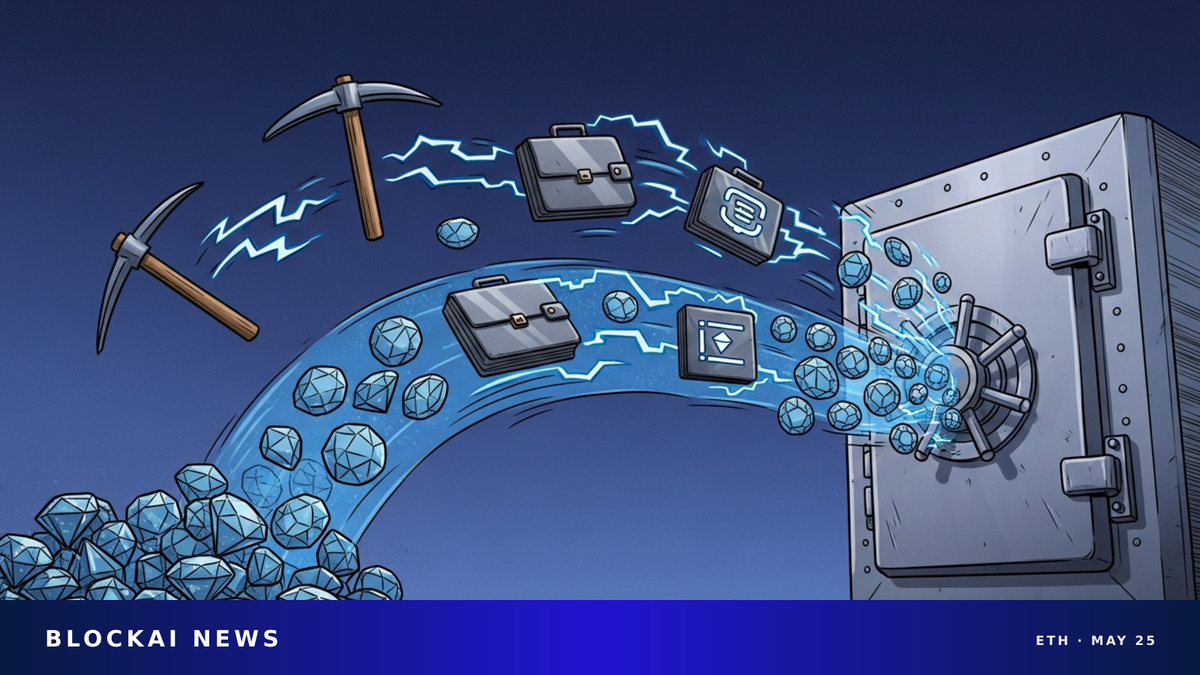
BitMine Immersion Technologies didn't wait for an all-time high to keep buying. On May 23, 2026, on-chain analysts at Lookonchain and EmberCN flagged two freshly created wallets pulling a combined 60,000 ETH — worth about $126 million — off BitGo and Kraken, with the flow patterns lining up cleanly against BitMine's prior treasury accumulation. Within hours, Chairman Tom Lee was on X talking about the FTSE Russell preliminary inclusion list. The two stories are the same story.
TL;DR
- BitMine added 60,000 ETH (~$126M) on May 23, pushing total holdings above 5.2M ETH — roughly 4.3% of circulating supply.
- Tom Lee confirmed BMNR sits on FTSE Russell's preliminary list for Russell 1000 inclusion in June 2026, unlocking exposure to a $12.2T benchmark.
- Unlike BTC treasuries, BitMine stakes the bulk of its ETH — 4.36M tokens generating $297M annualized — giving it a cash-flow story Saylor never had.
How $126M Got On-Chain in One Window
The fingerprint was familiar. Lookonchain and EmberCN both flagged the same pattern Lookonchain has tracked all spring: two new wallets, freshly funded, pulling ETH directly from BitGo custody and a Kraken hot wallet, then sitting quietly. No quick redistribution. No DEX activity. Just accumulation.
It seems that Tom Lee(@fundstrat)'s #Bitmine bought another 20,000 $ETH($42.3M) from BitGo 7 hours ago.
— Lookonchain (@lookonchain) February 10, 2026
Today alone, it has bought 40,000 $ETH($83.4M).https://t.co/cY4jpzYpQu pic.twitter.com/YNTMDgdo3h
The size — 60,000 ETH at roughly $2,100 per coin — is consistent with BitMine's modus operandi. Earlier May purchases ran $145M, $154M, and $62M. The structural shape is identical: BitGo as primary custodian, Kraken and occasionally FalconX as the execution venues, new wallets every time to avoid clustering analytics.
The 60K ETH lift carries BitMine's reported treasury past 5.2 million ETH. The company's most recent 8-K disclosure pegged total crypto, cash, and "moonshot" holdings at $13.4 billion, against roughly 120.7M ETH in total supply. BitMine now controls more than 4.3% of every Ether in existence — and the company has been publicly explicit that the long-term floor is 5%.
That target is not rhetorical. At today's price, going from 4.3% to 5% means buying roughly another 845,000 ETH — about $1.8 billion in additional accumulation. The market is treating this as a structural bid, not a one-off.
From Immersion-Cooled Miner to ETH Treasury Conglomerate
It's worth remembering how recently BitMine was a different company. BMNR's original business was immersion-cooled Bitcoin mining infrastructure — a hardware bet on cheap-watt economics that most of its peers have since pivoted toward AI compute. BitMine took a different exit ramp.
In July 2025, the company raised a $250 million private placement specifically to anchor an Ethereum treasury strategy. Tom Lee — the Fundstrat founder and a long-time CNBC fixture — came in as chairman. By the end of 2025, BitMine had ~163,000 ETH. Eight months later it has 32 times that. The capital flywheel is straightforward: issue equity at the premium that BMNR commands as a pure-play ETH proxy, convert proceeds to spot ETH, stake almost all of it, and let protocol yield compound the position even when the company isn't actively raising.
The mechanic is openly modeled on MicroStrategy. The differences matter, though, and are mostly in BitMine's favor. As of the May 3 disclosure, BitMine had 4,362,757 ETH staked, generating $297 million in annualized staking revenue at a 2.91% seven-day yield. When the position is fully staked, management projects $352 million annually. Saylor's BTC sits idle by design. BitMine's ETH earns.
That cash flow does two things. It funds operating expenses without forcing equity dilution, and it gives the stock something resembling a multiple — a metric MicroStrategy's permabulls have had to wave away for years. It also gives BitMine optionality on the rest of the Ethereum stack: liquid restaking, validator services, eventually a likely play in regulated staking-as-a-service as the new SEC and OCC posture firms up.
What Russell 1000 Means in Practice
The May 23 X post from Lee was a heads-up: FTSE Russell published its preliminary index reconstitution list, and BMNR cleared the $5.7 billion market-cap threshold for Russell 1000 inclusion in the June 2026 rebalance. BMNR is currently a Russell 3000 constituent. Russell 1000 is a different animal.
Russell US Indexes benchmark approximately $12.2 trillion in tracked assets. Lee's argument — and it is a quantitative one, not a hype line — is that passive index funds and ETFs typically hold 20% to 25% of a constituent's market capitalization. At BMNR's current market cap, that translates into hundreds of millions of dollars of forced buying spread over the reconstitution window and the months that follow. More importantly, the much wider universe of active institutional managers who limit their mandate to Russell 1000 names would, for the first time, be allowed to look at BMNR.
That is the second-order story. The first-order story is more interesting: BMNR becomes the cleanest way for a generalist long-only fund to get spot ETH exposure with no custody, no derivatives, no swaps documentation. Charles Schwab is finally rolling out spot crypto for retail, but for many institutional mandates, an equity ticker remains the only acceptable wrapper. BMNR is positioning to be that ticker.
Lee has also been candid on X that BitMine intends to moderate the pace of accumulation, presumably to manage premium-to-NAV and avoid forced selling pressure ahead of the index event. The 60,000 ETH May 23 print was, in that context, a measured buy — not an all-out bid. The Ethereum security stack continues to mature alongside — Vitalik's May 19 push for formal verification is exactly the kind of underlying that institutional desks need to see firming up.
Key Takeaways
- Structural demand floor. BitMine alone is on track to remove another ~845,000 ETH from float to reach its 5% supply target.
- Yield-bearing treasury. 4.36M ETH staked at 2.91% is a cash-flow asset that MicroStrategy's BTC pile cannot replicate.
- Russell 1000 = forced buyers. Inclusion in the June reconstitution opens BMNR to passive vehicles tracking $12.2T in assets.
The Bottom Line. The BTC corporate-treasury wave of 2024–2025 proved that one well-capitalized public company can structurally tighten the spot market in a way no ETF can — because the ETF is a passive wrapper while a treasury company is an active buyer with permanent capital. MicroStrategy proved that for Bitcoin. BitMine is proving it for Ethereum, with the added wrinkle that staking yield turns the position into a quasi-cash-flowing asset. Watch the June Russell reconstitution announcement, whether Lee accelerates buying if ETH dips below $2,000, and follow-on ETH treasury announcements from mid-cap public companies. If even one or two more cross the $1 billion threshold, the 2024-style BTC treasury wave officially has its ETH-shaped sequel.
Frequently Asked Questions
How much ETH does BitMine now hold after the May 23 purchase?
BitMine's treasury crossed 5.2 million ETH after the 60,000 ETH ($126 million) buy reported on May 23, 2026 — roughly 4.3% of circulating supply, with a stated long-term goal of reaching 5%. Disclosures show 4,362,757 ETH staked, generating an annualized $297 million in protocol rewards. The 60K-coin lift continued a multi-month accumulation cadence in which BitMine has used a rotating set of fresh wallets to pull ETH directly from BitGo custody and Kraken's hot wallet.
Why is Russell 1000 inclusion a big deal for BMNR?
Russell 1000 is the benchmark for roughly $12.2 trillion of US equity assets. Chairman Tom Lee argues that passive index funds and ETFs typically hold 20–25% of a constituent's market cap. If BMNR is added in the June 2026 reconstitution, that forced buying could become a persistent bid under the stock — and indirectly under ETH. Inclusion also opens BMNR to the large universe of active institutional mandates restricted to Russell 1000 names.
Is BitMine really 'the MicroStrategy of Ethereum'?
The mechanic is similar: issue equity at a premium to net asset value, convert proceeds into the underlying crypto, repeat. But BitMine layers in staking yield — something BTC treasuries cannot do. At a 2.91% 7-day staking yield, the position throws off roughly $297 million annualized, giving the equity story a cash-flow component MicroStrategy's BTC pile lacks. The flywheel: equity premium → spot accumulation → staking yield → operating coverage → repeat.
Reviewed by Jason Lee, Founder & Editor-in-Chief, BlockAI News.
Sources
Primary sources
- BitMine Immersion Technologies — Form 8-K (Ex. 99.1), SEC EDGAR
- BitMine official press release — 5.21M ETH, $13.4B total holdings (PR Newswire)
- Lookonchain on X — BitMine-linked wallets pulling ETH from BitGo/Kraken
- BMNR 8-K — $13.4B treasury and 4,362,757 ETH staked (Stocktitan)
From BlockAI News
- Charles Schwab opens spot bitcoin and ethereum to retail
- The institutional crypto regulatory stack
- Vitalik on AI formal verification for Ethereum security
- Bitcoin miners as AI infrastructure landlords
How we report: This article cites primary sources, regulatory filings, and on-chain data where available. BlockAI News uses AI tools to assist with research and first-draft generation; every article is reviewed and edited by a human editor before publication. Read our full How We Report page, Editorial Policy, AI Use Policy, and Corrections Policy.