A Thiel Fellow's Bet: OCC Just Conditionally Chartered the First US Bank Built for AI Agents and Stablecoin Clearing
OCC conditionally approved Augustus, a national bank designed from scratch for AI-agent clearing, stablecoin settlement, and machine-speed compliance. CEO is 25-year-old Thiel Fellow Ferdinand Dabitz. The pitch: legacy banks are made of paper, Augustus is made of code.

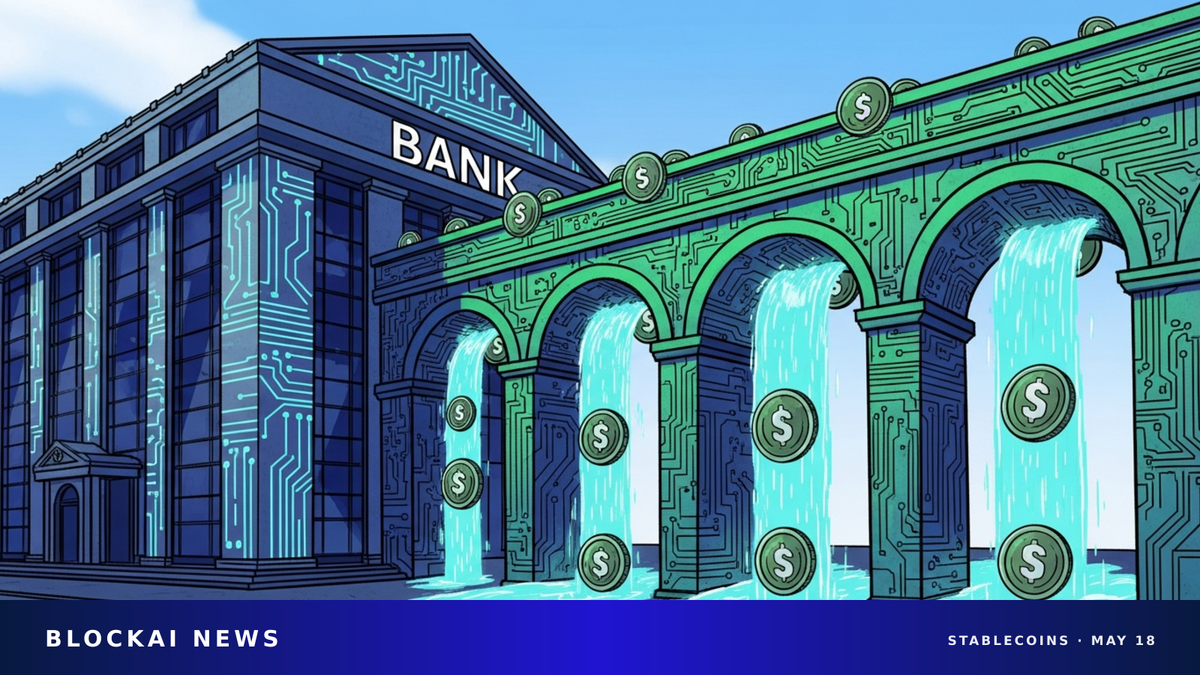
The line that the new bank's 25-year-old CEO chose for his launch tweet was direct enough that it will get quoted in regulatory testimony for a decade: "Legacy banks are made of paper. Augustus is made of code." On May 11, 2026, the Office of the Comptroller of the Currency granted Augustus a conditional national bank charter — the first US bank built from scratch on a stablecoin-and-AI-native core. Ferdinand Dabitz, a German-born 2025 Thiel Fellow who founded the Berlin payments company Ivy in 2021 and rebranded it Augustus the same day as the OCC announcement, is set to become the youngest CEO of a federally chartered bank in roughly 140 years.
TL;DR
- OCC conditionally approved Augustus, a full-service US national bank, on May 11, 2026. The charter is the first to be granted to an institution whose product design is explicitly "AI agents as account holders" plus 24/7 stablecoin clearing.
- Founder/CEO: Ferdinand Dabitz, 25, German-born, 2025 Thiel Fellow, co-founder of Berlin A2A-payments company Ivy. President: Greg Quarles, an 18-year OCC veteran. Backers include Valar Ventures (Thiel-linked), Creandum, and angels from Ramp, Deel, and Circle.
- The conditional charter requires Augustus to satisfy capital, AML, IT, and governance conditions before activation. Augustus says activation is "weeks, not years" — putting the operational test on track for summer 2026.
What OCC actually conditionally approved
The OCC's interagency licensing artifact for Augustus is currently a single PDF on the regulator's digital-asset charter page; the agency has not yet posted a numbered "Conditional Approval" letter (the most recent published is #1361 from January 2026). The substantive approval, however, is clear from Augustus's own filings: a full-service national bank charter — not a trust charter — that intends to hold customer deposits, settle payments, and issue and accept tokenized money. That is a different category of license from Anchorage Digital (national trust), Paxos National Trust, or the four trust charters the OCC approved in December 2025 for Circle, Ripple, Paxos, and BitGo.
"Conditional" does specific regulatory work here. Augustus must pre-fund a minimum capital level, prove its independent BSA/AML program is fully staffed and tested, run an OCC-supervised IT and operational readiness review, and meet business-plan adherence terms for the first three years. National-bank conditional approvals typically include a charter-window expiration — Paxos missed its in 2023 by failing to clear those conditions within eighteen months. Augustus is signaling confidence that it can close that window in weeks, which would be unusual but not unprecedented given how much of the bank's infrastructure has been pre-built by Ivy.
The president of the bank, Greg Quarles, spent eighteen years inside the OCC as a commissioned national bank examiner and assistant deputy comptroller. That pairing — a 25-year-old founder with a senior ex-OCC executive running operations — is the cleanest signal of how Augustus expects to clear its conditions. Quarles has shipped pre-opening exams from the other side of the table; the bank's internal procedures are likely tuned to the regulator's actual checklist rather than to a stylized version of it. The funding stack also matters: Valar Ventures (Peter Thiel's fund) led, with Creandum and angels from Ramp, Deel, and Circle reportedly participating, taking total Ivy-now-Augustus funding to roughly $40M.
Why an AI-clearing bank needs different plumbing
Strip away the marketing and the real innovation Augustus is pitching is a three-layer stablecoin architecture: stablecoins as a funding rail for payments, as a treasury and liquidity instrument, and — critically — as an interface layer for AI agents transacting on behalf of humans and businesses. That third layer is what makes Augustus different from every prior crypto-friendly bank application the OCC has reviewed. The implicit claim is that the legacy correspondent-banking model — multiple intermediated hops, batch settlement, human-driven AML — cannot serve a market in which a Sierra agent, a Notion workflow, or a custom enterprise bot is the actual transaction originator.
The AML and risk plumbing inside Augustus is the part that will get the regulatory scrutiny. The bank's stated design is to embed real-time monitoring of stablecoin flows and automated KYC at the agent level. Conceptually, that aligns Augustus with the same thesis the CLARITY Act's AI-sandbox amendment has been wrestling with in the Senate Banking Committee, and with the agentic compliance roadmap that Elliptic just raised $120M to build. The unstated bet is that an OCC-supervised bank designed for machine-speed compliance becomes the preferred US settlement endpoint for the agent economy — instead of crypto exchanges, instead of fintech wallets, instead of the existing correspondent banks that simply cannot redesign their backbone in time.
The historical analogue Augustus invokes — and there is no avoiding it given the name — is the original Augustus, who centralized the Roman mint and created what was effectively the first network-wide unit of account for the Mediterranean. The branding is not subtle. The strategic positioning is. Dabitz has framed Augustus's mission as "secure and advance Western currency dominance by upgrading clearing to the AI era." That is a stablecoin-policy argument as much as it is a product pitch, and it lands at the same moment the Treasury is preparing to publicly favor US-dollar-denominated stablecoins over alternative private monies for cross-border settlement.
BREAKING: German 25 year old Ferdinand Dabitz becomes the youngest person ever to lead a federally chartered bank. https://t.co/EEAfIXpYRR pic.twitter.com/QM69HyZXOg
— etn. (@etnshow) May 11, 2026
The graveyard of crypto bank charters Augustus is trying to escape
Augustus is the latest entrant in a category that has had more failures than successes. Anchorage Digital Bank — the first crypto firm with an OCC charter, granted January 13, 2021 — is structurally a national trust, not a full-service bank, and was hit with an OCC consent order in April 2022 over BSA/AML deficiencies that took two years to work through. Custodia Bank, a Wyoming SPDI, has been the most public cautionary tale: denied a Federal Reserve master account in January 2023, denied Fed membership the same month, and on March 29, 2024 lost its federal court challenge in Wyoming. Paxos's earlier OCC conditional charter expired in March 2023 after failing to clear its eighteen-month operational window, with Protego suffering the same fate.
The pattern in those failures is consistent: each previous attempt assumed regulators would adapt to their model. Augustus is structurally different in three ways. First, the OCC has now affirmatively re-engaged with the digital-asset bank category — the December 2025 trust charters for Circle, Ripple, Paxos, and BitGo signaled that, and the May 2026 Augustus approval extends it to full-service banking. Second, Augustus is starting with an ex-OCC president, which means the bank's internal supervisory expectations are calibrated to actual OCC processes rather than to founder optimism. Third, the political environment is now more amenable to programmable money: the Warsh Fed has signaled it will not actively obstruct stablecoin-aligned banking infrastructure.
The unflattering version of the story is also worth naming. Conditional approval is not activation. A 25-year-old CEO running a federally chartered bank will face every governance objection a bank examiner can raise, and the bank's product surface is, on paper, exactly the kind of design that gets paused if a single AML control fails an audit. The Custodia trajectory is a reminder that the OCC granting a license does not mean the Fed will grant a master account — and a bank that cannot settle in central-bank money cannot clear anything at scale.
Our take: The interesting outcome is not whether Augustus opens. It is whether other US fintechs read the May 11 approval as a signal that the OCC is willing to grant full-service national charters to digitally-native operators with credible compliance leadership. If that read sticks, expect at least two more applications from established crypto-banking-adjacent firms in the back half of 2026 — and a regulatory tilt that favors AI-clearing-native institutions over retrofitted correspondent banks for the next leg of stablecoin issuance and tokenized-deposit volume.
Frequently Asked Questions
What is Augustus Bank and when did it get OCC approval?
Augustus is a US national bank built from scratch on a stablecoin + AI-native core. On May 11, 2026, the Office of the Comptroller of the Currency (OCC) granted Augustus a conditional national bank charter. The company was renamed from Ivy (a Berlin-based open-banking platform) the same day. Founder and CEO is 25-year-old Ferdinand Dabitz, a 2025 Thiel Fellow.
What does 'conditional' approval mean here?
Conditional means Augustus has the charter in principle but must satisfy pre-opening conditions (paid-in minimum capital, an approved business plan, an independent BSA/AML program, board and senior management sign-offs, and an IT/operational readiness review) before it can transact. Augustus says it expects activation in 'weeks, not years.'
How is Augustus different from Anchorage, Custodia, or Paxos?
Anchorage Digital is a national trust charter (not full-service) and has faced an OCC consent order. Custodia is a Wyoming SPDI that was denied a Fed master account and lost in federal court. Paxos's earlier OCC conditional charter expired after an 18-month operational window. Augustus is pitching the first full-service national bank built natively for stablecoin clearing and AI-agent accounts, not retrofitted from a custodian or fintech model.
Reviewed by Jason Lee, Founder & Editor-in-Chief, BlockAI News.
Sources
Primary sources
- OCC — Augustus National Bank, N.A. licensing document
- Augustus — OCC conditional approval press release (May 11, 2026)
- OCC — December 2025 national trust charter release
- Banking Dive — Augustus OCC charter coverage
- Custodia v. FRB ruling text (comparable case)
- @ferdidabitz — Ferdinand Dabitz, CEO, Augustus Bank
How we report: This article cites primary sources, regulatory filings, and on-chain data where available. BlockAI News uses AI tools to assist with research and first-draft generation; every article is reviewed and edited by a human editor before publication. Read our full How We Report page, Editorial Policy, AI Use Policy, and Corrections Policy.