THORChain's $10.7M Loss Wasn't a Smart-Contract Bug — It Was a Cryptographic Time Bomb
On May 15, THORChain paused trading after a ~$10.7M cross-chain exploit drained one Asgard vault across BTC, ETH, BNB Chain, and Base. Root cause was not a smart contract bug — it was a flaw in the GG20 threshold signature scheme, exploited by a single newly churned malicious validator.

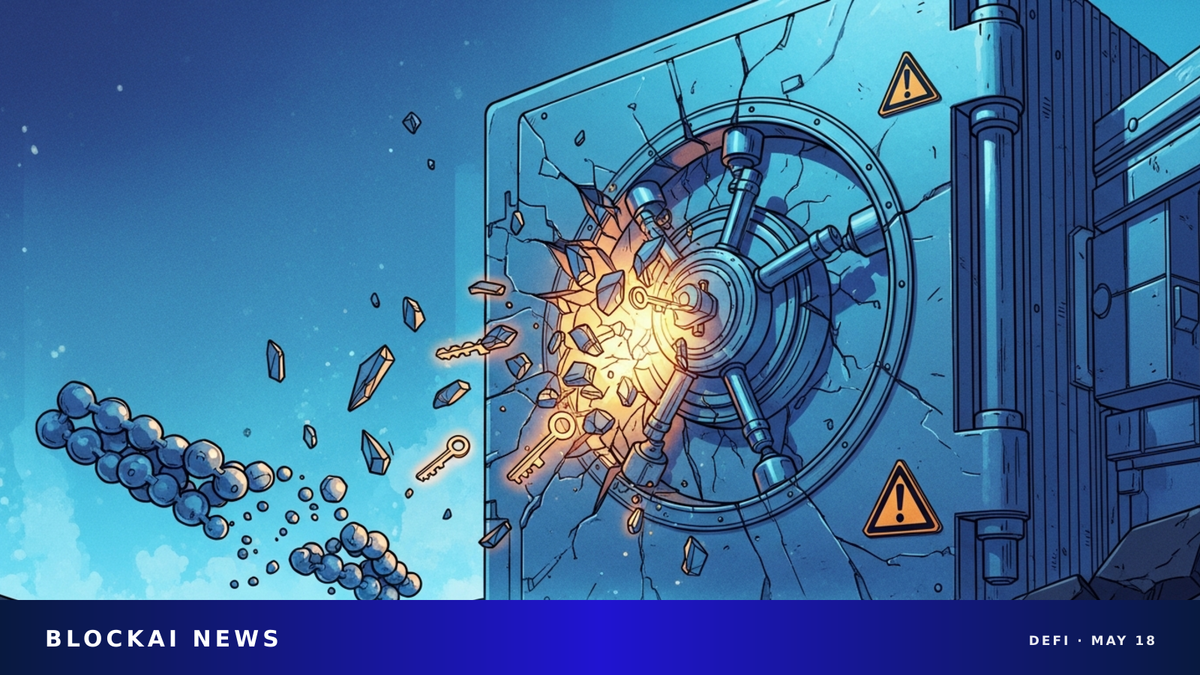
At 09:45 UTC on Friday, May 15, 2026, on-chain investigator ZachXBT flagged unauthorized outflows from one of THORChain's six Asgard vaults. Eight minutes later, node operators flipped Mimir governance flags to halt trading and signing across the network. A twelve-hour-forty-two-minute pause began. By the time it ended, roughly $10.7 million in protocol-owned liquidity had been drained across Bitcoin, Ethereum, BNB Chain, and Base — and the cross-chain DeFi sector had a new kind of post-mortem on its hands. This was not a bridge bug. It was not a smart-contract logic flaw. It was a slow, mathematically elegant exploit of the cryptographic primitive that THORChain uses to control its multisig.
TL;DR
- May 15 incident: ~$10.7M drained from one of six Asgard vaults. Chains affected: BTC, ETH, BNB Chain, Base. THORChain paused trading and signing for ~12h 42m via Mimir governance flags. Protocol-owned liquidity only — no individual user swap balances were stolen.
- Root cause is now widely believed to be a vulnerability in the GG20 threshold signature scheme implementation. A newly churned malicious validator appears to have slowly leaked key material during keygen and signing rounds, then reconstructed an Asgard vault private key offline.
- This is the fourth significant THORChain incident — but the first that is not a smart-contract or router bug. Prior 2021 exploits ($4.9M and $8M) were Bifrost router issues. This one breaks at the cryptography layer, which is a different (and harder) class of fix.
What actually happened on May 15
The forensic sequence has been pieced together from TRM Labs, ZachXBT, PeckShield, and the THORChain core team's own statements. A new validator node — identified as thor16ucjv3v695mq283me7esh0wdhajjalengcn84q — entered THORChain's active validator set days before the exploit through the normal churn process by which new nodes rotate into vault-signing duty. That node, the forensics work suggests, was operated by a single malicious actor whose Ethereum addresses for RUNE bonding trace forward to the wallets that later received stolen funds.
The exploit unfolded around 09:45 UTC. The attacker initiated unauthorized withdrawals from a single Asgard vault — the multisig structure that holds bridged assets on Bitcoin, Ethereum, BNB Chain, and Base. Within roughly eight minutes, ZachXBT's tracking surfaced the anomaly publicly. Multiple node operators ran make pause locally; the Mimir module's TRADING-HALT and SIGNING-HALT parameters flipped at block 26190429. By the time the chain came back online roughly twelve hours later, the attacker had moved approximately 36.75 BTC (~$3M at the time), about 3,443 ETH, ~96.6 BNB, and a smaller basket of Base-chain assets, for a total of approximately $10.7 million.
The loss breakdown is important: THORChain has emphasized that all six Asgard vaults are partitioned, and only one was compromised. That compartmentalization is what kept the damage limited to protocol-owned liquidity — the assets that THORChain's own LP infrastructure had committed to those bridges — rather than the entire universe of user-held positions. Individual swap traders did not lose principal. They did lose access for half a day, and any time-sensitive trades or unbonding were frozen during the pause. THORChain launched a refund portal on May 16-17, with explicit warnings about copycat scammer sites impersonating the legitimate process.
Why GG20 was always going to break
The technical post-mortem is the part that turns this from a routine cross-chain incident into a structural lesson. THORChain's Asgard vaults are protected by a Threshold Signature Scheme commonly referred to as GG20, after the foundational 2020 paper by Rosario Gennaro and Steven Goldfeder. The scheme lets a group of validators jointly produce signatures without any individual holding the complete private key — each node holds a share of the key, and a quorum collaborates to sign each transaction. In principle, this means an attacker who compromises any single node cannot move funds, because no single node has the full secret.
In practice, GG20 implementations have a long history of subtle flaws. Multiple academic papers between 2021 and 2024 documented vulnerabilities in real-world GG20 implementations — leakage of partial secret shares during the keygen protocol, side-channel signal in the abort handling, and timing-based recovery attacks that let a malicious participant reconstruct a victim's share over many signing rounds. The pattern that researchers have flagged repeatedly is the gap between the theoretical security proof (which assumes ideal abort behaviour, ideal randomness, and ideal protocol completion) and the messier reality of running this on a live network with churning validators, intermittent connectivity, and adversarial timing.
The working hypothesis put forward by THORChain core developers and external analysts including PeckShield and Cyvers — and explicitly suggested by Ledger CTO Charles Guillemet (@P3b7_) on X — is that the attacker's malicious node participated in enough signing rounds, with enough adversarial behaviour at the abort and verification stages, to leak fragments of the vault's private key share-by-share. Once enough fragments were accumulated, the attacker reconstructed the full key offline and used it to forge a signature that bypassed the quorum check. This is qualitatively different from THORChain's earlier exploits in July 2021, when a buggy Bifrost ETH router was tricked into honouring fake msg.value calls and forged deposit events. Those were smart-contract issues. This is cryptography.
That distinction matters operationally. Patching a router contract is an afternoon's work for an experienced Solidity team. Patching a TSS implementation is months — possibly a hard fork — because the network has to migrate every existing vault to a new signing scheme without compromising the assets sitting in those vaults during the migration. THORChain has since added Halborn audits, the June 2024 Code4rena audit contest, and additional internal reviews. None of those review surfaces appears to have caught what the May 15 attacker found.
The cross-chain liquidity problem no one is solving
The broader lesson is that cross-chain liquidity infrastructure remains DeFi's highest-risk layer, and the risk has shifted from one category to another. The first wave of bridge exploits (Ronin, Wormhole, Nomad) were primarily contract-logic or signature-verification bugs. The newer wave — Multichain in 2023, several smaller TSS-based bridges in 2024-2025, and now THORChain — is moving up the stack to cryptographic-primitive-level issues. That is harder to detect with conventional audits, harder to patch, and easier for a sophisticated attacker to weaponize over multiple weeks of validator activity.
The competitive context makes the timing especially uncomfortable. The same week THORChain was patching its TSS exposure, DTCC and Chainlink were deploying a 24/7 collateral AppChain, the UK regulators were committing to a 2028 settlement synchronisation service, and OCC was conditionally chartering a US bank built for stablecoin clearing. Institutional cross-chain infrastructure is increasingly being shaped by financial-market plumbing standards, where a $10.7M loss from a single vault would be career-ending news. The continued tolerance for this class of risk inside permissionless DeFi will get smaller over the next 12-24 months — both from regulators and from institutional LP allocations.
The user-funds-safe framing is also worth examining honestly. THORChain is correct that no individual swap balance was stolen. But "user funds safe" is a narrower claim than "users unaffected." Twelve hours of frozen swaps is a meaningful cost to a trader running cross-chain arbitrage, an LP earning fees on Asgard vault assets, or anyone trying to exit a position during a fast-moving market. The protocol-owned-liquidity framing — that THORChain's own LP infrastructure ate the loss — also has limits: that liquidity ultimately came from RUNE bondholders and protocol revenue, and the cost flows downstream over time.
Our take: THORChain's defensive posture on May 15 was good — fast detection, fast pause, transparent on-chain forensics, and a working refund process within 48 hours. The cryptographic root cause is the worrying part. GG20 has been the de-facto TSS standard for production cross-chain systems for four years, and the academic literature has been signalling its implementation risk for at least two. The next round of cross-chain protocol audits should focus on the cryptographic primitive, not just the contracts that sit on top of it. The DeFi sector now has an open question: how many other live bridges and cross-chain liquidity layers are running GG20-style TSS schemes whose audit surface stopped at the contract level? The answer determines whether May 15 was an isolated incident or the first of several.
Frequently Asked Questions
What happened to THORChain on May 15, 2026?
At approximately 09:45 UTC on Friday May 15, on-chain investigator ZachXBT flagged unauthorized outflows from one of THORChain's six Asgard vaults. Within minutes, node operators triggered the network's Mimir governance module to set TRADING-HALT and SIGNING-HALT flags. The pause lasted roughly 12 hours and 42 minutes. Total loss was approximately $10.7 million across Bitcoin (~36.75 BTC), Ethereum (~3,443 ETH), BNB Chain, and Base assets — all of it protocol-owned liquidity from a single Asgard vault.
What is GG20 and why does it matter here?
GG20 (named for the 2020 paper by Gennaro and Goldfeder) is a Threshold Signature Scheme — a multi-party computation protocol that lets a set of validators jointly sign transactions without any single party ever holding the full private key. THORChain uses it to manage the multisig on its cross-chain Asgard vaults. The exploit appears to have leveraged subtle implementation flaws in the keygen and signing rounds, allowing a single malicious validator to leak enough key material over time to reconstruct a vault key offline.
Were user funds lost?
THORChain says no — losses were confined to one of six Asgard vaults and represent protocol-owned liquidity, not user balances. Individual swap traders did not lose principal, though all users were affected by the 12-hour halt that froze swaps and bond unbonding. A refund portal launched on May 16-17, with THORChain warning users about copycat scammer sites impersonating the official process.
Reviewed by Jason Lee, Founder & Editor-in-Chief, BlockAI News.
Sources
Primary sources
- TRM Labs — THORChain exploit forensics
- THORChain — 2021 ETH router exploits post-mortem
- Halborn — THORChain July 2021 post-mortem
- Code4rena — THORChain 2024 audit contest
- Etherscan — Flagged attacker ETH address
- @THORChain — official X
- @peckshield — on-chain forensics
How we report: This article cites primary sources, regulatory filings, and on-chain data where available. BlockAI News uses AI tools to assist with research and first-draft generation; every article is reviewed and edited by a human editor before publication. Read our full How We Report page, Editorial Policy, AI Use Policy, and Corrections Policy.