Polymarket Taps Chainalysis for Surveillance Stack After DOJ Indicts Soldier on Insider Trades
Polymarket integrated Chainalysis market-integrity tools — real-time onchain surveillance plus a prediction-market detection model. The deal lands after DOJ indicted Army soldier Gannon Van Dyke for $33K in bets that returned $409,881 on classified intelligence.


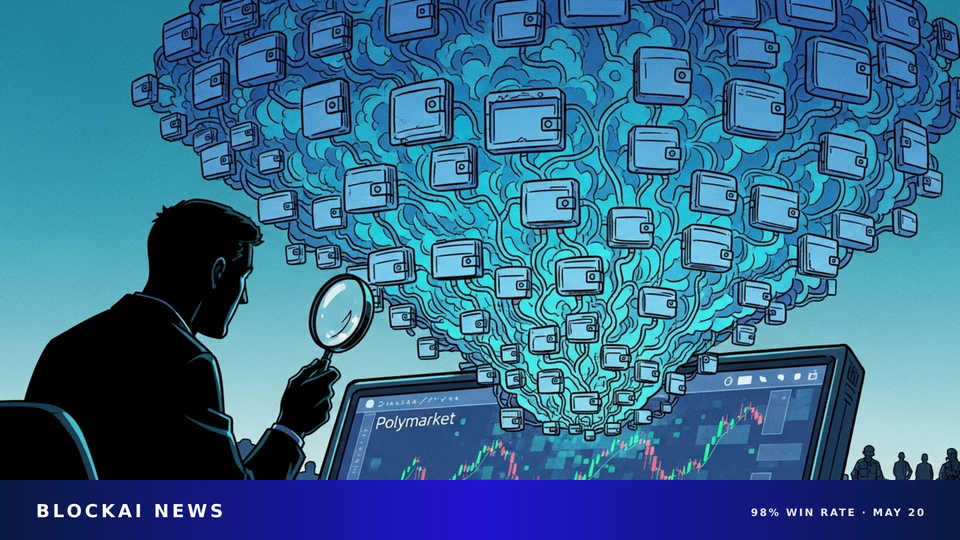
Polymarket integrated Chainalysis's market-integrity stack on April 30 — real-time onchain surveillance, investigative tools that generate blockchain-verified evidence, on-chain threat prevention, and professional services covering detection development and complex investigations. The deal was announced shortly after the U.S. Department of Justice indicted active-duty Army soldier Gannon Ken Van Dyke for using classified intelligence tied to a Nicolás Maduro-related military operation to place 13 bets totaling roughly $33,000 on Polymarket — generating profits of approximately $409,881 after the operation's outcome aligned with his positions.
What Chainalysis is actually deploying
The integration sits on three pieces of the Chainalysis Data Solutions stack. First, Reactor-class investigation tooling, which lets Polymarket's compliance team trace funds across chains and produce blockchain-verified evidence packages suitable for regulator or law-enforcement handoff. Second, on-chain threat prevention, which screens incoming wallets against sanctions lists, fraud signatures, and an institutional risk-scoring layer. Third — and this is the new piece — a detection model trained specifically on prediction-market trading patterns that surfaces irregular activity (concentrated last-minute buys, coordinated wallets, insider-knowledge signatures) in real time. The system monitors Polymarket's blockchain activity continuously and flags anomalies to a compliance team, which then has the workflow tools to investigate and act.
Why this is a category-defining moment for prediction markets
Polymarket has grown explosively in 2026 — weekly trading volume has been at or above $1 billion for most of the year, and the platform is in active CFTC re-onboarding negotiations to allow U.S. retail back onto its main exchange. Until this week, Polymarket was operating with surveillance capability that lagged regulated equity markets by a meaningful margin. The Van Dyke indictment was the public-triggered moment when that gap became politically untenable, but the underlying problem was structural: prediction markets resolve on real-world events, which means insider knowledge from privileged positions (military operations, regulatory decisions, corporate announcements) generates trading signals that look indistinguishable from luck without surveillance tooling. The Chainalysis integration is what brings NYSE-class market integrity standards to a venue that, until now, has operated more like an unregulated derivatives exchange.
The skeptics' read
Three concerns. First, detection model false-positive risk: pattern-based anomaly detection generates flags that need human review, and if Polymarket's compliance team is undersized, legitimate traders may face friction or temporary trading restrictions. Second, cross-jurisdiction enforcement: Chainalysis tooling produces evidence; converting that into civil claw-backs or criminal prosecutions still requires coordination with DOJ, SEC and international regulators, all of whom have different standards. Third, privacy and chilling effects: surveillance at this scale creates a record of every trade and trader on Polymarket, which is incompatible with the venue's earlier crypto-native ethos and may push some sophisticated users to centralized off-shore alternatives.
Why this upgrade matters more for U.S. re-onboarding than for the Van Dyke case itself
The Van Dyke indictment is the catalyst, but the Chainalysis integration is engineered for a different outcome: Polymarket's CFTC re-onboarding to U.S. retail. The platform is currently in active negotiations with the agency to allow U.S. traders back onto its main exchange after a multi-year period of restricted access — and the regulatory ask is, predictably, that Polymarket demonstrate NYSE-comparable market-integrity controls. Until this week, Polymarket's surveillance capability lagged regulated equity markets by a meaningful margin; the Chainalysis stack closes that gap by replicating the kinds of pattern-detection, evidence-generation and threat-prevention tooling that the SEC and FINRA expect from licensed venues.
The structural irony: blockchain-based settlement makes prediction markets easier to surveil at scale, not harder. Every trade is a public on-chain transaction; every wallet is traceable; every funding source is auditable. Equity-market surveillance has to reconstruct trade histories from broker-dealer records and exchange tapes; Polymarket's compliance team can ingest blockchain data directly. If the Chainalysis integration delivers as advertised, it becomes a model that Kalshi, Hyperliquid and Gemini Olympus will need to match — and the U.S. prediction-market category transitions from "less surveilled than NYSE" to "more surveilled than NYSE" within 12 months. That is the regulatory positioning Polymarket is buying.
What to Watch
Three signals over the next 90 days. First public investigation outcome: a published Polymarket compliance report citing a Chainalysis-generated investigation that resulted in account closure or claw-back is the credibility signal. CFTC negotiation progress: any movement on Polymarket's re-onboarding to U.S. retail markets, with the surveillance stack cited as an enabling control, would prove the deal's strategic value. Kalshi and Gemini Olympus response: regulated competitors are likely to publish their own surveillance frameworks — watch for parallel announcements at kalshi.com/integrity and gemini.com/markets. Watch polymarket.com/blog for follow-ups.
Daily Web3 × AI intel, straight to your inbox. Subscribe to BlockAI News.
How we report: This article cites primary sources, regulatory filings, and on-chain data where available. BlockAI News uses AI tools to assist with research and first-draft generation; every article is reviewed and edited by a human editor before publication. Read our full How We Report page, Editorial Policy, AI Use Policy, and Corrections Policy.