NEAR's 14.8% Day: Dynamic Resharding and Post-Quantum Bets on the AI Agent Layer
NEAR Protocol rallied 14.8% in 24h on May 23 as the chain pitched dynamic resharding plus FIPS-204 post-quantum signing as the settlement layer for AI agents. Here's what the upgrade actually does, why agents need it, and what the market just repriced.

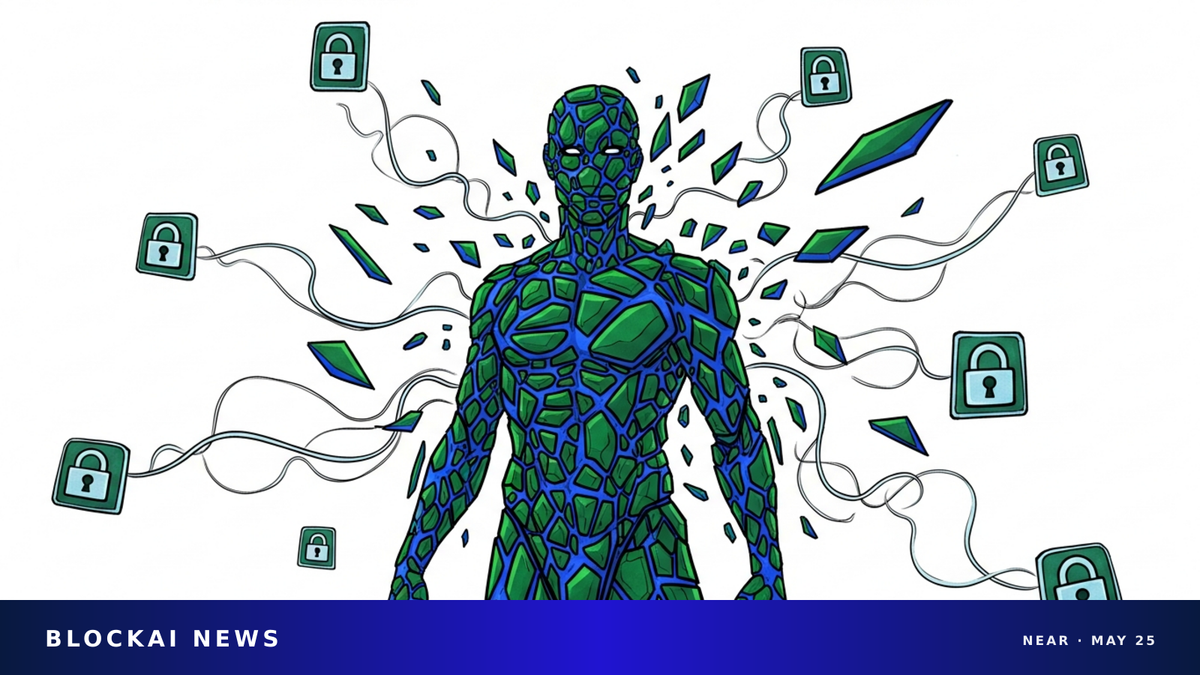
NEAR Protocol spent May 23 doing the one thing every L1 chasing the AI agent narrative has been promising for two years and not delivering: it told the market exactly how it plans to settle bots-trading-with-bots traffic, and the market repriced. NEAR rallied 14.8% in 24 hours after the protocol's May 21 X thread laid out two upgrades shipping together in June — dynamic resharding that splits the network without human votes, and a FIPS-204 post-quantum signing testnet. The pitch: the chain agents actually settle on has to scale on its own and survive the quantum cliff.
TL;DR
- NEAR's network upgrade 2.13 (June 2026) bundles dynamic resharding plus a post-quantum-safe signing testnet using FIPS-204 ML-DSA — the first L1 shipping both in a single release.
- Dynamic resharding lets the chain split shards automatically when one hits a state-size threshold, removing the multi-week validator coordination that has gated past resharding. NEAR's stated long-term ceiling is 70+ shards and 1M+ TPS in test environments.
- NEAR rallied 14.8% on May 23 on a stack of catalysts: the upgrade pitch, a risk-on macro day, and Arthur Hayes naming NEAR in his "holy trinity" altcoin call.
The Resharding Math That Makes Agents Cheap
The case for a chain designed around AI agents is not really about throughput in the abstract. It is about what happens to fees and finality the moment a coordinated swarm of agents decides to do something at once — a flash sale, a market dislocation, an arbitrage window opening across 14 venues. On every L1 still doing manual capacity planning, the agent layer hits a ceiling and prices itself out the moment it becomes interesting.
NEAR's existing sharded architecture, Nightshade 2.0, launched on mainnet in August 2024, separated validators from full state storage and let the network run six shards independently. Adding shards, though, still required validators to coordinate, hold a vote, and wait through governance. It worked, but the cadence — months between expansions — is wrong for a workload that wants more capacity in milliseconds.
Dynamic resharding kills the human bottleneck. Per NEAR Protocol's May 21 X thread, when a shard hits a predefined state-size threshold, it splits deterministically. State witnesses validate the split, and a new shard is live without governance. NEAR's long-term ceiling, repeatedly cited in protocol comms, is 70+ shards — which in December 2025 test environments hit a sustained throughput above 1 million transactions per second.
Dynamic resharding is coming to NEAR.
— NEAR Protocol (@NEARProtocol) May 20, 2026
The upcoming network upgrade will enable the protocol to add shards automatically as demand grows.
This delivers on NEAR's founding vision of building the world's most scalable blockchain protocol at the highest level of performance 🧵 pic.twitter.com/jQU3UC95FY
The Visa comparison is the one NEAR keeps reaching for, and it is not just a marketing number. Visa's published peak capacity sits around 65,000 TPS. A chain that can split itself to outpace card-rail throughput, while keeping per-transaction fees at fractions of a cent, becomes the only credible substrate for the kind of high-frequency agent commerce that enterprise agent platforms like Sierra are quietly designing toward. The same logic underwrites the AP2 agentic commerce protocol announcement at Consensus Miami — agents that pay each other in real-time need rails that do not throttle when adoption spikes.
The competitive frame matters. Solana wins on raw finality (sub-second versus NEAR's roughly two seconds) and has been pulling enterprise distribution wins — Mastercard, Worldpay, Western Union on its developer platform in early 2026. BNB Chain has volume and Binance's distribution. Neither is pitching itself as the chain whose entire scaling thesis bends around what autonomous software agents will need in 2028. NEAR is making the bet that the agent workload is a structurally different traffic pattern from human DeFi, and that building for it now is worth giving up some headline finality.
Why Post-Quantum Matters Before 2030
The post-quantum-safe signing upgrade is the part most market commentary skipped over, and it is the more interesting half of upgrade 2.13. NEAR is implementing FIPS-204 — also known as ML-DSA, or Module-Lattice-Based Digital Signature Algorithm — the standard NIST finalized in August 2024 after a multi-year competition that started life as CRYSTALS-Dilithium.
The mechanism on NEAR is direct. Account holders replace their existing key with a quantum-safe ML-DSA key in a single transaction. The migration also extends quantum-safe Chain Signatures across 35+ external chains, meaning a NEAR account can manage Bitcoin, Ethereum, and Solana assets through signatures that lattice-based cryptanalysis cannot break with currently theorized quantum attacks.
Why does this matter for the AI agent thesis specifically? Two reasons that compound. First, agents hold keys for long horizons. A trading agent funded today and left to run for three years has an exposure window that ordinary users do not — every minute it is online is a minute its signing key is in active use, generating signatures, and (theoretically) accumulating data a future quantum adversary could "harvest now, decrypt later." Second, the institutional buyers most likely to deploy capital through agents — the same ones now using Sygnum's MCP-mediated agent execution at a regulated bank — have explicit post-quantum migration deadlines baked into their compliance roadmaps. NIST's transition guidance pushes the federal target inside 2030. Banks read federal guidance as a floor.
The competitive read is simple: Solana, BNB Chain, and Ethereum have not announced a credible post-quantum signature migration. Ethereum's account abstraction work technically permits ML-DSA at the smart-contract-wallet level, but there is no protocol-level rollout. NEAR is the first major L1 putting it in the core protocol — and bundling it with a scaling release so validators and tooling have to migrate once.
What NEAR's 14.8% Day Was Pricing
The 14.8% 24-hour move on May 23 was overdetermined, which is usually a sign markets are catching up to something they had been wrong about. Three catalysts stacked.
The first was the substance of the upgrade itself. Until May 21, NEAR's AI agent positioning was largely narrative — Illia Polosukhin's keynote references, NEAR Intents as a cross-chain settlement layer, the Confidential GPU Marketplace work. Dynamic resharding plus post-quantum-safe signing changed it from positioning into a shipping roadmap with a June date and a concrete network upgrade number (2.13). Roadmaps with version numbers reprice differently than vision decks.
The second was the macro backdrop. May 23 caught a risk-on rotation as a US-Iran de-escalation headline pulled capital back into AI-linked altcoins. NEAR was sitting in the intersection of two narratives — AI infrastructure and quantum-safe — that made it a natural destination for that rotation.
The third was Arthur Hayes naming NEAR in his "holy trinity" altcoin call alongside Hyperliquid and Zcash. Hayes calls do not move charts on their own anymore, but they reliably trigger short-cover squeezes when they land on a setup the funding rate had been leaning hard against. Per on-chain data, short liquidations stacked into NEAR's move, amplifying what would otherwise have been a 6–8% upgrade reaction into a multi-week rally that took NEAR to a six-month high around $2.32.
The order of catalysts is important for what comes next. The Hayes squeeze and the macro rotation are exogenous and reverse easily. What does not unwind is the upgrade itself. If 2.13 ships in June with dynamic resharding live on mainnet and the post-quantum testnet open for migration, NEAR will have moved the goalposts on what an "AI agent chain" has to ship to even be credible. Every L1 still pitching the narrative without a version number will have to answer for the gap. Watch chains already hosting agent volume: Notion's developer platform and MCP runtime and Bitget's 1M-user AI trading milestone both telegraphed that the agent layer is moving from demos to volume faster than most L1 roadmaps assumed.
Key Takeaways
- The upgrade has a date. NEAR network upgrade 2.13 — dynamic resharding plus post-quantum-safe signing testnet — is targeted for June 2026.
- The agent thesis got a shipping spec. NEAR moved from "we'll be the AI chain" narrative to a roadmap with version numbers, a 70+ shard ceiling, and an ML-DSA migration path.
- Quantum is no longer abstract risk. NEAR is the first major L1 putting FIPS-204 signatures in core protocol, with institutional buyers reading federal 2030 deadlines as compliance floors.
The Bottom Line. Every L1 has spent eighteen months saying it is the AI agent chain. NEAR's May 21 thread is the first time one of them put a network upgrade number, a ship date, and a post-quantum migration path next to the claim. The 14.8% move is the market acknowledging the difference between a narrative and a roadmap. June will tell us whether the roadmap is the same thing as a working chain.
Frequently Asked Questions
What is dynamic resharding on NEAR Protocol?
Dynamic resharding is a NEAR network upgrade where shards split automatically the moment one of them hits a predefined state-size threshold, without validator votes or governance delay. It is shipping as part of network upgrade 2.13, expected in June 2026, and replaces the manual, multi-week resharding process NEAR has used since Nightshade 2.0. State witnesses validate the split deterministically, and a new shard becomes live without governance coordination.
Why is NEAR adding post-quantum cryptography now?
NEAR is adopting FIPS-204 (ML-DSA, formerly CRYSTALS-Dilithium), the lattice-based signature scheme NIST standardized in August 2024. The post-quantum-safe signing testnet is being introduced alongside dynamic resharding in upgrade 2.13. NEAR's argument is that AI agents holding long-lived keys are uniquely exposed to a future cryptographically relevant quantum computer, so the migration has to start before that risk is priced in. The institutional buyers most likely to deploy capital through agents have explicit post-quantum migration deadlines baked into their compliance roadmaps.
Why did NEAR rally 14.8% on May 23, 2026?
Three things stacked. NEAR Protocol's May 21 X announcement of dynamic resharding plus post-quantum signing reframed the chain as an AI agent settlement layer, not a generic L1. A risk-on macro move into AI-linked names followed a US-Iran de-escalation headline. And Arthur Hayes named NEAR in his 'holy trinity' altcoin call, triggering a short-cover squeeze that compounded the 14.8% 24-hour move into a multi-week 50% rally.
Reviewed by Jason Lee, Founder & Editor-in-Chief, BlockAI News.
Sources
Primary sources
- NEAR Protocol on X — dynamic resharding announcement (May 21, 2026)
- NEAR Protocol on X — network upgrade 2.13 post-quantum-safe signing
- NEAR Protocol blog — Nightshade 2.0 launches on mainnet
- NIST FIPS-204 — Module-Lattice-Based Digital Signature Standard
- Illia Polosukhin (@ilblackdragon) on X — NEAR co-founder
From BlockAI News
- Sygnum's MCP-mediated AI agent execution at a regulated bank
- Sierra's $950M raise at $15.8B valuation
- Notion's developer platform + AI agent runtime + MCP
- Bitget AI trading hits 1M users, $1.2B volume
- PayPal × Google AP2 agentic commerce protocol
How we report: This article cites primary sources, regulatory filings, and on-chain data where available. BlockAI News uses AI tools to assist with research and first-draft generation; every article is reviewed and edited by a human editor before publication. Read our full How We Report page, Editorial Policy, AI Use Policy, and Corrections Policy.