Hermes Agent Hits 97,000 GitHub Stars in 8 Weeks — And Its Web3 DNA Could Change the AI Agent Landscape
Hermes Agent by Nous Research has hit 97,000 GitHub stars in 8 weeks. Behind the numbers is a Web3-native AI lab backed by Paradigm and a16z — and an unresolved token question the crypto community can't stop talking about.

In Brief
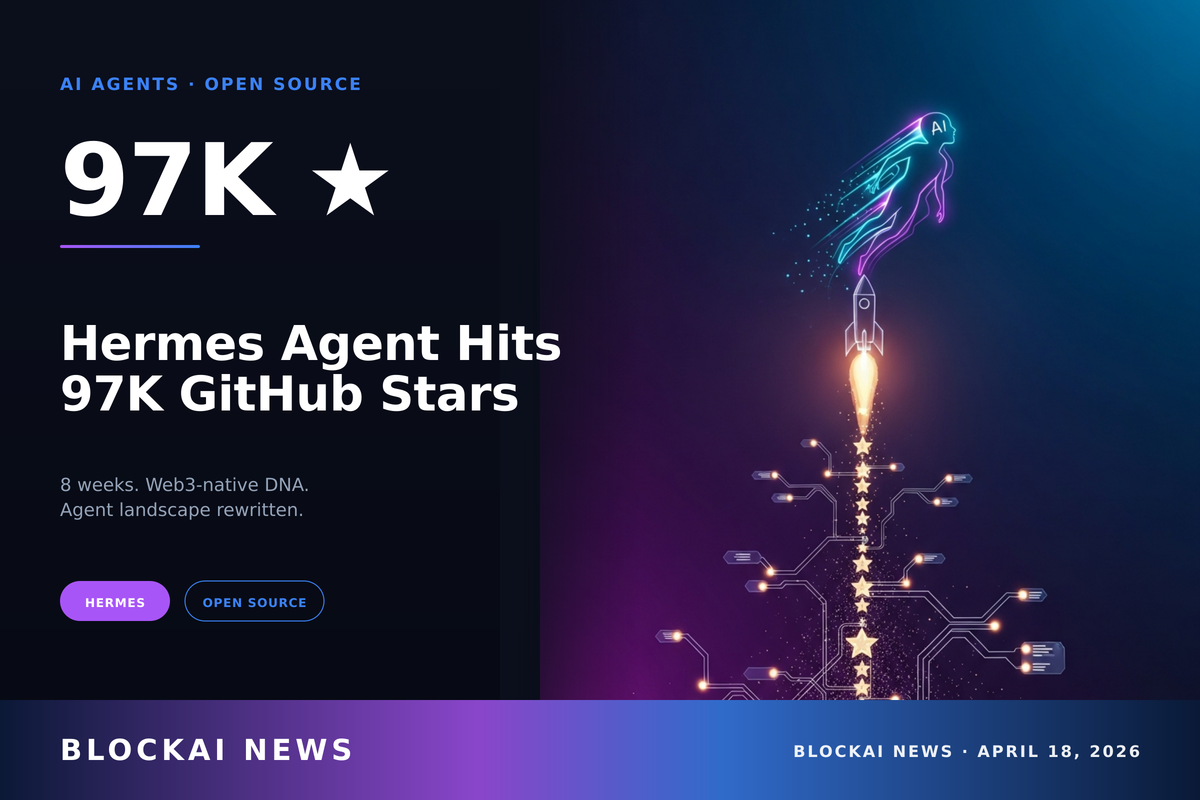
- Hermes Agent, an open-source AI agent framework by Nous Research, has accumulated over 97,000 GitHub stars in just 8 weeks — one of the fastest-growing open-source projects in 2026.
- The team behind it has deep Web3 roots: CEO Jeffrey Quesnelle previously led Ethereum MEV infrastructure at Eden Network, and the project has raised $70M from crypto-native investors, including Paradigm and a16z.
- Hermes runs locally, learns from every interaction, and supports 16 platforms, including iMessage and WeChat — positioning it as a persistent personal AI agent, not just another chatbot.
In early 2026, GitHub's trending list became a reliable signal for what the developer community actually cares about. And for the past six weeks, one project has dominated it: Hermes Agent, an open-source AI agent framework built by Nous Research.
The numbers are hard to ignore. Since its release in late February 2026, Hermes Agent has accumulated over 97,000 GitHub stars — a milestone that puts it in the top 0.0014% of all open-source projects ever. On April 8 alone, following the release of version v0.8.0, the project added over 6,400 stars in a single day.
But what makes Hermes genuinely interesting for the Web3 × AI space isn't just the star count. It's who built it, and why.
What Hermes Agent Actually Does
Hermes Agent is not a coding assistant or a chatbot wrapper. It is a persistent, self-improving AI agent that runs locally on your device and learns from every interaction.
The core premise: most AI agents today are stateless — every conversation starts from zero. Hermes breaks that pattern by building a continuous memory system across sessions. It extracts skills from completed tasks, remembers user preferences, and gets meaningfully better over time as you use it.
As of v0.9.0 (released April 13, 2026), Hermes supports 16 platforms, including iMessage, WeChat, and Android via Termux. It also ships a local web dashboard for managing your agent without touching configuration files, and a Fast Mode that routes requests through priority queues for OpenAI and Anthropic models — including GPT-5.4 and Claude.
Meet Hermes Agent, the open source agent that grows with you.
— Nous Research (@NousResearch) February 25, 2026
Hermes Agent remembers what it learns and gets more capable over time, with a multi-level memory system and persistent dedicated machine access. pic.twitter.com/Xe55wBbUuo
The Web3 DNA That Wall Street Missed
Here is what most mainstream tech coverage has overlooked: Hermes Agent is not a Silicon Valley story. It's a Web3 story.
Nous Research CEO Jeffrey Quesnelle was previously the lead engineer at Eden Network, an Ethereum MEV infrastructure project. The organization raised approximately $70 million across two funding rounds — both priced in tokens rather than traditional equity, with backing from Paradigm and a16z, two of the most prominent crypto-native venture firms in the world.
The implications are significant. Nous Research was built with a decentralized-first philosophy: open-source code, community-driven development, and distributed model training. These aren't just product choices — they're structural commitments that reflect a Web3-native approach to building AI infrastructure.
The Token Question No One Can Answer Yet
Perhaps the most consequential question hanging over Hermes Agent is one that Nous Research has pointedly refused to answer: will there be a token?
As of April 2026, the organization remains in a "no token issued" state with no announced distribution mechanism. But the Web3 community has already begun speculating. Unofficial "NOUS" tokens have appeared on-chain. Third-party platforms are incentivizing community participation with hints of potential rewards. On Crypto Twitter, discussions of anticipated airdrops have become a regular fixture in Hermes-related threads.
None of this is confirmed. Nous Research has not commented on tokenization plans. But the structural characteristics of Hermes — local execution, persistent behavioral data, measurable user contributions — read like the foundation of a tokenized incentive system to anyone fluent in Web3 mechanics.
For the crypto community, the question isn't whether a token will come. It's when, and what the distribution will look like.
Introducing the Nous Portal Tool Gateway, one login to access over 400 LLMs and power all core tools in Hermes Agent.
— Teknium (e/λ) (@Teknium) April 16, 2026
Check it out below! https://t.co/vX3WHjnpQf
Why This Matters for Web3 Builders
For developers in the Web3 × AI space, Hermes represents something more important than another trending GitHub repo. It's a proof of concept that the infrastructure assumptions of Web3 — decentralized governance, open-source code, community-driven incentives — can be applied to AI agent development at scale.
If Hermes does eventually tokenize, it would create one of the first cases where persistent agent usage directly translates into verifiable on-chain contributions. Your agent's work history becomes an asset. The time you spend training it becomes equity.
That's a fundamentally different model from the subscription-based, platform-controlled AI products that currently dominate the market. And it's a model that the crypto community, with its experience in token incentive design and decentralized coordination, is uniquely positioned to build and benefit from.
Bottom Line
Hermes Agent is a genuinely useful product that happens to have deep Web3 roots. Its rise on GitHub is real — driven by developer demand for persistent, locally-run agents that actually improve over time. The Web3 backing from Paradigm and a16z gives it structural credibility that pure-AI projects often lack. And the unresolved token question makes it one of the most closely watched projects at the AI × crypto intersection heading into the second half of 2026.
Whether or not a token materializes, Hermes is already reshaping how developers think about what an AI agent can be.
Sources
- Nous Research official: https://hermes-agent.nousresearch.com/
- GitHub repository: https://github.com/NousResearch/hermes-agent
- Release notes v0.9.0: https://github.com/NousResearch/hermes-agent/releases
- Hermes Atlas community report: https://hermesatlas.com/reports/state-of-hermes-april-2026
Stay ahead of Web3 × AI. Get daily insights on the intersection of AI and blockchain, delivered to your inbox.
How we report: This article cites primary sources, regulatory filings, and on-chain data where available. BlockAI News uses AI tools to assist with research and first-draft generation; every article is reviewed and edited by a human editor before publication. Read our full How We Report page, Editorial Policy, AI Use Policy, and Corrections Policy.