
Anthropic Releases Claude Opus 4.7: What It Means for Web3 Developers and AI Agent Projects
Anthropic's new Claude Opus 4.7 delivers stronger agentic coding, better self-verification, and new cost-control tools — at the same price as Opus 4.6. Here's what it means for Web3 teams running AI agents.

In Brief
- Anthropic released Claude Opus 4.7 on April 16, delivering a 13% improvement in coding task resolution over Opus 4.6 and stronger long-running agentic execution.
- New features including "xhigh" effort levels and task budgets give developers finer control over reasoning depth and compute cost — directly relevant for Web3 teams running AI agents in production.
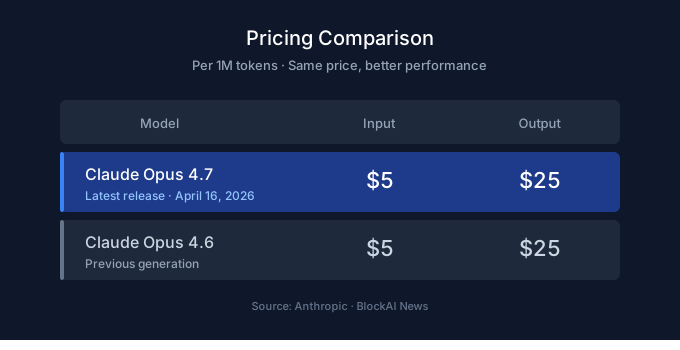
- Pricing stays the same at $5 per million input tokens and $25 per million output tokens, making it a drop-in upgrade for projects already on the Claude API.
On April 16, Anthropic released Claude Opus 4.7, the latest upgrade to its flagship model, bringing meaningful improvements to agentic coding, vision processing, and long-running task execution. For developers building AI-powered applications on Web3 infrastructure, the release introduces several capabilities worth close attention.
Introducing Claude Opus 4.7, our most capable Opus model yet.
— Claude (@claudeai) April 16, 2026
It handles long-running tasks with more rigor, follows instructions more precisely, and verifies its own outputs before reporting back.
You can hand off your hardest work with less supervision. pic.twitter.com/PtlRdpQcG5
What's New in Opus 4.7
The headline upgrade is software engineering performance. Anthropic says users can now hand off their hardest coding work — the kind that previously needed close supervision — to Opus 4.7 with confidence. On Anthropic's internal 93-task coding benchmark, Opus 4.7 delivered a 13% improvement in resolution over Opus 4.6, including solving four tasks that neither Opus 4.6 nor Sonnet 4.6 could crack.
Vision capability also received a major upgrade. Opus 4.7 processes images at resolutions up to 2,576 pixels on the long edge, representing more than three times the capacity of prior Claude models. For projects working with on-chain data visualisations or complex protocol documentation, this opens up new possibilities.
Two new developer tools stand out. A new effort level called "xhigh" has been introduced, sitting between the existing high and max settings, giving users more granular control over the tradeoff between reasoning depth and response speed. Additionally, task budgets are now available in public beta for API users, allowing developers to set constraints on how much reasoning Claude applies to longer tasks — directly relevant to anyone running cost-sensitive agentic workflows.
Why This Matters for Web3 × AI Projects
The improvements to agentic execution are the most directly relevant to the Web3 space. Projects building AI agents that interact with smart contracts, execute on-chain transactions, or manage multi-step DeFi workflows depend on models that can run reliably without constant human oversight. Opus 4.7's gains in instruction-following and self-verification — the model now devises ways to verify its own outputs before reporting back — reduce the risk of errors in autonomous execution contexts.
The new task budgets feature is particularly interesting for Web3 developers working with cost constraints. Gas fees and API costs both add up quickly in production environments. Having finer control over how much compute Claude spends on each reasoning step gives developers a practical lever to manage costs without entirely sacrificing output quality.
Memory improvements are also worth noting. Opus 4.7 is better at using file system-based memory, remembering important notes across long, multi-session work — a capability that matters for AI agents designed to manage ongoing protocol interactions or track evolving on-chain states over time.
The Mythos Question
Anthropic publicly conceded that Opus 4.7 does not match the performance of Mythos Preview, a highly advanced system the company hasn't released to the public due to safety concerns. For most developers, this won't be a practical limitation — Opus 4.7 remains the most capable generally available Claude model, and the gap to Mythos is unlikely to affect typical Web3 development workflows.
Pricing remains the same as Opus 4.6: $5 per million input tokens and $25 per million output tokens. The model is available via the Claude API, Amazon Bedrock, Google Cloud Vertex AI, and Microsoft Foundry.
Bottom Line
For Web3 teams evaluating AI models for agent infrastructure, Opus 4.7 is a meaningful step forward. The combination of stronger agentic execution, better self-verification, and new cost-control tools makes it a more practical choice for production deployments than its predecessor. Whether it's enough to shift projects already committed to competing models is a separate question — but for teams still evaluating their stack, it's worth testing.
Stay ahead of Web3 × AI. Get daily insights on the intersection of AI and blockchain, delivered to your inbox.
How we report: This article cites primary sources, regulatory filings, and on-chain data where available. BlockAI News uses AI tools to assist with research and first-draft generation; every article is reviewed and edited by a human editor before publication. Read our full How We Report page, Editorial Policy, AI Use Policy, and Corrections Policy.