The Agentic Wallet Race Is On: Cobo Launches AI-Native Wallet for 80+ Chains
Cobo just launched an AI-native wallet supporting 80+ blockchains, escalating an agentic wallet race that Coinbase opened in February. Inside the three launches in 70 days that built the production stack for autonomous on-chain AI — and the security gap nobody has solved.

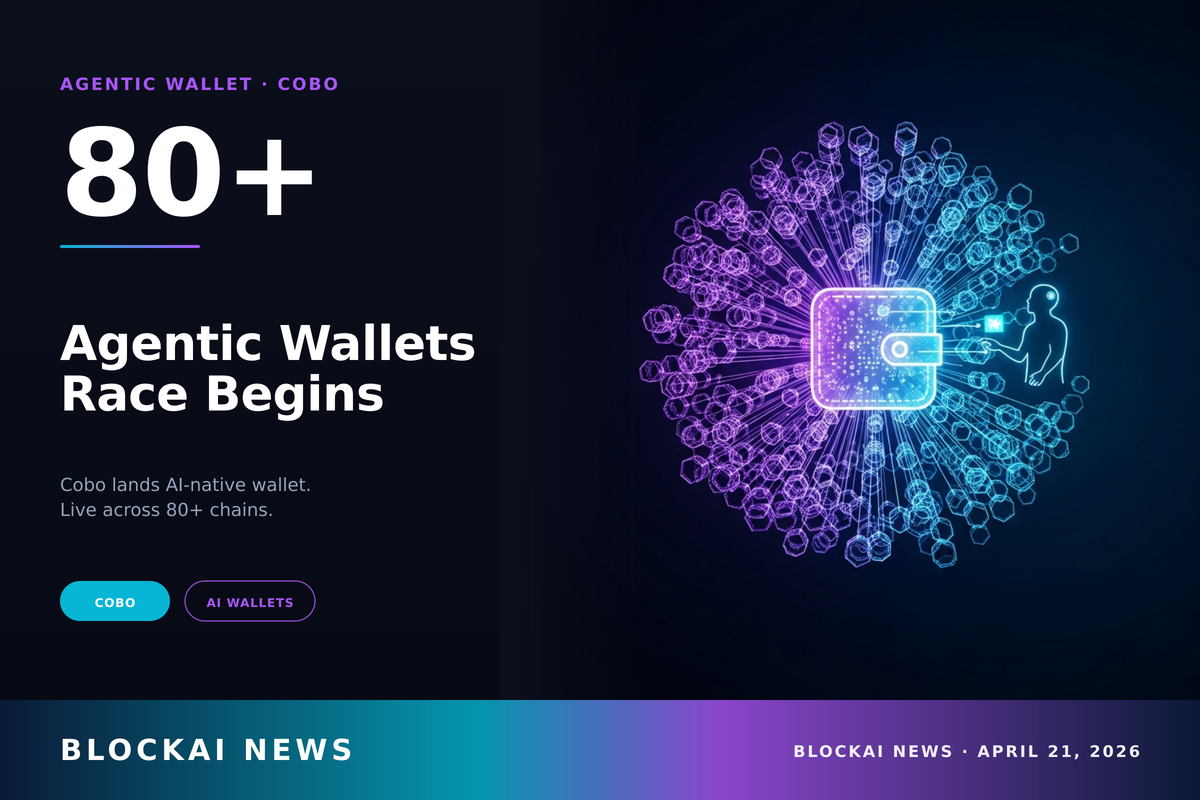
On April 20, Cobo — the institutional crypto custody platform managing wallets for funds, exchanges, and Web3 startups — launched its Agentic Wallet, a wallet purpose-built for autonomous AI agents to execute on-chain transactions across more than 80 blockchains, including Ethereum, BNB Chain, Arbitrum, and Solana.
It is the second major agentic wallet launch from a top-tier crypto firm in less than three months. Coinbase shipped its own Agentic Wallets on February 11. And on April 8, Anthropic released Claude Managed Agents — a fully managed cloud agent runtime priced at $0.08 per session-hour, already deployed in production by Notion, Rakuten, Asana, and Atlassian.
Three launches. One emerging stack. The frontier of crypto in 2026 is no longer about humans signing transactions. It is about giving AI the keys.
What Cobo just shipped
Cobo’s Agentic Wallet is targeted at a specific bottleneck: developers building AI-powered DeFi tools currently have to glue together custody, gas management, transaction signing, and chain-specific RPCs themselves — then fight ongoing key-rotation and security audits. Cobo’s pitch is that its existing institutional custody infrastructure can absorb all of that complexity behind a single API.
Key technical claims from the launch:
- 80+ chains supported out of the box, including Ethereum, BNB Chain, Arbitrum, Solana, plus Cosmos and Bitcoin L2s.
- MPC-secured key management — inheriting the same cryptographic architecture Cobo uses for its institutional custody clients.
- Programmable policy engine — spending caps, allow-listed counterparties, and time-bound session permissions, all enforceable before a transaction is signed.
- Native AI integration — the wallet exposes its capabilities as tools that LLM agents (Claude, GPT, open-source models) can invoke directly.
Coinbase opened the race in February
When Coinbase launched Agentic Wallets on February 11, 2026, it framed the product around a payments protocol it had been quietly building called x402 — a standard for machine-to-machine payments that, per Coinbase’s own numbers, has already been battle-tested with over 50 million transactions.
Coinbase’s product gave AI agents five composable building blocks: Authenticate, Fund, Send, Trade, and Earn. Behind those primitives sit programmable spending limits (per-session and per-transaction caps), enclave isolation that keeps private keys inside Coinbase infrastructure, and built-in KYT (Know Your Transaction) compliance screening.
In other words, Coinbase published a reference design for what an AI-native crypto wallet looks like. Cobo’s April 20 launch is the first credible competitor built specifically to challenge it on multi-chain breadth — Coinbase’s wallet is heavily Base/Ethereum-weighted, while Cobo leads with chain-agnostic coverage.
And Anthropic just gave every developer the agent runtime
The third leg of the stack is the agent itself — the actual AI that sits between user intent and wallet execution. Until April this year, building production-grade agents meant writing your own orchestration layer, sandboxing, error recovery, and session state. That changed on April 8, when Anthropic shipped Claude Managed Agents in public beta.
From Anthropic’s announcement and confirmed details:
- Pricing: $0.08 per session-hour of active runtime, on top of standard Claude API token costs.
- What it handles for you: isolated sandboxed containers, code execution, web browsing, file operations, scoped permissions, and session continuity across long-running tasks.
- Production users at launch: Notion (Custom Agents, private alpha), Rakuten (cross-department enterprise agents), Asana (AI Teammates), Atlassian (Jira agent), Sentry (debugging and patch generation), Vibecode (AI-native app deployment).
- Performance claim: up to a 10-point improvement on structured file generation tasks vs. standard prompting.
Wire any of these together with Cobo or Coinbase’s wallet APIs and you have, for the first time, a turnkey stack for autonomous on-chain AI: Claude does the thinking, the wallet does the spending, and the developer barely writes glue code.
Why this is happening now
Three forces converged in Q1 2026:
1. AI agents are already moving real money
AI-powered trading bots reportedly account for roughly 58% of total crypto trading volume in 2026. The infrastructure question stopped being theoretical the moment that share crossed a majority. If most volume is already algorithmic, every exchange, custodian, and wallet provider has a commercial incentive to make agentic flows a first-class product instead of a hack.
2. The x402 standard gave the industry a shared payments rail
Coinbase’s 50M+ x402 transactions in roughly a year created the first real proof point that machine-to-machine micropayments work at scale. That removed the chicken-and-egg problem for downstream products like Cobo’s.
3. Big tech has joined the party
Ant Group also rolled out an AI-agent crypto transaction platform in April, signaling that the agentic-wallet thesis is no longer a crypto-native bet — it is a category that traditional fintech giants now want exposure to.
The unsolved problem: security
Researchers have been waving red flags for months. In Cobo's Agentic Wallet, security researchers warned that intermediary systems handling AI agent requests can read and modify data in transit — a class of attack that, in the worst case, exposes private keys and enables downstream attacks at scale.
All three of the products above try to address this differently:
- Coinbase keeps keys inside its own enclaves and adds KYT screening at the transaction layer.
- Cobo uses MPC so no single party (including the AI) ever holds a complete private key.
- Anthropic isolates each agent session in its own sandboxed container with scoped permissions.
None of these eliminate the core risk. They reduce blast radius. The first significant agentic-wallet exploit — and there will be one — will likely come from the seams between these layers: a Claude session calling a Cobo API with a prompt-injected instruction, or a malicious MCP server pretending to be a legitimate tool. The industry has not built the audit tools for this attack surface yet.
What to watch next
- Cobo × Coinbase market split — will developers consolidate on Coinbase’s Base-centric stack, or will Cobo’s 80-chain coverage win the multi-chain DeFi crowd?
- First production agent at scale — still no consumer-facing AI agent has crossed $100M in monthly on-chain volume. Whoever does it first effectively defines the category.
- A regulator response — the SEC, CFTC, and EU’s MiCA framework all currently assume a human signs every transaction. That assumption breaks the moment agents settle even a fraction of trading volume autonomously.
- The first major exploit — not if, but when. The post-mortem will reshape security standards for the entire stack.
The bottom line
Three months ago, agentic wallet was a pitch deck phrase. Today there are two production-grade implementations from top-three institutional players, a managed agent runtime from the lab that builds Claude, and a fintech giant in Hangzhou shipping its own version. The infrastructure layer for autonomous on-chain AI just got built — in public, in three months, by companies that compete with each other.
Whoever owns the wallet that AI agents use to spend money will own one of the most valuable surfaces in crypto. The race is on.
Sources
Coinbase — Introducing Agentic Wallets (February 11, 2026)
Cobo's Agentic Wallet (April 20, 2026)
Anthropic — Claude Managed Agents (April 8, 2026)
Ant Group Platform Lets AI Agents Make Crypto Transactions — PYMNTS
Cobo's Agentic Wallet (April 13, 2026)
Want more Web3 × AI security coverage like this? Join our Telegram community for real-time alerts on the biggest exploits, funding rounds, and AI breakthroughs in the space.
How we report: This article cites primary sources, regulatory filings, and on-chain data where available. BlockAI News uses AI tools to assist with research and first-draft generation; every article is reviewed and edited by a human editor before publication. Read our full How We Report page, Editorial Policy, AI Use Policy, and Corrections Policy.