OpenGradient Raises $9.5M to Build the Compute Layer for Verifiable AI — Backed by a16z Crypto and Coinbase Ventures
OpenGradient raises $9.5M led by a16z crypto and Coinbase Ventures to build a decentralized compute layer for verifiable AI — where every inference comes with cryptographic proof, auditable on-chain.


In Brief
- OpenGradient announced $9.5M in total funding on April 14, 2026
- Led by a16z crypto, with Coinbase Ventures, SV Angel, and Foresight Ventures participating
- Angel investors include Balaji Srinivasan (ex-Coinbase CTO) and Sandeep Nailwal (Polygon co-founder)
- The network has processed over 2 million verifiable inferences and generated 500,000+ cryptographic proofs
- $OPG Token Generation Event scheduled for April 21, 2026
The question of whether AI can be trusted is one of the defining challenges of this decade. OpenGradient thinks the answer lies on-chain.
On April 14, 2026, the New York-based startup announced $9.5 million in total funding to scale its network for open, auditable AI model execution. The round was led by a16z crypto, with participation from Coinbase Ventures, SV Angel, Foresight Ventures, Pragma, SALT, Symbolic Capital, Canonical Crypto, Black Dragon, NEAR, Celestia, and Thanefield Capital.
The angel investor list reads like a who's who of crypto infrastructure: Balaji Srinivasan (former Coinbase CTO), Illia Polosukhin (NEAR co-founder), Sandeep Nailwal (Polygon co-founder), Bruno Faviero (Magna), and Ryan Watkins of Syncracy Capital, among others.
What OpenGradient Actually Builds
OpenGradient positions itself as the "compute layer for verifiable AI" — an infrastructure that doesn't just run AI models, but proves they ran correctly.
Rather than functioning as a standalone blockchain, OpenGradient operates as a specialized AI coprocessor. Applications, blockchains, or AI agents can outsource computationally heavy tasks to their network of GPU and Trusted Execution Environment (TEE) nodes. Every inference comes with a cryptographic proof attached — allowing downstream applications to independently verify what model ran, on what input, and what it returned.
Think of it as a public audit trail for AI decisions, built directly into the infrastructure layer. The network currently hosts over 2,000 AI models from more than 100 developers, has processed 2 million+ verifiable inferences, and generated 500,000+ cryptographic proofs.
"The AI stack is consolidating around a handful of closed providers, and the applications being built on top have no way to audit what's running underneath. We're building the open alternative — infrastructure where models are inspectable, execution is provable, and developers own the intelligence their products depend on."
— Matthew Wang, Co-founder & CEO, OpenGradient
 OpenGradient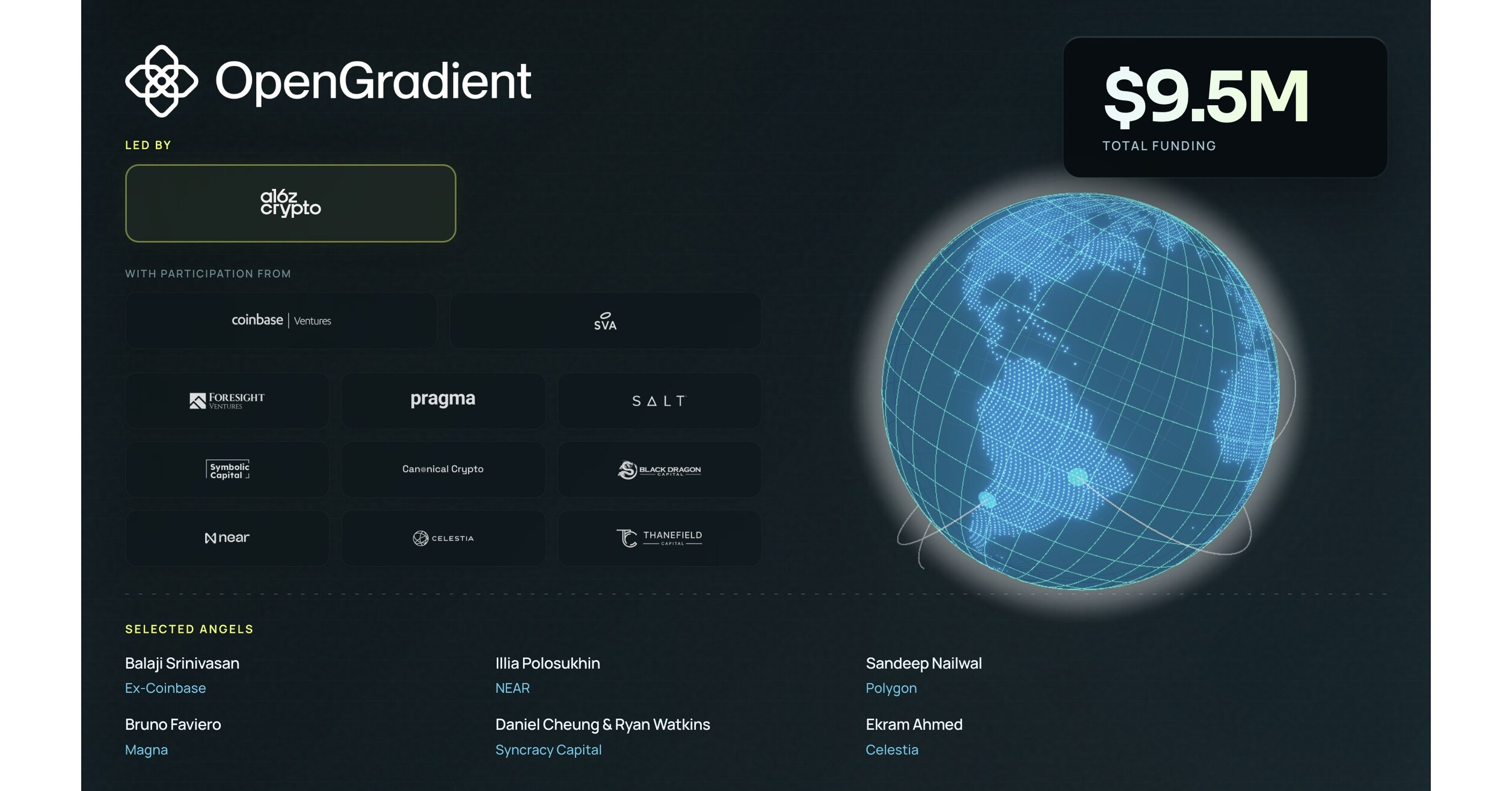
Why This Matters for Web3
The timing is no accident. As AI agents increasingly manage crypto wallets, execute on-chain transactions, and participate in DeFi protocols, the question of accountability becomes critical. If an AI agent moves funds autonomously, who verifies that it did what it was supposed to do?
OpenGradient's answer is cryptographic proof — verifiable on-chain, accessible to anyone. Its current stack includes three layers:
- Verifiable Inference Network — attaches cryptographic proofs to every AI inference
- Decentralized Model Hub — an on-chain repository with 2,000+ models that developers can publish and monetize
- Developer Tooling — lets applications use AI with guarantees around execution, provenance, and monetization
The Bigger Picture
This round reflects a broader trend in the Web3 × AI space. According to Binance Research, 40 cents of every crypto venture capital dollar in 2025 went to AI-focused firms — more than double the 18 cents the year before. Total crypto VC reached $7.9 billion in 2025, up 44% year-over-year.
AI Share of Crypto VC Funding
2025 AI share
40%
vs 2024
+122%
Total crypto VC 2025
$7.9B
Source: Binance Research, 2026
Projects like Nava (which raised $8.3M the same week) are tackling the trust problem at the transaction layer. OpenGradient is going deeper — building the compute foundation that makes AI outputs provable by design.
One More Thing: $OPG Token
Readers following OpenGradient's testnet should note: the project's $OPG token airdrop registration is live, with the Token Generation Event (TGE) scheduled for April 21, 2026. Season 1 eligible activities include community campaigns, Model Hub contributions, and testnet participation. Claims remain open through April 28.
This is not financial advice. Always do your own research.
Sources
- OpenGradient official website — opengradient.ai
- OpenGradient press release — PR Newswire, April 14, 2026
- Binance Research: AI share of crypto VC, 2025
- a16z crypto portfolio — a16zcrypto.com
- OpenGradient Model Hub — hub.opengradient.ai
Stay ahead of Web3 × AI. Get daily insights on the intersection of AI and blockchain, delivered to your inbox.
How we report: This article cites primary sources, regulatory filings, and on-chain data where available. BlockAI News uses AI tools to assist with research and first-draft generation; every article is reviewed and edited by a human editor before publication. Read our full How We Report page, Editorial Policy, AI Use Policy, and Corrections Policy.