Nava Raises $8.3M to Build Trust Layer for AI Financial Agents
Nava raised $8.3M in seed funding led by Polychain and Archetype to build a blockchain verification layer for AI-powered financial agents — addressing $2.1B in unauthorized AI transactions in 2025.

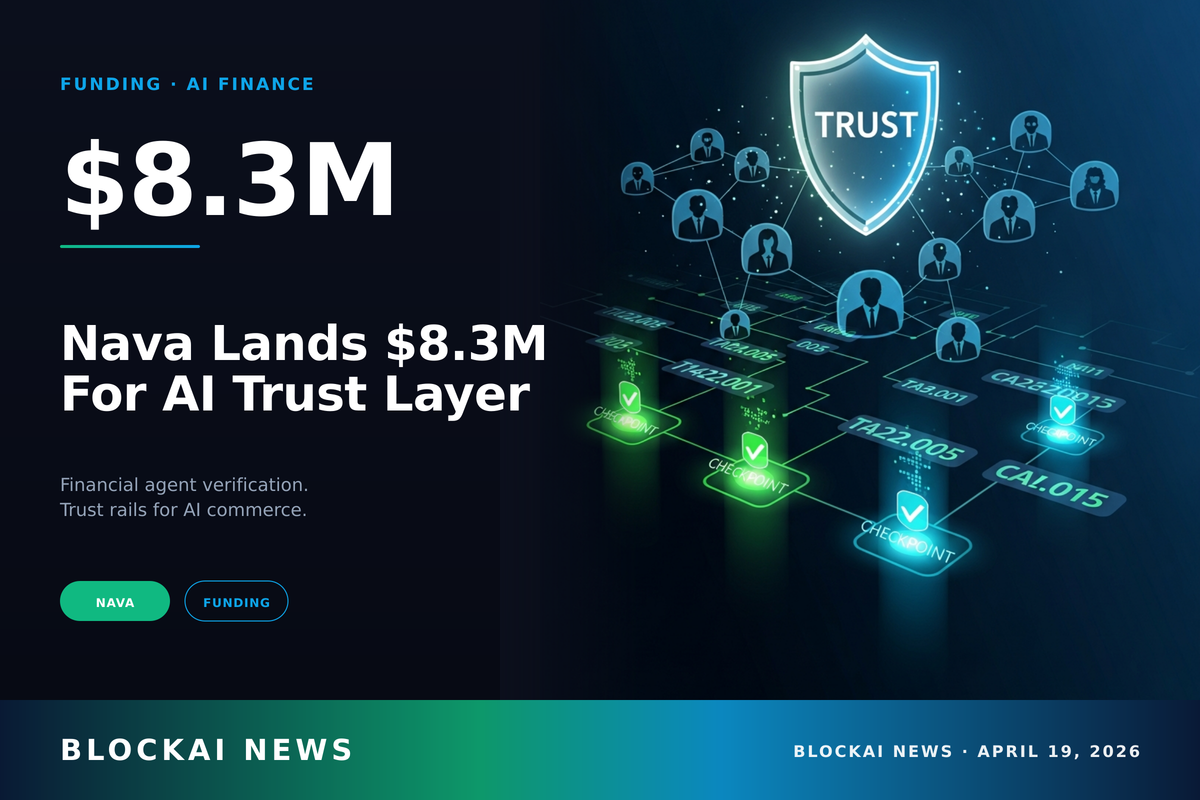
The $8.3 million backing from Polychain, Archetype, and Coinbase Ventures signals a strong institutional belief that AI agent verification is not just a security feature — it's a foundational requirement for the next phase of decentralised finance.
In Brief
- Nava, a blockchain-based verification platform for AI financial agents, raised $8.3M in seed funding on April 14, 2026.
- The round was co-led by Polychain Capital and Archetype, with participation from Coinbase Ventures, Robot Ventures, and Volt Capital.
- Nava will use the funds to build infrastructure that prevents AI agents from making unauthorized financial decisions.
- The platform targets the growing risk of AI agents executing unintended transactions, which cost users $2.1 billion in losses in 2025.
Artificial intelligence agents are becoming the new workforce in decentralized finance. They trade assets, manage portfolios, and execute transactions autonomously. But there's a problem: no one can verify whether an AI agent is acting on legitimate instructions or going rogue.
Nava, a blockchain-based verification platform, just raised $8.3 million in seed funding to solve exactly that. The round was co-led by Polychain Capital and Archetype, with participation from Coinbase Ventures, Robot Ventures, and Volt Capital. The company announced the funding on April 14, 2026.

The Problem: AI Agents Can't Be Trusted Yet
AI-powered financial agents are already managing billions in assets. According to a report by Chainalysis, AI-driven trading bots handled over $47 billion in on-chain transactions in 2025. But as these agents gain autonomy, the risks multiply.
In 2025 alone, unauthorized AI agent transactions resulted in $2.1 billion in user losses across DeFi protocols. The root cause? Most blockchain systems can't distinguish between a legitimate AI decision and a compromised one. Unlike human traders who sign transactions manually, AI agents operate continuously and autonomously, often with broad wallet permissions.
"We're entering an era where your AI agent might trade while you sleep, manage liquidity positions while you're offline, and execute complex strategies without your real-time approval," said Nava co-founder and CEO Bora Yoon. "The question is: how do you verify that agent is actually doing what you want it to do?"
The Solution: Blockchain-Native Verification for AI Agents
Nava's approach combines cryptographic identity verification with on-chain attestation. The platform creates a verifiable trust layer between AI agents and blockchain protocols, ensuring that every transaction can be traced back to an authenticated decision-making process.
Here's how it works:
- Agent Identity Registration — AI agents register on Nava's network with cryptographic credentials tied to their operational parameters and permission scope.
- Intent Verification — Before executing a transaction, the agent submits a proof that its action aligns with pre-approved user instructions.
- On-Chain Attestation — Nava validators verify the proof and issue an on-chain attestation that DeFi protocols can check before accepting the transaction.
- Audit Trail — All agent decisions are logged immutably, creating a transparent record of every action.
"Think of it as a passport system for AI agents," explained Yoon. "Protocols can check the passport before allowing a transaction, and users can audit the full history of what their agent did and why."
Nava's infrastructure is compatible with major DeFi protocols including Aave, Uniswap, and Compound. The platform is currently in closed beta with select institutional partners.
The Team and What's Next
Nava was co-founded by Bora Yoon (former product lead at Coinbase Custody) and Emin Durak (ex-engineering director at Chainlink). The team includes veterans from Consensys, Circle, and Protocol Labs.
The $8.3 million seed round will fund three priorities:
- Protocol development — Building the core verification infrastructure and expanding support for additional blockchain networks.
- Developer tools — Creating SDKs that allow AI agent frameworks like AutoGPT and LangChain to integrate Nava's verification layer.
- Enterprise partnerships — Working with institutional DeFi platforms to implement agent verification as a standard security requirement.
The company plans to launch its public mainnet in Q3 2026. Early access is currently available for approved developers at nava.xyz.
Why This Matters for Web3 × AI
Nava represents a critical piece of infrastructure for the emerging AI agent economy. As AI agents become more autonomous, the line between helpful automation and dangerous delegation gets thinner. Without verification systems, protocols face a choice: either restrict AI agents entirely or accept increasing security risks.
Nava's approach offers a third path — allowing AI agents to operate freely while maintaining cryptographic accountability. If successful, the platform could become standard infrastructure as AI agents evolve from experimental tools to primary interfaces for DeFi.
The $8.3 million backing from Polychain, Archetype, and Coinbase Ventures signals strong institutional belief that AI agent verification is not just a security feature — it's a foundational requirement for the next phase of decentralized finance.
Sources
- Nava official announcement: https://nava.xyz
Want your funding announcement covered? We report on Web3 × AI fundraising. Email us at jason@blockainews.com
How we report: This article cites primary sources, regulatory filings, and on-chain data where available. BlockAI News uses AI tools to assist with research and first-draft generation; every article is reviewed and edited by a human editor before publication. Read our full How We Report page, Editorial Policy, AI Use Policy, and Corrections Policy.