Solana Won the AI Payment Layer — Here's How Five Institutions Confirmed It in One Day
Five institutions, five products, one blockchain, one day. On May 5, Cloudflare, Google Cloud, State Street, Western Union, SoFi, and MoonPay all chose Solana for AI agent payments — independently. Here is what each launched and why Solana won.

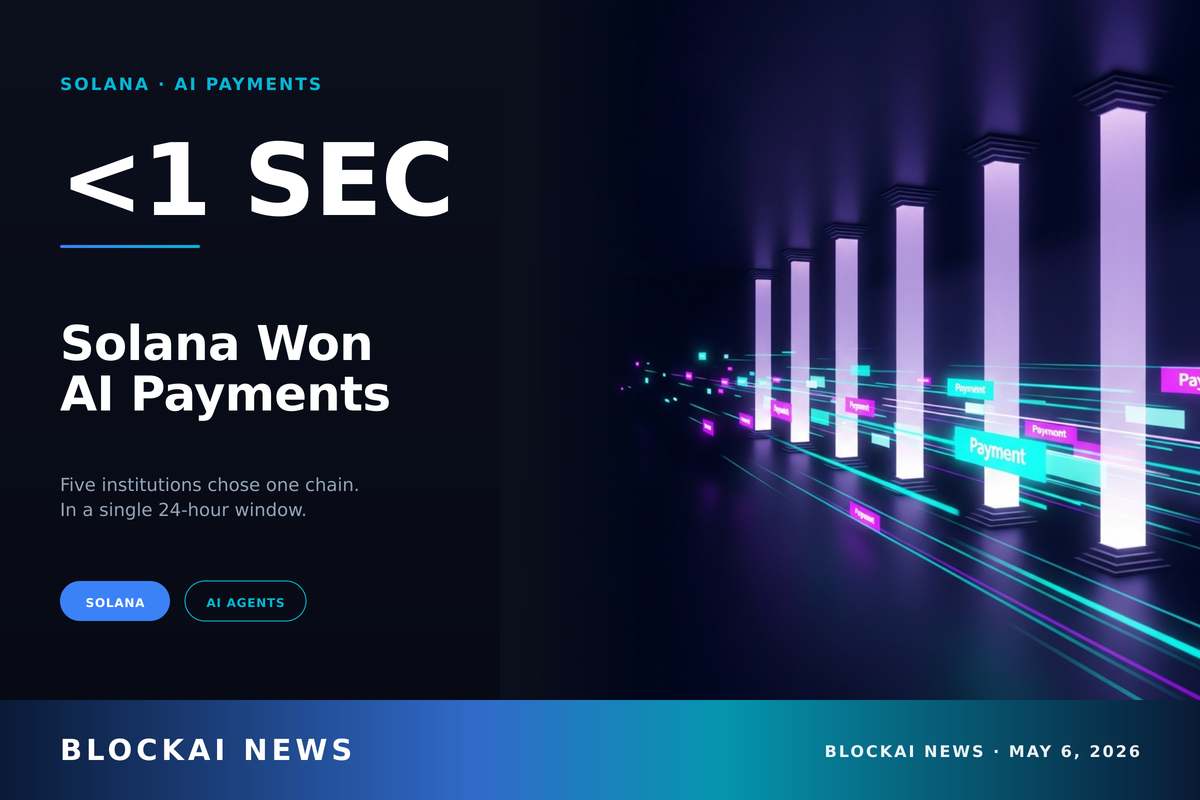
Five separate institutions. Five separate products. One blockchain. One day.
On Tuesday, May 5, 2026, every major stablecoin and AI payment announcement pointed at Solana. Google Cloud and the Solana Foundation launched Pay.sh, an API gateway that lets autonomous AI agents pay for Gemini, BigQuery, Anthropic's Claude Code, OpenAI's Codex, and roughly 50 other services in fractions of a cent per call. State Street Investment Management and Galaxy Digital launched SWEEP, a tokenized money market fund running on Solana with $200 million in seed capital from Ondo Finance. Western Union launched USDPT, a US dollar-backed stablecoin issued by Anchorage Digital Bank, going live in Bolivia and the Philippines first and targeting more than 40 countries by year-end. SoFi expanded its SoFiUSD stablecoin from Ethereum to Solana, bolting it onto a new "Big Business Banking" enterprise platform. And MoonPay paid $100 million in stock to acquire DFlow, the order-routing infrastructure that already powers trading on Coinbase and Phantom.
None of these companies coordinated. None issued a joint press release. The convergence was market-driven, not manufactured. And that makes it the most significant infrastructure signal of 2026 so far: when five independent institutions reach the same conclusion on the same day, that's not a trend — that's consensus forming in real time.
A Billion Calls a Day
The same week Solana's stablecoin stack lit up, Cloudflare's chief strategy officer Stephanie Cohen took the stage at CoinDesk's Consensus conference in Miami and dropped a number that frames the entire shift.
"We have a billion 402 responses every single day on the Cloudflare network. A billion voices saying, I want to keep producing whatever I'm producing, but I need to be paid for it in order to keep doing that." — Stephanie Cohen, Chief Strategy Officer, Cloudflare
A billion daily HTTP 402 responses. The status code "Payment Required" had sat reserved but unused since 1995. In 2026, it's one of the most-common Cloudflare responses — not because humans started clicking ads, but because AI agents started consuming the internet at scale. Cloudflare's data shows AI scrapers now visit websites at a 10,000-to-1 ratio compared to the human visitors those scrapers send back. A decade ago that ratio was 2-to-1.
The economic model that funded the open web — humans clicking ads, subscribing to publications, making purchases — is breaking under the weight of agent traffic. x402, the open payment protocol Cloudflare and Coinbase launched the x402 Foundation around in September 2025, is the proposed fix: any server returns 402 with a payment instruction, the agent pays in stablecoin on Base or Solana, the server verifies the on-chain transaction and serves the resource. As of March 2026, x402 had processed 119 million transactions on Base, 35 million on Solana, and was running at $600 million in annualized volume — with zero protocol fees.
Solana isn't just one of two chains x402 settles on. It's the chain every institution that announced new AI payment infrastructure this week chose to deploy on first.
Pay.sh Plugs Solana Into Google Cloud
Pay.sh is the most explicit AI agent payment product to launch this week. The Solana Foundation built it with Google Cloud as an API proxy hosted on Google Cloud Platform. An AI agent's Solana wallet acts as its identity. When the agent makes an API call, Pay.sh routes the request, verifies a stablecoin payment, applies rate limits and quotas, and forwards the call to the underlying service.
The list of underlying services is the key detail. Pay.sh launched connected to Google's own products — Gemini, BigQuery, Vertex AI — and to 50-plus third-party services that include Anthropic's Claude Code, OpenAI's Codex, OpenClaw, Hermes, blockchain infrastructure providers Helius and Alchemy, and onchain data services Dune Analytics and Nansen.
In other words: an AI agent built today can pay per call for code generation from Anthropic, model inference from Google, blockchain queries from Helius, and onchain analytics from Dune — all through one wallet, all settled in stablecoins on Solana, none of it requiring the developer behind the agent to set up subscriptions or hit minimum spend thresholds with each individual provider.
This is the procurement collapse that's been theorized for two years finally shipping in production. Enterprise buying becomes pay-per-call. API monetization becomes machine-readable. Subscription forms become legacy software.
SWEEP Turns Idle Stablecoins Into Yield
If Pay.sh is the agent's checkout, SWEEP is the agent's savings account.
State Street Investment Management — managers of $44 trillion in assets under custody — and Galaxy Asset Management announced SWEEP (State Street Galaxy Onchain Liquidity Sweep Fund) as a tokenized cash-management vehicle running on Solana. The fund accepts PayPal USD (PYUSD) for subscriptions and redemptions. Anchorage Digital handles digital-asset custody. NAV Consulting serves as transfer agent. Galaxy is using Chainlink's NAVLink to publish daily NAV onchain and Chainlink CCIP for cross-chain interoperability with Stellar and Ethereum, both of which the fund will expand to next.
Ondo Finance committed approximately $200 million as seed capital. Initial subscription minimums are $5 million for entities, $1 million for individuals. SWEEP is restricted to qualified purchasers — a deliberate choice that signals the institutional nature of the customer base State Street and Galaxy are targeting.
"For years we've argued that traditional finance and crypto would converge on the same rails. We believe SWEEP is what that looks like in practice — with a fund managed by an experienced cash manager being available for investors onchain, on infrastructure Galaxy built for institutions." — Mike Novogratz, Founder and CEO, Galaxy Digital
The product solves an obvious AI agent problem: idle capital. An agent fleet running financial automation holds stablecoin reserves between transactions. Those reserves sit dead. SWEEP lets enterprise treasuries — and the agent fleets they fund — earn money-market yield on stablecoin balances without leaving Solana. State Street wouldn't ship this for retail investors. They're shipping it for the institutional clients whose AI deployments are starting to sit on real cash.
Western Union Brings 200 Countries Onchain
Western Union's USDPT announcement is the most institutionally significant of the five. Issued by Anchorage Digital Bank N.A. — the first federally regulated crypto bank in the United States — and built on Solana, USDPT is designed for treasury management and transaction settlement across Western Union's global network. The token went live first in Bolivia and the Philippines, two markets that together represent roughly 130 million people. Western Union plans to deploy USDPT across more than 40 countries throughout 2026.
A consumer-facing product called "Stable by Western Union" launches later this year alongside USDPT, giving retail customers in 40-plus countries direct access to dollar-denominated digital savings.
The point isn't the immediate transaction volume. It's the off-ramp. Every crypto-native stablecoin issuer has spent years building cash-out infrastructure that Western Union already has — 500,000 physical agent locations, 200-country settlement coverage, compliance frameworks that pre-date crypto. By tokenizing its own dollar product on Solana, Western Union didn't just launch a stablecoin — it brought its remittance network onchain. Any AI agent transacting in USDPT now has a fiat exit point in nearly every country on Earth.
SoFi Adds the Bank Charter
SoFiUSD launched on Ethereum in December 2025 from SoFi Bank, N.A. — the first nationally chartered US bank to issue a stablecoin. This week, SoFi expanded the product to Solana and bolted it onto a new "Big Business Banking" enterprise platform that combines 24/7 fiat rails, the SoFiUSD stablecoin, and Solana-powered crypto payments under one roof.
The future of on-chain settlement is here. ⚡️
— SoFi (@SoFi) December 18, 2025
Today we launched SoFiUSD, a fully reserved #stablecoin issued by SoFi Bank, N.A., positioning us as a stablecoin infrastructure provider for other banks, fintechs, and enterprise platforms.
We are the first nationally chartered…
Ben Reynolds, SoFi's head of corporate finance, kept the explanation blunt:
"We chose Solana as a chain suitable for payments." — Ben Reynolds, Head of Corporate Finance, SoFi
The reasoning he offered — cost, payment speed, processing capacity — was identical to what every other institution this week implicitly stated through their product choice.
The strategic value of SoFiUSD is the bank charter. Enterprise procurement teams reviewing AI agent payment infrastructure ask the same question: who issues the stablecoin, and what regulatory protection sits behind it? A federally chartered US bank issuing a fully reserved stablecoin is a different counterparty than a crypto-native issuer. SoFiUSD doesn't compete with USDC on liquidity — it competes on the compliance review meeting that decides which stablecoin gets approved for production deployments.
MoonPay Buys the Plumbing
MoonPay's $100 million all-stock acquisition of DFlow is the deal that makes the rest of the stack work better. DFlow has processed more than $50 billion in cumulative trading volume since launching in April 2025, including over $12 billion in Q1 2026 alone, serving more than one million active traders across 500-plus applications. Coinbase and Phantom both route Solana trades through DFlow's just-in-time order routing — a technical innovation that re-optimizes the route at execution time rather than computing it in advance, a critical difference on a chain where on-chain conditions can shift between submission and finality.
BREAKING NEWS: @MoonPay announces acquisition of @DFlow
— Solana (@solana) May 5, 2026
DFLow’s DEX aggregator and prediction markets API has powered tens of billions in transacted volume. They now join the world’s most-used onramp to create a complete and seamless onchain consumer experience. pic.twitter.com/fK09T12i3K
For MoonPay, this is the sixth acquisition in 18 months — Helio, Iron, Meso, Decent, and now DFlow. The pattern is clear: MoonPay is consolidating Solana-native infrastructure under one roof. For AI agents that need to swap between stablecoins, execute DEX trades, or rebalance treasury positions, DFlow under MoonPay means optimized execution at institutional grade. The plumbing got upgraded.
Why Solana, Not Ethereum
Five institutions. Same chain. Why?
The honest answer is unit economics. An AI agent making 1,000 micropayments per day at a fraction of a cent per call cannot afford $2 to $5 per Ethereum mainnet transaction. The math doesn't close. Solana's typical transaction cost of $0.00025 changes the equation entirely.
But cost alone doesn't fully explain the institutional convergence. Ethereum L2s offer comparable fees. What Solana offers that fragmented L2s don't is a single, unified liquidity layer — one chain with native USDC support, institutional-grade custody, sub-second finality, and no bridge complexity. Enterprise AI procurement teams reviewing payment infrastructure don't want to evaluate seven L2s and the bridge providers between them. They want one chain, one custody story, one compliance review. Solana delivers that today; the L2 ecosystem doesn't.
There's also the bet Solana made architecturally from the beginning. High throughput, parallel execution, validator design optimized for predictable latency — Solana was engineered for the use case that just arrived. Five institutions independently confirming that engineering bet in a single week is the clearest validation it has received.
Three Gaps Still Open
The infrastructure question is settled. The adoption question is not.
First, the major AI agent frameworks — LangChain, AutoGPT, Anthropic's Claude tool-use APIs — don't yet have native stablecoin wallet support as a standard primitive. Until paying for an API call is as easy as calling the API, agent payments stay confined to early adopters who'll integrate the wallet libraries themselves.
Second, regulatory clarity on autonomous payment authorization remains thin. Can an AI agent sign a payment instruction without a human countersignature? Different jurisdictions are going to answer differently over the next 18 months, and the institutions that just launched Solana stablecoin products are already running this question through their compliance teams.
Third, the fraud and abuse patterns for machine-initiated payments are still being mapped. Pay.sh's middleware makes it easy for any developer to charge agents for API access — but agent fleets at scale create new attack surfaces (cost-amplification attacks, recursive call loops, token-draining exploits) that human-rate-limited APIs never had to worry about.
The Day Solana's Bet Paid Off
May 5, 2026 won't go down as the day AI agent payments became mainstream — that's still a 2027 problem. It'll go down as the day the infrastructure stopped being theoretical.
Cloudflare runs x402 across a network handling a billion daily payment-required responses. Solana settles those payments at fractions of a cent. State Street and Galaxy give the system a yield-bearing reserve. Western Union and SoFi give it bank-grade compliance and global off-ramp. MoonPay buys the order routing that makes the whole stack faster.
Five companies. Five products. One blockchain. One day. Watch what gets built on top of it.
Stay close to BlockAI News.
The next TradFi blockchain choice won't announce itself this loudly. Make sure you're watching when it does.
How we report: This article cites primary sources, regulatory filings, and on-chain data where available. BlockAI News uses AI tools to assist with research and first-draft generation; every article is reviewed and edited by a human editor before publication. Read our full How We Report page, Editorial Policy, AI Use Policy, and Corrections Policy.