China Just Blocked Meta's $2B Manus Deal — and Rewrote the AI M&A Playbook
Beijing's NDRC ordered Meta to unwind a $2B acquisition already signed, integrated, and announced. Combined with travel bans on Manus co-founders, the move sets new precedent for cross-border AI M&A and forces every Western acquirer to reprice Chinese-founded AI startup risk.

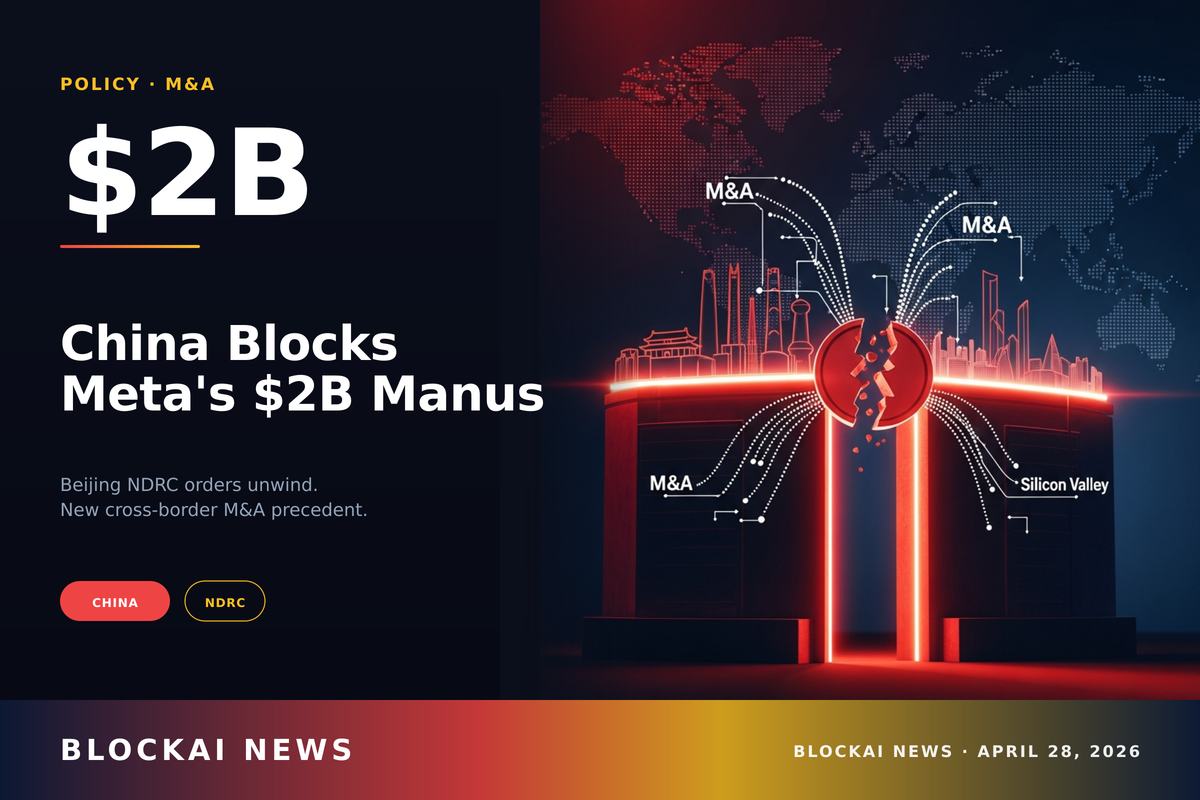
Beijing's NDRC ordered Meta to unwind a $2 billion acquisition that had already been signed, integrated, and announced. The move — combined with travel bans on Manus co-founders Xiao Hong and Yichao Ji since late March — sets a new precedent for cross-border AI M&A and forces every Western acquirer to reprice the regulatory risk on Chinese-founded AI startups.
1 — The Veto
On April 27, 2026, China's National Development and Reform Commission (NDRC) issued a one-line notice prohibiting foreign investment in Manus and requiring both parties to unwind the transaction. The notice, published without elaboration on the agency's official site, cited "applicable foreign investment laws and regulations" — wording that has historically been used to invoke national-security-driven veto authority under the 2020 Foreign Investment Law.
Meta's official response from a company spokesperson stated that the transaction "complied fully with applicable law" and that the company anticipates "an appropriate resolution to the inquiry." The Wall Street Journal reported within hours that Meta is preparing to formally unwind the deal within weeks, including reversing the integration of Manus engineers and product into Meta's internal Ads Manager and platform agent stacks.
The deal timeline tells the story:
- Dec 2025: Meta announces $2B acquisition of Manus; founders accept VP titles at Meta
- Jan 2026: Ministry of Commerce launches probe
- Mar 2026: NDRC adds anti-monopoly review; co-founders banned from leaving China (FT scoop)
- Apr 27 2026: NDRC issues unwind order
- Apr 28 2026: WSJ reports Meta beginning teardown of integration
China has ordered Meta’s $2.5 billion acquisition of artificial-intelligence startup Manus to be unwound on security grounds https://t.co/icoF4WQ2gx
— The Wall Street Journal (@WSJ) April 27, 2026
The Manus block is the moment AI joins semiconductors, telecom, and rare earths on the list of strategic assets China refuses to let walk out the door. Founders, VCs, and U.S. acquirers spent four years not believing this could happen. They no longer have that luxury — and every Chinese-founder AI startup now has to pick a country before its first dollar of foreign capital, not after.
— Jason Lee, Founder, BlockAI News
2 — How We Got Here
Manus didn't exist 14 months ago. The company launched its general-purpose autonomous AI agent on March 6, 2025, with a single demo video that quickly accumulated 1 million+ views and grew its waitlist to 2 million people in one week. Influential tech figures including Twitter co-founder Jack Dorsey and Hugging Face product lead Victor Mustar shared the demo. By August 2025, Sacra estimated Manus had hit a $90M annualized revenue run-rate — five months after launch.
The product is the work of two founders: Xiao Hong (CEO) and Yichao Ji (Chief Scientist), both veterans of Butterfly Effect, the Chinese-founded company behind the earlier Monica AI assistant (2023). Manus was technically incorporated in Singapore in mid-2025 — a path many Chinese AI startups have used to operate outside Beijing's direct oversight while preserving access to Western capital and customers.
Introducing Manus: the first general AI agent.
— Manus (@ManusAI) March 5, 2025
Try Manus today and see the future of human-machine collaboration: https://t.co/IKBPiiHsta pic.twitter.com/z3C8fUK3eN
Meta's December 2025 acquisition was announced as a strategic catch-up move. Mark Zuckerberg had spent 2025 watching OpenAI ship Operator, Anthropic ship Computer Use, and Google ship the ADK — while Meta's in-house agent efforts inside Reality Labs and FAIR lagged the frontier. Manus brought a battle-tested production agent stack, a global user base, and two founders Meta could install at the VP level.
It was the kind of deal that historically would have closed without political friction. Instead, it triggered the most aggressive cross-border AI block in recent history. The Financial Times broke the story in late March that Beijing had imposed exit bans on Xiao and Ji while the probe ran — an enforcement tool extreme enough that it signaled the deal was already in serious trouble.
China has told two co-founders of artificial-intelligence startup Manus, which was bought by Meta, not to leave the country https://t.co/kCBZaBM3y3
— The Wall Street Journal (@WSJ) March 25, 2026
3 — Why Beijing Drew the Line
For two decades, China's M&A blocks targeted hard tech: the 2018 Qualcomm-NXP $44B veto, the 2023 Micron market ban, the chronic delays on semiconductor and aerospace deals. The Manus block is the first time Beijing has explicitly applied the same posture to AI software — specifically to an autonomous agent's training methodology and execution stack.
Three factors reshaped the calculus:
Strategic redefinition of "key technology." The 2024 update to the Catalogue of Technologies Prohibited or Restricted from Export added "AI agent task decomposition methods" and "multi-modal reasoning training data" to the restricted list. Manus's core IP — the agent orchestration layer + RLHF pipelines — falls squarely inside that definition. Selling it to a US tech giant is now legally treated like selling chip lithography blueprints.
The "talent extraction" narrative. Chinese state media spent 2025 framing US Big Tech's interest in Chinese AI founders as a talent virgin extraction threat (人才虹吸). The phrase appeared in People's Daily op-eds and Xinhua commentary following Xi Jinping's September 2025 AI strategy speech at the Politburo Collective Study Session. The Manus deal — Xiao Hong as Meta VP, Yichao Ji running an AI lab inside Reality Labs — became the textbook case of what Beijing wanted to prevent.
The Singapore loophole closing. Manus's Singapore re-incorporation in mid-2025 was meant to defuse exactly this risk. Beijing's response — invoking jurisdiction over a Singapore entity because the founders, IP origin, and engineering team were Chinese — signals the loophole no longer works. Any China-founded AI company, regardless of holding-company location, is now subject to potential NDRC veto on cross-border M&A.
The thing I’m most surprised by with Beijing’s block of the Manus deal is that they let it get this far.
— Kyle Chan (@kyleichan) April 28, 2026
Manus made a big splash last year and was even touted on Chinese state media. The move to Singapore might’ve seemed smart from a commercial standpoint, but the optics were…
4 — The Compliance Architecture
The legal mechanics matter for every deal team rethinking China-touch AI investments. NDRC's veto authority rests on three overlapping statutes:
- Foreign Investment Law (2020), Article 35: Authorizes the State Council to halt or unwind any foreign investment that "endangers state security" — interpreted broadly enough to cover technology transfer.
- Data Outbound Security Assessment Measures (2022): Requires CAC review for any cross-border transfer of "important data" — which now explicitly includes AI training datasets and model weights.
- Critical Information Infrastructure Security Protection Regulations (2021): Allows declaring AI infrastructure operators as "critical" — triggering retention obligations even after sale.
The combined effect: a deal can be signed, integrated, announced, and operating — and Beijing can still order it unwound. There is no good-faith "we already closed" defense.
Travel bans on founders are not new (the tool has been used in financial fraud and tax evasion cases for years), but their use in M&A enforcement is rare. Their function here is straightforward: Xiao and Ji are the only people who can sign the unwind paperwork on the Manus side. Keeping them onshore guarantees that an unwind order is enforceable.
Meta's legal options are essentially nil. Cross-border challenges to Chinese regulatory decisions through arbitration or WTO mechanisms have no successful precedent in tech-sector M&A. Major law firms in Beijing — including King & Wood Mallesons and JunHe — have publicly described the unwind order as "practically uncontestable."
5 — The Industry Tremor
The block reverberates in three directions, and each one is already pricing in.
VC valuations re-rate immediately. Every Chinese-founder AI startup pitching dollar-VCs this week is hearing the same question: "how would NDRC react if a US acquirer offered to buy you?" The honest answer is "they'd block it" — which means the implicit "acquisition exit" path that justified ~30% of late-stage AI valuations just disappeared. Expect a 20-30% haircut on Chinese-founded AI valuations within two quarters as the news prices in.
M&A path closes for Western acquirers. Any future Meta / Google / Microsoft / OpenAI / Apple acquisition of a Chinese-founded AI startup must now factor NDRC pre-clearance — which, as Manus demonstrates, is functionally unavailable. For companies like Smartisan-rooted teams (DeepSeek, ZetaAI), Tsinghua spinouts, and Alibaba alumni labs, the US-acquirer exit path is closed. They are now structurally domestic-only.
Talent flow reverses. The career calculus for a top Chinese AI researcher just changed. Pre-2026, the path was: build something good in China, get acquired by a US lab, become a US-based VP at a Big Tech firm. That path is now blocked at both ends — China won't approve the sale, and the US (via CFIUS expansion expected later in 2026) is increasingly unwilling to clear the inbound. Expect more Chinese AI talent to stay domestic, accelerating the parallel-stack divergence.
This is structurally symmetric to the 2024-2025 TikTok divestiture battle, just inverted: the US tried to force ByteDance to divest TikTok over national-security concerns; China is now forcing Meta to divest Manus over the same logic. The mutual escalation cycle is now established as a precedent both governments accept.
After China's cancellation of Meta's purchase of Manus, why would any founder start an AI company in China if they had a choice? In China you have access to less compute, less capital, and salaries are lower than in the West. And if you are so successful that a non-Chinese firm…
— Chris McGuire (@ChrisRMcGuire) April 27, 2026
The Meta-Manus Saga and China’s Message to AI Talent
— Desmond Shum (@DesmondShum) March 18, 2026
Chinese AI talent is getting squeezed from both sides.
In the West, many no longer feel welcome. So quite a few went back to China — drawn by family ties, opportunity, and the belief that China’s AI industry is where the…
6 — What to Watch · BlockAI's View
Three near-term watchpoints:
Manus's next chapter. Three plausible paths: (a) independent operation with new domestic capital — most likely; (b) domestic acquisition by Alibaba, Tencent, or ByteDance, all of whom were rumored to have approached the team in 2025; (c) state-aligned absorption via a Chinese Academy of Sciences or other state-funded vehicle. Whichever path, expect Manus to raise a strategic round at $1-1.5B valuation within 90 days — a defensive move to restore confidence.
Beijing's next veto. The Manus block establishes a precedent. The next obvious targets: any Western acquisition approach to Zhipu AI, Moonshot AI, DeepSeek, or 01.AI. Each has had quiet outreach from US labs. Expect formal blocks — or, more likely, preemptive deal cancellations as Western counterparties read the writing on the wall.
US response. Expect CFIUS to expand its mandate to cover "reverse" cases — investments by Chinese-founded entities into US AI infrastructure. Export controls on AI chips will tighten further. The bipartisan committee that produced the 2024 China Selective Coupling report will likely push new legislation in Q3.
BlockAI's View. The Manus veto isn't an isolated regulatory action — it's the opening of a new phase in AI sovereignty contest. For the next 18-24 months, expect cross-border AI M&A volume to collapse 60-80%. AI talent flow will retreat from globalization toward regional clusters. The cost for a Chinese AI founder to credibly target "list in the US" or "accept dollar VC" has just become permanent and enormous. The era of frictionless AI capital flow is over; the era of geographic AI moats has begun. Western acquirers shopping for AI talent need to update both their target lists and their valuation models — Chinese-founded teams are now an asset class with a built-in exit lock.
 TechCrunchCNN BusinessBloombergThe Washington PostTheNextWeb
Stay close to BlockAI News.
Beijing's veto won't be the last AI-stack realignment to land without warning. Subscribe to see the next one before it becomes consensus.
How we report: This article cites primary sources, regulatory filings, and on-chain data where available. BlockAI News uses AI tools to assist with research and first-draft generation; every article is reviewed and edited by a human editor before publication. Read our full How We Report page, Editorial Policy, AI Use Policy, and Corrections Policy.