OpenAI's Great Rebalancing: $138B, Two Clouds, and the End of the Microsoft Era
Microsoft's six-year OpenAI exclusivity ended April 27. By April 28, OpenAI was on AWS — with a $138B total compute commitment. Inside the deal that rewrote AI's cloud map.

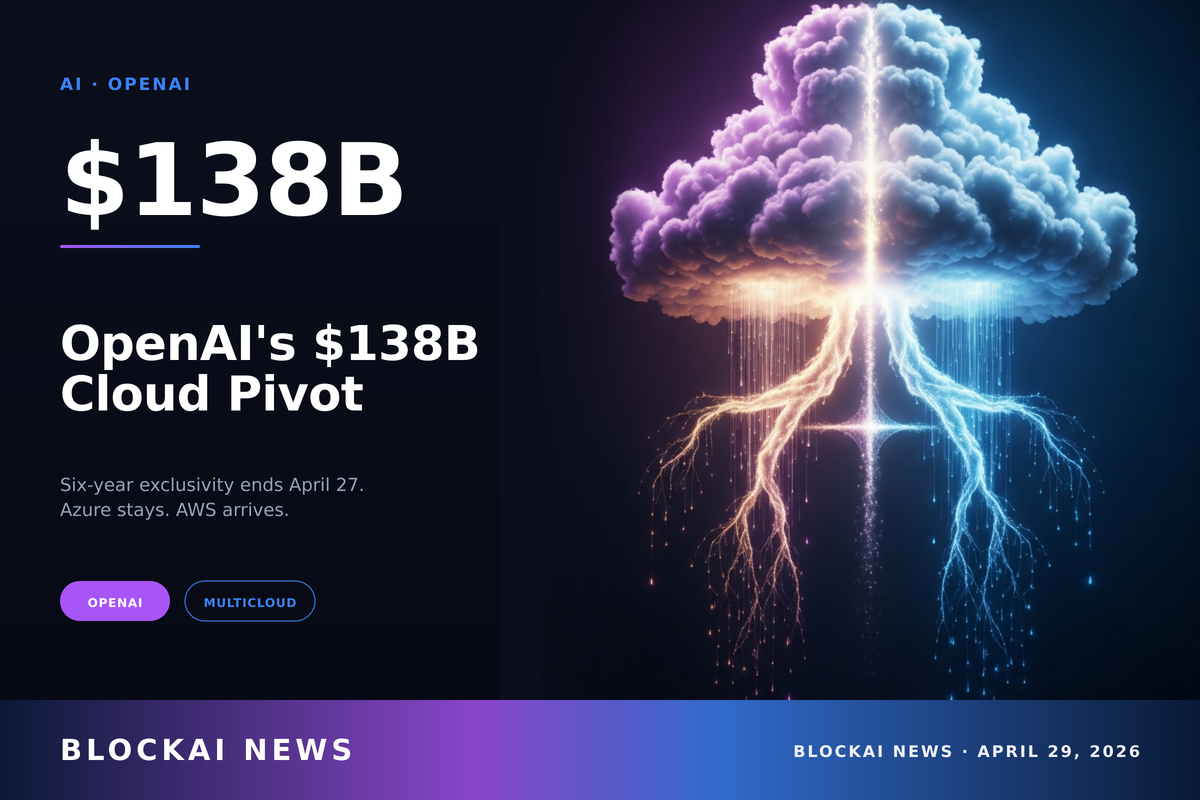
On April 27, 2026, Microsoft and OpenAI dismantled the partnership that had defined the first two years of the generative AI economy. Twenty-four hours later, OpenAI's models were live on AWS Bedrock, alongside its Codex coding agent and a brand-new Bedrock Managed Agents service powered by OpenAI. The financial backbone of the move: a $100 billion compute commitment from OpenAI to AWS over eight years — added to OpenAI's existing $38B AWS contract. Total commitment: $138 billion. This is not a new AWS partnership. This is the formal end of the era when one cloud could anchor a frontier AI lab.
Two Press Releases, 24 Hours Apart
The announcements landed in textbook corporate sequencing.
April 27. Microsoft and OpenAI co-published "The next phase of the Microsoft–OpenAI partnership." The document does three things at once. It removes Microsoft's exclusive cloud-reseller status — OpenAI products will continue to debut on Azure, but OpenAI is now free to ship to any cloud. It removes the AGI clause that had tied Microsoft's IP rights and revenue share to OpenAI achieving artificial general intelligence; rights are now fixed to a calendar (through 2032), not a speculative technical milestone. And it caps the revenue share OpenAI pays Microsoft. The cap is the financial signal — Microsoft prefers a known maximum exposure to a runaway-OpenAI scenario over the previously uncapped upside.
Source: Read OpenAI's official announcement →
April 28. AWS announced general availability of OpenAI's models on Amazon Bedrock, alongside the Codex coding agent and a new Bedrock Managed Agents service powered by OpenAI. AWS CEO Andy Jassy framed it on X as a "very interesting announcement"; the rollout would have taken weeks of cross-org integration to ship cleanly within twenty-four hours of Microsoft's signoff.
 Amazon Staff
The speed makes one thing clear: this was negotiated for months. The April 27 document is the legal trigger. April 28 is the commercial reveal. Sam Altman and Satya Nadella personally finalized the terms — the only way a deal of this complexity moves on a 24-hour public timeline.
The rest of the AI cloud market just learned, in a single business day, that the most concentrated AI vendor relationship in tech history is now multi-vendor. Anthropic's Bedrock-only frontier moat just got contested. Google's Vertex AI just lost its "we have third-party frontier models you don't" angle against Azure. Every CIO procurement deck written between January and April will be rewritten by mid-May.
For three years, the assumption was that frontier-lab compute and frontier-lab distribution would consolidate around the same cloud. The April 27–28 announcements are the formal end of that assumption. Two clouds now have OpenAI; two clouds have Anthropic; the cloud market for frontier AI is, for the first time, genuinely contested.
— Jason Lee, Founder, BlockAI News
The Real Number Is $138 Billion
Headlines focused on $100 billion. The full picture is bigger.
OpenAI had an existing $38 billion AWS commitment signed earlier this year — capacity that was already booked but not yet drawn down. The April 28 announcement added $100 billion over eight years to that base, bringing total contracted AWS spend to $138 billion through roughly 2034. Averaged across years, that is $17.25 billion per year — though front-loaded, given OpenAI's training-compute trajectory.
Translate that into accelerator units. At today's blended pricing — somewhere between $25,000 and $40,000 per high-end GPU equivalent (H100, H200, B100, Trainium2, depending on what AWS allocates to OpenAI's workloads) — $17 billion buys roughly 425,000 to 700,000 accelerators per year of effective capacity. That is more than the entire deployed AI-compute footprint of any single enterprise in the world today. OpenAI just locked it in for eight years, and committed to drawing it down.
The supply-side implication is that OpenAI is betting compute scarcity continues through 2034. The procurement-side implication is that AWS just landed the customer that will set the marginal price for frontier-AI compute for the next decade. Whatever pricing AWS quotes other frontier labs from late 2026 onward will be informed by what it costs to serve OpenAI at this volume.
This is also the largest single non-government infrastructure commitment in computing history, by a margin that isn't close. Nobody has ever pre-committed to a single cloud at this scale before. The deal is structurally closer to a sovereign infrastructure agreement than to a normal SaaS commitment.
 Jordan Novet
Frontier Is the Hidden Pivot
The press release everyone read says OpenAI is now on Bedrock. The clause everyone missed is that AWS becomes the exclusive third-party cloud distribution provider for Frontier — OpenAI's enterprise platform launched in February 2026 for building and managing AI coworkers in Fortune 500 environments.
Frontier is the more strategic launch. Bedrock-with-OpenAI is a model API; Frontier-on-AWS is a managed agent runtime, with its own onboarding, compliance, and sales motion, sold by AWS reps to AWS customers. OpenAI's COO Brad Lightcap has framed Frontier as the bridge to enterprise AI deployments that "have not yet really seen AI penetrate enterprise business processes." Capgemini, BCG, McKinsey, and Accenture have all signed on as Frontier integration partners.
The competitive consequence is the awkward part. Microsoft Copilot is built on OpenAI models served via Azure. Frontier is built on the same OpenAI models served via AWS. Same underlying intelligence, two different cloud destinations, two different sales motions, two different enterprise compliance perimeters. Fortune 500 buyers now have an apples-to-apples bake-off between Microsoft's Copilot stack and OpenAI's own Frontier stack — and OpenAI controls both the models and one of the distribution channels.
That dynamic flips the historical Microsoft–OpenAI power asymmetry. For three years, Microsoft was OpenAI's largest customer, biggest investor, and exclusive distributor. After April 28, Microsoft is OpenAI's largest competitor in enterprise AI procurement — competing against the model vendor's own enterprise product, with the model vendor's own AWS sales team carrying the deck.
 Julie Bort
Anthropic Just Got Its Toughest Quarter
The other immediate loser in this restructuring is Anthropic.
Bedrock, since the 2023 Amazon investment, has been Anthropic's primary cloud distribution moat. Claude on Bedrock was the frontier-LLM offering an AWS sales rep would lead with. After April 28, that rep has two frontier options to pitch — and the OpenAI brand is, for most enterprise buyers, the more recognizable one.
The competitive playbook for Anthropic now narrows from exclusivity to differentiation. Claude Code's native sandboxing — shipped in October 2025 with Linux bubblewrap and macOS Seatbelt isolation — is one credible wedge; agent safety is the kind of feature enterprise CISOs care about, and OpenAI Codex has been visibly slower to publish equivalent primitives. Computer Use (Anthropic's agentic GUI control tool) is another angle that AWS's Bedrock Managed Agents won't immediately replicate.
But the structural fact is unflattering. AWS just turned its frontier-AI shelf from "Anthropic plus the rest" into "Anthropic plus OpenAI plus the rest." Anthropic's AWS-dependent revenue concentration becomes a vulnerability in a way it wasn't before. Expect Anthropic to publicly accelerate diversification — Google Cloud and Oracle channel partnerships are obvious near-term moves — and to lean harder on Claude's enterprise-safety positioning to justify AWS pricing differentials against OpenAI.
The next quarter's Anthropic revenue print (private, but leaked metrics typically surface) will be the first public data on whether Bedrock-distributed Claude revenue is decelerating in real time.
Microsoft's Defensive Engineering
What did Microsoft actually keep, and what did it lose?
Kept:
- IP license through 2032. Microsoft can continue to use OpenAI's models and products for Copilot, Azure OpenAI Service, and any internal applications, with no cliff.
- Revenue share continues at the same percentage, now extended through 2030, but with a total dollar cap.
- Co-development continues. The "stateful runtime technology" underpinning Bedrock Managed Agents was co-built with Microsoft input even though it ships on AWS.
- Right of first deployment. New OpenAI products debut on Azure first, unless Microsoft chooses or is unable to support them.
Lost:
- Exclusivity. The moat that made Azure the default frontier-AI cloud is gone.
- Pricing power. With OpenAI now multi-cloud, Microsoft can no longer demand a premium on the basis of being the only place enterprise buyers can run OpenAI models at scale.
- The AGI clause. OpenAI is no longer obligated to give Microsoft preferential access if it achieves artificial general intelligence. The hedge against the most speculative possible upside is gone.
The cap on the revenue share is the most analytically interesting data point. It says Microsoft prefers a known maximum exposure to OpenAI's hypergrowth over uncapped upside. That is a sober posture. If Microsoft believed OpenAI was on a 10x revenue trajectory through 2030, the rational move would be to defend uncapped revenue share at any cost. Capping it implies the Microsoft side of the negotiation believes diminishing returns set in earlier — that protecting Azure's gross margin against pricing pressure matters more than capturing future OpenAI upside.
 Microsoft Corporate Blogs
 Ashley Capoot
What to Watch · BlockAI's View
Three near-term indicators will tell you whether this is a one-off or a structural shift.
First, Anthropic's response timeline. Expect a Bedrock-native Claude differentiation push — extended-context pricing, Computer Use enterprise SLAs, Claude Code multi-agent orchestration — within sixty days. If Anthropic ships nothing significant by July, that's the signal that Bedrock-distributed Claude is materially decelerating against the new OpenAI competition.
Second, Microsoft's frontier-equivalent. Microsoft now needs an OpenAI-independent enterprise AI story. Watch Phi-5 / Phi-6 development pace, Copilot Studio agent capabilities, and rumored Mistral or Cohere distribution deals. If Microsoft can't ship a credible Azure-native frontier story by Q4, the AI-revenue narrative inside Microsoft starts to wobble — and the equity market will start pricing that in.
Third, the Google quadrant. Google has Vertex AI but no major external frontier lab in its enterprise channel. The pressure to either acquire or partner is now real. Watch the Cohere, Mistral, and Reka corridors for activity. A Google–Mistral distribution deal in 2026 would be the logical move; an outright Google acquisition of one of the small-cap frontier labs would be the more aggressive move.

BlockAI's View. This isn't actually a story about AWS winning OpenAI. It's the story about every frontier lab now needing multi-cloud distribution to maintain pricing power against the hyperscalers. The era when one cloud could anchor one frontier lab is over because lab founders learned, in real time, that exclusivity becomes a tax on growth the moment enterprise procurement gets sophisticated enough to ask "but can we run it on our cloud?" Cloud–frontier-lab pairing was always strategically dangerous for the lab; it just took until 2026 for everyone to admit it. The next chapter: every major frontier model on every major cloud, with clouds competing on tooling rather than exclusivity.
For a companion read on this week's other AI-stack realignment — Beijing's veto of Meta's $2B Manus acquisition — see: China Just Blocked Meta's $2B Manus Deal — and Rewrote the AI M&A Playbook.
Stay close to BlockAI News.
The next time the stack realigns, it'll happen in 24 hours again. We'll have the structural read before consensus catches up.
How we report: This article cites primary sources, regulatory filings, and on-chain data where available. BlockAI News uses AI tools to assist with research and first-draft generation; every article is reviewed and edited by a human editor before publication. Read our full How We Report page, Editorial Policy, AI Use Policy, and Corrections Policy.