Ondo, JPMorgan, Mastercard & Ripple Settle Tokenized Treasuries on XRPL
Four financial heavyweights — Ondo Finance, JPMorgan, Mastercard, and Ripple — have jointly demonstrated cross-border tokenized U.S. Treasury settlement on the XRP Ledger, a proof-of-concept that signals institutional RWA infrastructure is converging on public blockchain rails faster than most an...


In a milestone that crystallises the convergence of traditional finance and public blockchain infrastructure, Ondo Finance, JPMorgan, Mastercard, and Ripple have jointly demonstrated cross-border settlement of tokenized U.S. Treasury securities on the XRP Ledger (XRPL) — a live proof-of-concept announced in the first week of May 2026 that industry observers are calling one of the most consequential institutional Web3 collaborations to date.
What Just Changed
The demonstration centred on Ondo Finance's tokenized short-duration Treasury product — principally its OUSG (Ondo U.S. Government Bond Fund) token — being settled cross-border using XRPL as the underlying settlement layer. According to the company's official communications, the collaboration brought together four distinct institutional capabilities: Ondo's real-world asset (RWA) tokenization infrastructure, JPMorgan's institutional custody and payment rails (likely channelled through its Onyx digital assets division), Mastercard's cross-border payment network expertise via its Multi-Token Network (MTN), and Ripple's XRPL protocol and its associated RLUSD stablecoin ecosystem.
The architecture matters as much as the participants. Rather than settling on a permissioned private ledger — the route most banks have historically preferred — this demonstration explicitly used the public XRP Ledger, a choice that carries significant signalling weight. XRPL supports native decentralised exchange functionality and a built-in automated market maker (AMM), features that allow tokenized Treasuries to be traded and settled without routing through a central clearing counterparty. Per Ripple's published developer documentation, the ledger finalises transactions in three to five seconds with fees measured in fractions of a cent — parameters that make it technically viable for high-frequency institutional settlement.
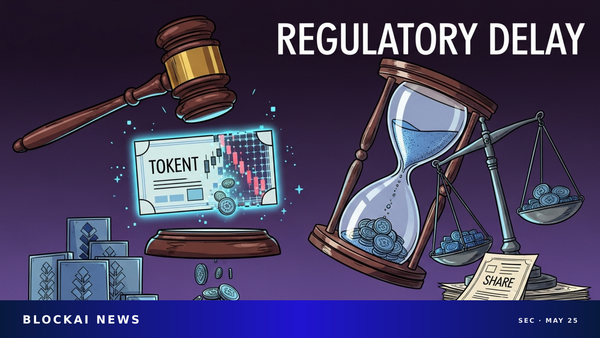
The timing is deliberate. With U.S. Securities and Exchange Commission (SEC) guidance on tokenized securities growing incrementally clearer under its current leadership, and the House Financial Services Committee advancing stablecoin legislation through Q1 2026, large institutions are racing to establish proof-of-concept pedigree before regulatory frameworks fully solidify. Being first on record with a multi-party, multi-corridor settlement demonstration is a form of regulatory and commercial positioning as much as a technical exercise.
The Capital Picture
The tokenized Treasury market context amplifies the significance. Total on-chain tokenized government securities have grown to an estimated $4–5 billion in notional value across all chains as of early 2026, up from under $800 million at the start of 2024, based on aggregated data from on-chain analytics providers. Ondo Finance has been among the fastest-growing issuers in that cohort, with OUSG and its sister product USDY collectively representing hundreds of millions in assets under management.
JPMorgan's Onyx division, which has processed over $1 trillion in repo and intraday liquidity transactions on its permissioned Liink and JPM Coin networks since inception, brings credibility in institutional-scale throughput. Its participation here — on a public ledger rather than its own infrastructure — is the detail analysts should not overlook. It suggests JPMorgan is hedging its architecture bet, maintaining proprietary rails while simultaneously building interoperability with open networks.
Mastercard's involvement through its Multi-Token Network, launched in pilot form in 2023 and expanded through 2025, provides the cross-border payment corridor dimension. The MTN was designed explicitly to connect regulated financial institutions transacting in tokenized assets — making it a natural bridge layer between Ondo's Treasury tokens and end institutional buyers in non-U.S. jurisdictions. Cross-border settlement of U.S. sovereign debt has historically required correspondent banking chains that introduce T+1 to T+2 delays and layered FX costs; the XRPL-based demonstration targeted near-instant atomic settlement, eliminating those friction points in a controlled environment.
Ripple, for its part, has spent the period following its 2023 partial legal victory against the SEC aggressively repositioning XRPL as an institutional-grade asset settlement layer. The launch of RLUSD — its USD-pegged stablecoin — in late 2024 and subsequent integrations with payment corridors have been building blocks toward exactly this kind of multi-party demonstration.
BlockAI News' Take
The instinct in Web3 circles will be to read this as a validation story for Ripple and XRPL. That reading is partially correct but undersells the broader structural shift. What this demonstration actually reveals is that institutional participants have quietly abandoned the binary choice between permissioned private chains and public networks. The new architecture is interoperability-first: custody and compliance sit with regulated entities like JPMorgan, cross-border corridors run through established payment networks like Mastercard, and settlement finality leverages public ledger speed and auditability.
That is a more durable model than any single-chain maximalist thesis. It also creates a genuine moat for the institutions involved. A four-party settlement demonstration of this kind is extraordinarily difficult to replicate quickly — it required months of legal, compliance, and technical alignment across organisations with very different risk cultures. Ondo's role as the RWA issuance layer is particularly strategic: whoever controls the on-chain representation of U.S. Treasuries at scale will become infrastructure for the next generation of DeFi collateral markets.
The risks are real, however. Regulatory treatment of tokenized securities remains jurisdiction-dependent, and a single adverse ruling in a major market — the EU under MiCA implementation, for example, or a reversal in SEC posture — could slow institutional onboarding materially. The demonstration also remains a proof-of-concept: the gap between a controlled multi-party test and live, at-scale production settlement is where most institutional blockchain projects have historically stalled.
Watch for whether Ondo or Ripple publish a formal technical whitepaper or regulatory filing detailing the settlement architecture, and whether JPMorgan's Onyx team references XRPL integration in any upcoming investor communications — those disclosures would signal the transition from demonstration to roadmap commitment.
How we report: This article cites primary sources, regulatory filings, and on-chain data where available. BlockAI News uses AI tools to assist with research and first-draft generation; every article is reviewed and edited by a human editor before publication. Read our full How We Report page, Editorial Policy, AI Use Policy, and Corrections Policy.