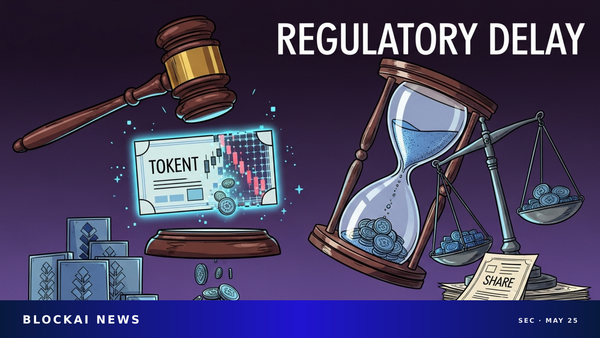
White House Eyes July 4 Deadline for Landmark Crypto Market Bill
The White House has set a July 4 target to pass landmark crypto market structure legislation — an aggressive timeline that would hand the U.S. its first comprehensive digital-asset regulatory framework and reshape how tokens are classified, traded, and overseen by federal agencies.


The White House is pushing to pass a comprehensive crypto market structure bill by July 4, 2026 — a politically symbolic deadline that, if met, would deliver the United States its first overarching federal framework for digital-asset regulation. The target was set by the administration's crypto policy adviser and signals that the executive branch is now actively driving legislative urgency on Capitol Hill, rather than waiting for Congress to move at its own pace.
What's New on the Table
The July 4 deadline is not merely aspirational calendar-marking. According to remarks attributed to the White House crypto adviser in public statements this week, the administration has been coordinating directly with key congressional committees — including those with jurisdiction over financial services and agriculture — to accelerate the drafting and markup process for market structure legislation. The bill in question is broadly understood to address the longstanding question of whether most digital assets should be treated as securities under the Securities and Exchange Commission (SEC) or as commodities under the Commodity Futures Trading Commission (CFTC).
That jurisdictional ambiguity has been the central fault line in U.S. crypto regulation for years, leaving projects, exchanges, and investors operating under an enforcement-first regime rather than a clear statutory framework. A successful market structure bill would, in principle, draw bright-line tests — potentially based on decentralization thresholds or functional-use criteria — to determine which regulator has primary authority over a given token or protocol.
The White House push comes alongside parallel momentum on stablecoin legislation, where both the GENIUS Act in the Senate and competing House proposals have already advanced through committee. Advisers appear to view the two tracks — stablecoins and broader market structure — as complementary rather than sequential, suggesting an ambition to deliver a twin-pillar regulatory package before the summer recess.
The Regulatory Wedge
Passing comprehensive market structure legislation by July 4 would require clearing several significant hurdles in fewer than 60 days. Congress is in session for only a portion of that window, and the legislative calendar is crowded with budget reconciliation and other priorities. Historically, crypto bills that have cleared committee have still stalled on the floor over disagreements about SEC versus CFTC primacy, DeFi carve-outs, and the treatment of proof-of-work versus proof-of-stake assets.
The current political environment, however, is arguably the most favorable it has ever been for crypto legislation. A White House that has publicly embraced the digital-asset sector — including through executive orders earlier this year directing agencies to support a national digital-asset stockpile and streamline regulatory clarity — now brings executive-branch pressure to bear in a way previous administrations did not. Industry groups including the Blockchain Association and the Chamber of Digital Commerce have both publicly supported legislative action this session.
Still, stakeholders remain cautious. Lobbying disclosures show that major crypto exchanges and Layer-1 protocol foundations have spent aggressively on Washington engagement over the past 18 months, yet prior legislative attempts — including versions of the Digital Asset Market Structure and Investor Protection Act — never made it to a full floor vote. The difference now, proponents argue, is that the executive branch is acting as a co-author rather than a bystander.
One critical technical question the bill must resolve is the classification of tokens that launch as securities but may become sufficiently decentralized over time to migrate to commodity status. The SEC under prior leadership resisted any such transformation doctrine, but a new commission composition and a White House willing to weigh in legislatively could change that calculus substantially.
What to Watch
The next 30 days will be decisive. Watch for whether the House Financial Services Committee and the Senate Banking Committee release a joint or parallel draft bill text — that would be the clearest signal that the July 4 target is operationally real rather than aspirational. A unified draft would need to reconcile differences on DeFi protocol liability, custody requirements for digital-asset intermediaries, and whether retail investors get explicit private rights of action under the new framework.
Market participants will also be monitoring the response from the SEC and CFTC themselves. Both agencies have signaled greater openness to regulatory sandboxes and no-action relief in recent months, but a statute that formally curtails SEC jurisdiction over tokens could still face institutional resistance from the commission's career staff and remaining enforcement divisions.
Internationally, the pressure is mutual. The European Union's MiCA regulation has been fully in effect since January 2025, giving EU-based exchanges a compliance runway that U.S. competitors still lack. A July 4 passage would close that gap faster than most analysts projected even six months ago — and could meaningfully shift where global crypto infrastructure chooses to domicile.
For the Web3 ecosystem broadly, the stakes extend well beyond compliance costs. A clear market structure law would unlock institutional capital that has remained on the sidelines specifically because of regulatory uncertainty, potentially catalyzing the next wave of tokenized real-world asset issuance, on-chain derivatives markets, and decentralized finance products built for U.S. audiences.
The key inflection point to watch: whether a unified bill text surfaces before Memorial Day — if it does, the July 4 target moves from ambitious to achievable; if it doesn't, expect the deadline to slip toward the fall session and the political window to narrow considerably.
How we report: This article cites primary sources, regulatory filings, and on-chain data where available. BlockAI News uses AI tools to assist with research and first-draft generation; every article is reviewed and edited by a human editor before publication. Read our full How We Report page, Editorial Policy, AI Use Policy, and Corrections Policy.