Reid Hoffman: NFTs Are AI's Missing Trust Layer
LinkedIn co-founder Reid Hoffman argues NFTs could stage a meaningful comeback — not as speculative art, but as cryptographic identity rails for AI agents transacting autonomously online. As bots outnumber humans in digital spaces, blockchain-verified credentials may become the only scalable trus...


Reid Hoffman, the LinkedIn co-founder and prominent Silicon Valley investor, has made a striking prediction: NFTs — widely written off after the 2022 market collapse — may be on the verge of a second act, this time driven not by speculative art flipping but by the structural demands of AI agents operating autonomously across the internet. Speaking publicly in early May 2026, Hoffman argued that as artificial intelligence systems increasingly conduct transactions, sign agreements, and represent human interests online, the internet's existing identity infrastructure is fundamentally inadequate — and that blockchain-based tokens may be the most credible solution already available.
What's Actually Happening
The argument Hoffman is advancing is less about nostalgia for the 2021 NFT boom and more about a cold-eyed infrastructure problem. Today's web identity stack — passwords, OAuth tokens, centralized KYC databases — was designed for humans who can be held accountable through legal and social mechanisms. AI agents, by contrast, are software processes. They can be cloned, spoofed, or operated anonymously. When an AI agent books a flight, executes a trade, or negotiates a service contract on behalf of a user, counterparties have no reliable way to verify whether they are dealing with a legitimate delegated agent or a malicious impersonator.
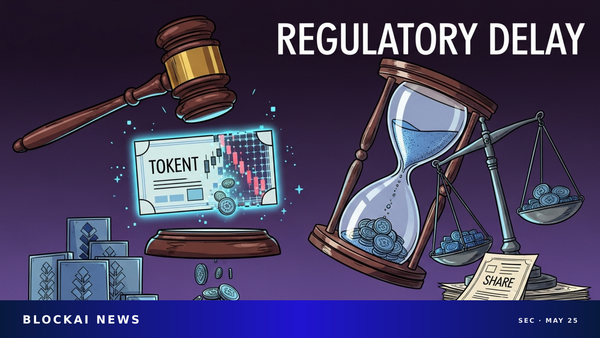
Hoffman's contention is that non-fungible tokens — specifically their capacity to represent unique, verifiable, on-chain ownership of a credential or identity — provide exactly the kind of unforgeable attestation that agentic systems require. In this framing, an NFT is not a JPEG; it is a signed, auditable proof of delegation. An agent holding a cryptographically verified credential issued by a known wallet could prove, to any counterparty on any platform, that it is authorized to act on behalf of a specific principal — without requiring a centralized identity provider to broker the interaction.
This reframing draws on work already underway in the decentralized identity community. Standards bodies including the World Wide Web Consortium (W3C) have spent several years developing Verifiable Credentials and Decentralized Identifiers (DIDs) — technical primitives that overlap significantly with the NFT-as-credential thesis Hoffman is articulating. Several Web3 infrastructure projects, including efforts within the Ethereum ecosystem and newer chains purpose-built for identity, have been exploring soulbound tokens — non-transferable NFTs proposed by Vitalik Buterin in a 2022 co-authored paper — as a mechanism for persistent, non-speculative identity claims.
The Capital Picture
Hoffman's comments are not purely theoretical. As a general partner at Greylock Partners and an early backer of companies including Inflection AI (later restructured, with key assets and personnel moving to Microsoft in a deal valued at approximately $650 million in 2024), he sits at the intersection of AI investment and Web3 thinking. His public statements tend to signal where institutional attention — and capital — may be turning.
The broader market context is notable. NFT trading volumes, which peaked at roughly $17 billion in January 2022 according to data aggregators tracking on-chain activity, collapsed by more than 97% through 2023 and remained subdued through most of 2025. However, a subset of NFT infrastructure — particularly projects focused on identity, access credentials, and on-chain reputation rather than speculative collectibles — continued to attract development funding even through the bear market. Protocols in this segment raised an estimated $200–400 million collectively between 2023 and 2025, according to publicly announced rounds tracked by venture databases.
The AI agent economy is scaling fast enough to make the identity problem urgent. Research from multiple AI labs suggests that by late 2026, a significant share of routine digital transactions — estimated at 15–30% of e-commerce interactions in some projections — could be initiated or completed by autonomous AI systems rather than humans typing directly. Each of those interactions creates a trust gap that existing systems were not designed to fill. If even a fraction of that transaction volume routes through crypto-native identity rails, the addressable market for NFT-based credential infrastructure becomes substantial.
BlockAI News' Take
Hoffman is identifying something real. The AI agent proliferation problem is not hypothetical — it is already creating friction across platforms. Cloudflare, in its 2025 infrastructure reports, noted a sharp rise in bot traffic that is increasingly indistinguishable from human-generated activity. Social platforms, payment processors, and API providers are all grappling with how to gate access for legitimate agents while excluding malicious ones. The tools they currently have — rate limiting, CAPTCHA variants, IP reputation scoring — are blunt instruments that fail at scale.
The NFT-as-identity thesis is credible precisely because it leverages infrastructure that already exists and has been battle-tested for value transfer. A cryptographic credential anchored on a public blockchain is auditable, portable, and does not require any single company to remain solvent or cooperative for it to function. That is a genuine advantage over centralized identity systems, which carry counterparty risk by design.
The risk, however, is the same one that has plagued Web3 adoption broadly: user experience and regulatory clarity. If AI agent credentials become a meaningful financial instrument — representing the right to transact on someone's behalf — they will attract scrutiny from financial regulators in the US, EU, and elsewhere who are still working through how to classify even basic token types. The SEC's evolving posture on digital assets and the EU's MiCA framework, which began phased enforcement in 2024, both create compliance surface area that enterprise adopters will need resolved before committing infrastructure budgets.
What to watch: whether major AI platform providers — OpenAI, Anthropic, Google DeepMind — begin formally endorsing or integrating any specific on-chain identity standard for their agent frameworks. If one of those players announces a partnership with an Ethereum-compatible identity protocol or issues a technical specification referencing NFT-based credentials, Hoffman's prediction will shift from provocative thesis to industry roadmap almost overnight.
How we report: This article cites primary sources, regulatory filings, and on-chain data where available. BlockAI News uses AI tools to assist with research and first-draft generation; every article is reviewed and edited by a human editor before publication. Read our full How We Report page, Editorial Policy, AI Use Policy, and Corrections Policy.