
Genesis AI Goes Full-Stack With GENE-26.5 Model and Robotic Hands
Khosla-backed Genesis AI debuts GENE-26.5, a full-stack foundation model paired with a dexterous robotic hands demo, after closing a $105M seed round. The launch signals a rare vertical integration bet in embodied AI — one model owning perception, planning, and physical actuation from the ground up.

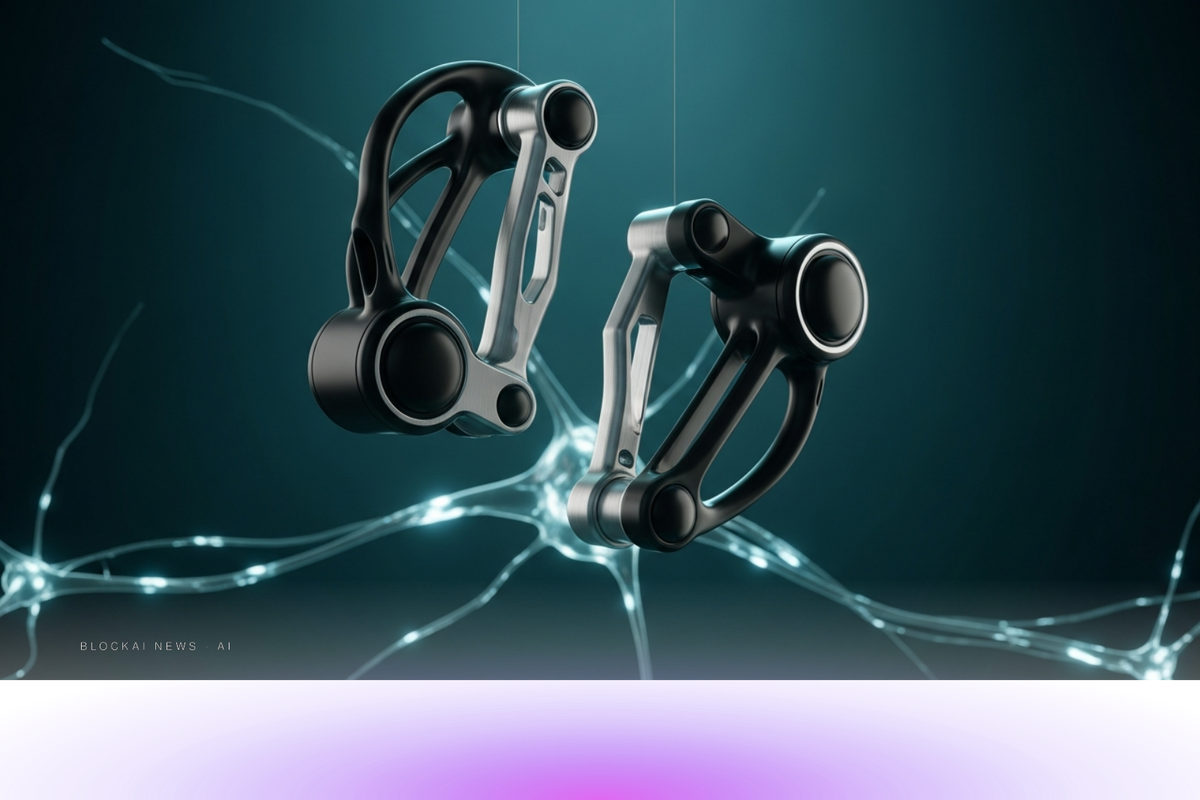
Embodied AI just got a serious new contender. Genesis AI, the robotics startup backed by Khosla Ventures, publicly unveiled its GENE-26.5 foundation model alongside a live dexterous robotic hands demonstration on May 6, according to the company's own release — the first concrete product reveal since the startup disclosed a landmark $105 million seed round earlier this year. The debut positions Genesis AI as one of the few players attempting to own the entire stack: perception, world modeling, motor planning, and physical actuation, unified under a single model architecture.
Inside the Architecture
GENE-26.5 is described by the company as a full-stack foundation model — meaning it is not a perception model bolted to a separate motion planner, nor a large language model repurposed for robot control. Instead, Genesis AI claims the architecture was designed end-to-end to close the loop between visual and tactile input and fine-grained motor output, a design philosophy the company's technical blog frames as "one gradient, one goal."
The demo centered on robotic hands performing multi-step manipulation tasks — folding fabric, sorting irregular objects, and assembling small components — without task-specific fine-tuning on each scenario. That last detail matters: most manipulation demos in the field still rely on per-task datasets numbering in the tens of thousands of teleoperated examples. Genesis AI claims GENE-26.5 generalizes across object categories after a comparatively lean data regime, though the company has not yet published the underlying benchmark numbers in a peer-reviewed venue as of this writing.
The choice of hands as the showcase hardware is itself a strategic signal. Hands are widely regarded as the hardest manipulation platform — they have more degrees of freedom, require tighter sensorimotor loops, and fail more visibly than simpler grippers. By leading with hands rather than a wheeled mobile platform or a parallel-jaw gripper, Genesis AI is implicitly arguing that its model's generalization is genuine rather than confined to easy manipulation regimes. The company's co-founders — whose backgrounds span DeepMind, Stanford Robotics Lab, and semiconductor design — have previously argued in public talks that the "finger-tip problem" is the true test of embodied intelligence.
The Capital Picture
The $105 million seed is, by most measures, the largest seed round disclosed in the embodied-AI segment to date, surpassing the $70 million seed raised by Physical Intelligence (π) in mid-2024. Khosla Ventures led the round, with participation from investors the company has not fully named in public disclosures — an SEC Form D filing dated earlier this spring lists the round size but leaves co-investor lines incomplete, a common practice at early formation stages.
At $105 million pre-product, the valuation implied by the raise — estimated at roughly $400–600 million based on standard seed-stage dilution bands, though Genesis AI has not confirmed a figure — reflects investor appetite for vertical integration plays in robotics after years of watching horizontal-layer startups struggle to monetize. The logic Khosla has articulated publicly around the bet mirrors what the firm argued about foundation models in language: whoever owns the base model captures most of the margin in the stack above it.
The timing is also notable. NVIDIA's Isaac robotics platform, Google DeepMind's RT-2 lineage, and Figure AI's partnership with OpenAI have all staked out positions in the embodied-AI race over the past eighteen months. Genesis AI's full-stack pitch is a direct counter-argument to the partnership model — the company is explicitly betting that tight vertical integration, not ecosystem collaboration, produces the fastest path to reliable real-world performance. If that thesis proves correct, the moat is deep; if it proves wrong, the capital burn at $105 million in before a single commercial unit ships is a steep price to find out.
BlockAI News' Take
Genesis AI's reveal is the most technically ambitious robotic-AI debut of 2026 so far, and the full-stack framing deserves to be taken seriously rather than dismissed as marketing. The embodied-AI field has suffered from a persistent integration tax — brilliant perception models that cannot talk efficiently to motion planners, sim-to-real transfer that degrades the moment objects leave the training distribution. If GENE-26.5 genuinely closes that loop at the architecture level, it represents a qualitative shift rather than an incremental improvement.
That said, several caveats warrant attention. First, the demo was controlled: lighting conditions, object sets, and surface textures were curated. Real-world generalization — the kind required in a warehouse, a hospital, or a home — demands performance across conditions no lab can fully anticipate. Second, Genesis AI has not released a technical report or preprint as of publication, which makes independent verification of the generalization claims impossible. The absence of peer-reviewed numbers is standard at this stage of a company's life, but it also means the strongest claims rest on a single company-produced video and press release. Third, the full-stack model architecture carries a scaling risk: training a single model end-to-end across perception and actuation is computationally expensive in ways that modular systems are not, and Genesis AI has not disclosed its compute infrastructure or training cost estimates.
None of these caveats invalidate the ambition. The right read is that GENE-26.5's public debut sets a bar the rest of the embodied-AI field will now have to respond to — and that the $105 million in Khosla capital buys Genesis AI enough runway to iterate toward the harder real-world benchmarks that will ultimately determine whether the full-stack bet pays off.
Watch for a technical preprint or arXiv deposit in the coming weeks, any announcement of a hardware manufacturing partner, and whether Khosla Ventures moves to lead a Series A — likely in the $200–300 million range given current robotics-AI valuations — before the end of 2026. Those three signals will tell us whether Genesis AI is building a generational company or a very well-funded demo.
How we report: This article cites primary sources, regulatory filings, and on-chain data where available. BlockAI News uses AI tools to assist with research and first-draft generation; every article is reviewed and edited by a human editor before publication. Read our full How We Report page, Editorial Policy, AI Use Policy, and Corrections Policy.