Wall Street's Tokenization Moment: What DTCC's 2026 Launch Means for the Next 18 Months
DTCC custodies $114 trillion in assets and clears virtually every US stock and bond trade. When it launches its tokenization platform in October 2026, the debate over whether mainstream finance will move on-chain ends — and a harder question begins.

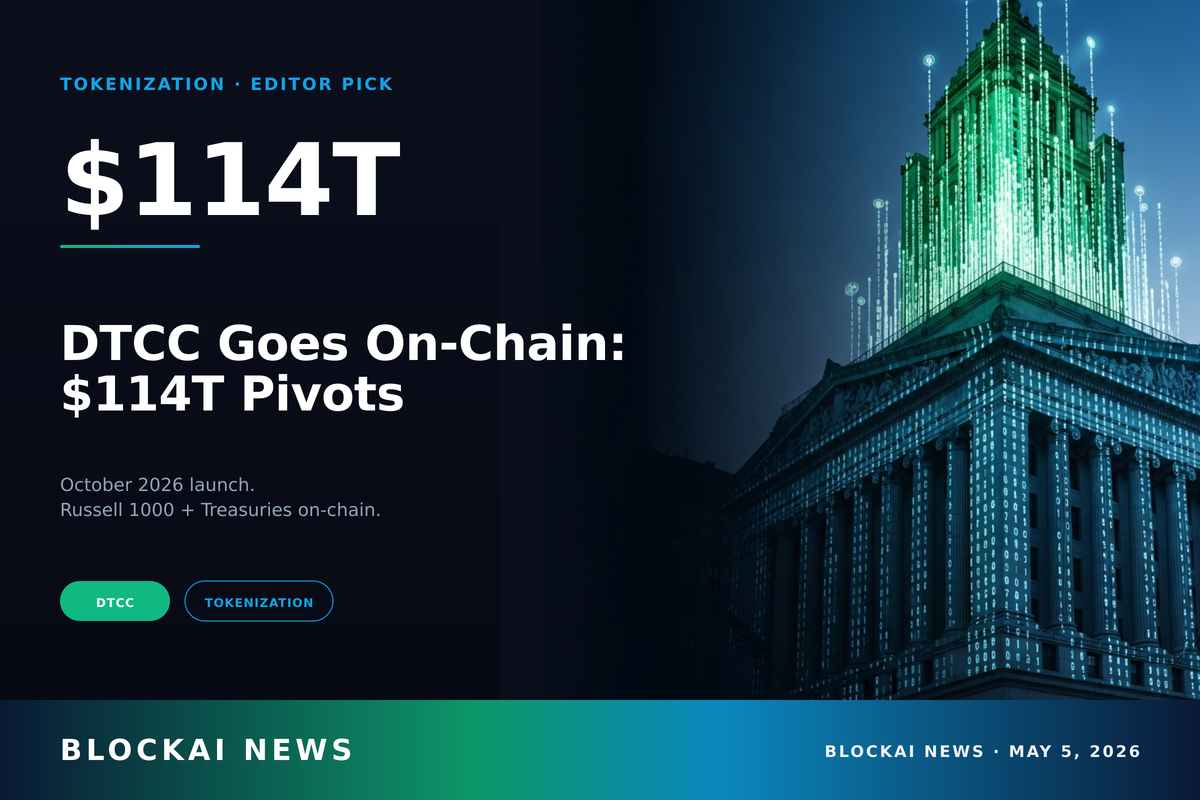
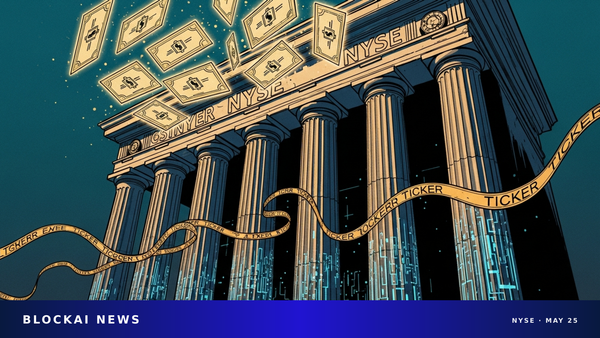
The debate over whether tokenized securities will achieve mainstream adoption has been running in financial circles for the better part of a decade. On May 4, 2026, the Depository Trust & Clearing Corporation delivered the answer. DTCC — which currently custodies more than $114 trillion in assets and clears virtually every US stock and bond transaction — announced that its tokenization platform will enter limited production in July 2026 and launch fully in October 2026. The platform will tokenize Russell 1000 constituents, major index ETFs, and US Treasuries — the most liquid, most widely held instruments in the world.
This is not a pilot. It is not a proof of concept. It is an infrastructure upgrade to the plumbing that processes the full depth of US capital markets, executed with regulatory authorization from the SEC, with 50+ institutions — including BlackRock, Goldman Sachs, JPMorgan, Morgan Stanley, Bank of America, Citadel Securities, NYSE, Circle, Coinbase, Kraken, and Ondo — actively shaping the product. When this launches in October, the on-chain securities market goes from "emerging" to "infrastructure."
Why This Is Different From Everything Before It
The tokenized securities market has produced dozens of pilots and announcements over the past five years: JPMorgan's Onyx, Citigroup's Citi Token Services, Franklin Templeton's tokenized money market fund, the various blockchain-native issuances on tZERO, Republic, and Securitize. All of these shared a common limitation: they were parallel systems. You had to opt in, move assets from the traditional system into a blockchain environment, and accept that your on-chain position had limited connectivity to the $100+ trillion in traditional finance liquidity that remained off-chain.
The DTCC launch eliminates that structural separation. DTCC is not creating a parallel system — it is upgrading the existing system. Russell 1000 stocks will continue to trade on NYSE and Nasdaq, clear through DTCC, and settle T+1 as they always have. The tokenization layer does not replace that infrastructure; it runs alongside it, adding on-chain representations of the same DTC-custodied positions that institutional investors already hold. The assets remain subject to the same entitlements, investor protections, and ownership rights as the traditional form. What changes is what you can do with them.
What Changes in the Next 18 Months
Three specific changes will materialize between now and the end of 2027.
First: stablecoin settlement replaces T+1 for participating institutions. Circle's participation in the working group means USDC will serve as a settlement asset within the DTCC platform. The first time a tokenized Russell 1000 position settles against USDC in delivery-versus-payment — likely in the July pilot — it will be the first mainstream stablecoin-denominated equity settlement inside US regulated infrastructure. As more participants join the platform, the T+1 cycle begins to fragment: institutions with on-chain accounts will increasingly prefer immediate, 24/7 settlement over end-of-day batch clearing. This will generate competitive pressure on the legacy settlement cycle that the SEC's 2024 T+1 mandate only partially addressed.
Second: on-chain collateral management becomes mainstream. Tokenized Treasuries are already a $8.7 billion market growing at 225% annually. With DTCC providing institutional-grade tokenized Treasuries at scale, the use of on-chain T-bills as collateral in DeFi lending protocols, perpetual futures margin, and inter-institutional repo will accelerate sharply. The risk management infrastructure for crypto-native institutions — which currently relies on USDC and stablecoins as primary collateral — will start incorporating tokenized Treasuries as the risk-free-rate asset. This brings TradFi risk-free-rate benchmarking into DeFi for the first time at institutional scale.
Third: the on-chain IPO pipeline opens. Securitize received FINRA approval this week to underwrite on-chain IPOs and custody tokenized securities. DTCC's October launch gives Securitize the settlement infrastructure it needs to run a complete on-chain capital formation process — from book-building through issuance through secondary market trading — all within regulated frameworks. The first on-chain IPO using the full DTCC+Securitize stack is likely to happen within 12 months of the October launch.
 DTCC
DTCCThe Risks Nobody Is Talking About
The DTCC launch is unambiguously positive for the on-chain securities thesis. But three structural risks deserve attention that the announcement coverage largely skipped.
Liquidity fragmentation. When institutional investors can trade tokenized Russell 1000 shares on-chain, they will arbitrage between the on-chain price and the NYSE/Nasdaq price. In normal conditions, that arbitrage will keep prices aligned. In stressed conditions — a circuit-breaker event, a liquidity crisis — the two markets may diverge in ways that existing risk management frameworks are not designed to handle. DTCC's parallel-system approach reduces this risk compared to a hard migration, but does not eliminate it. The July pilot will be the first real test of how quickly price alignment degrades under stress conditions.
Concentration risk in the stablecoin settlement layer. USDC is the de facto stablecoin for the DTCC platform, which means Circle becomes a critical financial infrastructure provider for the US equity market. A regulatory action against Circle, a de-peg event, or a technical failure in the USDC smart contract could cascade into equity settlement disruption. The systemic importance of USDC has been growing for two years; the DTCC launch will accelerate that trajectory to a point where USDC is no longer a "crypto stablecoin" but a "systemically important financial utility."
The winner-take-most dynamic. The DTCC platform gives incumbent participants — the 50+ firms in the working group — a structural head start in the tokenized securities market. Smaller broker-dealers, regional banks, and non-working-group fintechs will face a choice: integrate with the DTCC platform on whatever terms the incumbent group has already standardized, or build competing infrastructure that will struggle to match DTCC's network effects. The open question is whether the January 2027 rulemaking — which will formalize the three-year pilot into permanent regulation — locks in the working group's standards as de facto mandatory requirements.
DTCCThe View From Here
The DTCC tokenization launch is the inflection point that the on-chain finance market has been building toward since 2018. The market that emerges from the October launch will be structurally different from the market that exists today in three ways: settlement will begin moving toward T+0, stablecoin settlement will have mainstream institutional precedent, and on-chain equity positions will be the collateral of choice for the next generation of DeFi protocols.
The question worth tracking for the next 18 months is not whether this succeeds — it will. The question is who captures the most value from the transition. DTCC captures the infrastructure fee stream. Circle captures the stablecoin settlement premium. The 50+ working group members capture the first-mover operational advantage. The firms and protocols that are not in that room today will spend the next three years trying to retrofit into a standard they had no hand in designing.
Watch the October launch volume numbers. Watch which asset class — Treasuries, equities, or ETFs — gets the most on-chain activity in the first 30 days. And watch whether any firm outside the original working group achieves meaningful integration within 90 days of the general availability launch. Those three signals will tell you more about the actual trajectory of on-chain finance than any analyst report published this year.
Stay close to BlockAI News.
Wall Street's tokenization clock is now ticking. You'll want to be reading the right feed when October arrives.
How we report: This article cites primary sources, regulatory filings, and on-chain data where available. BlockAI News uses AI tools to assist with research and first-draft generation; every article is reviewed and edited by a human editor before publication. Read our full How We Report page, Editorial Policy, AI Use Policy, and Corrections Policy.