OpenAI Open-Sources Privacy Filter, a 1.5B-Parameter On-Device PII Stripper
OpenAI released Privacy Filter, a 1.5B-parameter Apache 2.0 model that masks 8 categories of sensitive data locally before content leaves the device — 96% accurate on PII-Masking-300k.

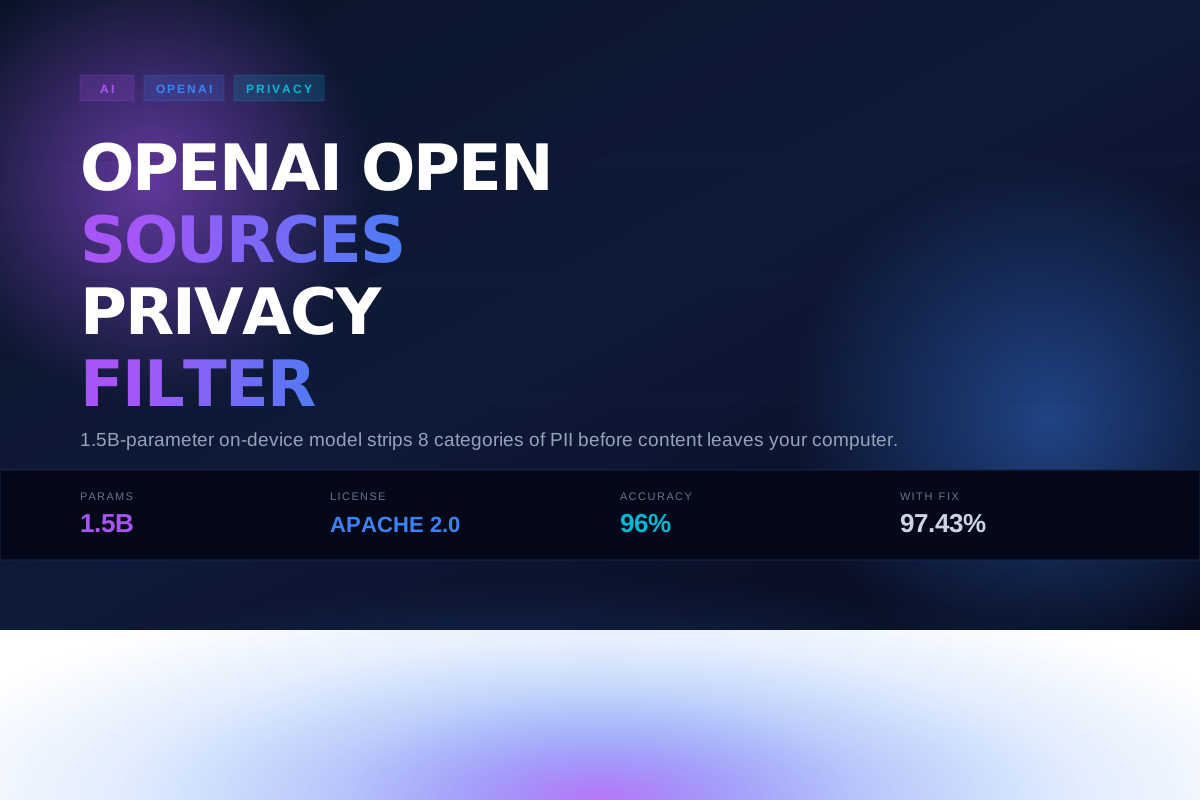
OpenAI on April 22, 2026 released Privacy Filter, a 1.5-billion-parameter open-source model that strips personally identifiable information locally before content leaves a user's device. The tool is published under the permissive Apache 2.0 license on both Hugging Face and GitHub.
What it masks
Privacy Filter covers eight data categories: names, addresses, emails, phone numbers, URLs, dates, account numbers, passwords, and API keys. Sensitive fields are replaced with placeholders such as [PRIVATE_PERSON] or [ACCOUNT_NUMBER]. The model runs locally on a personal computer, meaning no data is sent to external servers.
Benchmark accuracy
On the PII-Masking-300k benchmark, the model reports 96% accuracy out of the box, rising to 97.43% with OpenAI's correction layer applied.
OpenAI's caveats
OpenAI explicitly framed Privacy Filter as "not an anonymization tool, a compliance certification, or a substitute for policy review." The remaining 4% miss rate means the model is not suitable on its own for high-stakes settings such as healthcare or legal workflows.
Why it matters
An on-device, open-weights PII model directly addresses the enterprise blocker that has slowed consumer LLM adoption inside regulated workflows. By keeping the stripping step local, Privacy Filter lets teams use any cloud LLM without relying on provider-side redaction promises.
Want every AI × Web3 signal the moment it breaks? Subscribe to the BlockAI News daily brief.
How we report: This article cites primary sources, regulatory filings, and on-chain data where available. BlockAI News uses AI tools to assist with research and first-draft generation; every article is reviewed and edited by a human editor before publication. Read our full How We Report page, Editorial Policy, AI Use Policy, and Corrections Policy.