BlackRock Tells OCC: Drop the 20% Cap on Tokenized Stablecoin Reserves
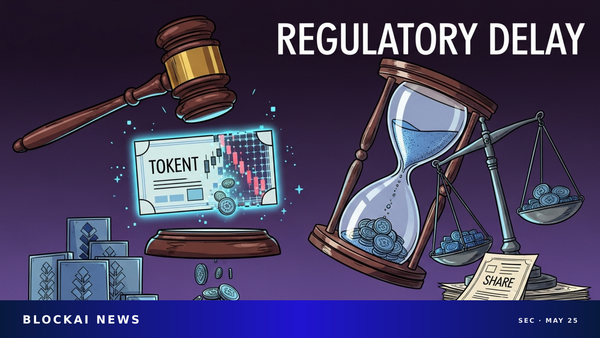
BlackRock filed a formal comment letter with the OCC opposing a proposed 20% ceiling on tokenized assets as stablecoin reserves under the GENIUS Act's draft rulemaking. The cap would constrain BlackRock's BUIDL fund. BlackRock is asking the OCC to remove the limit and expand eligible asset types.


BlackRock has filed a formal comment letter with the Office of the Comptroller of the Currency (OCC) opposing a proposed 20% ceiling on tokenized assets held as stablecoin reserves under the GENIUS Act's draft rulemaking. The limit would directly constrain BlackRock's BUIDL fund — the largest tokenized money-market product on-chain — by capping how much of a stablecoin issuer's reserves can be placed in tokenized vehicles. BlackRock is asking the OCC to remove the cap entirely and to expand the list of eligible reserve assets to include Treasury bond ETFs and two-year floating-rate Treasury bonds.
What the OCC's Proposed GENIUS Act Rule Actually Does
The OCC published a 376-page proposed rulemaking in April 2026 to implement the GENIUS Act (Guiding and Establishing National Innovation for U.S. Stablecoins Act), which passed Congress in 2025 and established a federal licensing framework for payment stablecoin issuers. The proposed rule applies to national banks, federal savings associations, and nonbank entities seeking approval as Federal Qualified Payment Stablecoin Issuers.
At its core, the rule requires stablecoins to be backed 1:1 by high-quality liquid assets (HQLA) — cash, short-duration Treasuries, central-bank reserves — held in segregated custody. The contested provision caps one subcategory of those HQLA: tokenized assets (digitized representations of qualifying instruments, such as shares in a tokenized money-market fund) cannot constitute more than 20% of a stablecoin's total reserves. The OCC's comment period closed May 1; BlackRock filed in the final window alongside responses from Davis Polk, Morgan Lewis, and Brookings Institution.
Morgan Stanley had already launched the MSNXX government money-market fund specifically structured to qualify as a GENIUS Act reserve vehicle, signaling that institutional players are racing to position their products inside whatever reserve framework the OCC finalizes.
Why BUIDL's Scale Makes This Fight High-Stakes
BlackRock's BUIDL fund has grown to become the dominant product in the tokenized money-market category, holding billions in short-duration Treasuries on-chain and distributing yield to token holders in real time. Economically, BUIDL shares and plain Treasury bills are functionally identical — both represent a claim on U.S. government debt. BlackRock's argument to the OCC is precisely this: if the underlying credit risk and liquidity profile are equivalent, treating them differently in a reserve framework is arbitrary and distortionary.
The 20% cap's practical consequence: a $1 billion stablecoin issuer could place only $200 million in BUIDL shares, forcing the remaining $800 million into direct Treasury holdings or cash. Those direct holdings yield roughly the same as BUIDL in the short term, but they bypass the operational efficiency, programmability, and 24/7 settlement that make tokenized reserves attractive. Stablecoin issuers — Circle, Paxos, Tether, and prospective bank issuers — would have both economic and operational incentive to maximize tokenized allocations if the cap were removed, and that's exactly the demand that BUIDL is built to capture.
BlackRock also asked the OCC to clarify whether Treasury bond ETFs qualify as eligible reserve assets and to add two-year floating-rate Treasury bonds to the approved list, both positions that would expand the yield and duration options available to stablecoin issuers without taking on additional credit risk.
BlockAI News' View
BlackRock's technical argument is sound: tokenized Treasury funds and direct Treasury holdings carry identical credit risk. The OCC's 20% ceiling is a technology-risk adjustment, not a credit-risk adjustment — the regulatory concern is the smart-contract and bridge infrastructure sitting on top of the Treasury holdings, not the holdings themselves. That's a legitimate concern today, but it's a solvable engineering problem, not a permanent structural flaw.
The more interesting question is what the final rule signals about the OCC's timeline for trusting tokenized infrastructure. A rule that removes the cap entirely endorses on-chain settlement as equivalently safe to traditional custody — a major statement. A rule that keeps the cap but raises it to 40% or 50% is a measured bet that the technology will mature, preserving optionality. A rule that keeps it at 20% sends the opposite signal to the asset management industry.
Watch the OCC's final rule publication, expected in late 2026, for the revised cap number. Watch BUIDL's AUM trajectory over the next six months: if stablecoin issuers begin pre-positioning assets into BUIDL ahead of the final rule, they're betting the cap gets raised. If AUM plateaus at the 20% boundary, they're not.
Track every DeFi move and regulatory shift, first. Subscribe to the BlockAI News daily brief.
How we report: This article cites primary sources, regulatory filings, and on-chain data where available. BlockAI News uses AI tools to assist with research and first-draft generation; every article is reviewed and edited by a human editor before publication. Read our full How We Report page, Editorial Policy, AI Use Policy, and Corrections Policy.