Coinbase's Base Adopts Succinct's SP1 Zero-Knowledge VM to Strengthen Its $7.4 Billion Rollup
Coinbase's Base L2 will integrate Succinct's SP1 zero-knowledge virtual machine under its Azul upgrade, replacing multi-day challenge periods with cryptographic finality for $7.4B in bridged assets while keeping its existing optimistic rollup structure.

Coinbase's Ethereum Layer 2 network Base, which holds $7.4 billion in bridged assets and ranks among the top three L2s by total value locked, has selected Succinct Labs and its SP1 zero-knowledge virtual machine to augment its existing optimistic rollup architecture under the Azul upgrade. The integration positions Base as the largest Ethereum L2 to adopt ZK-based validation mechanisms at production scale.
The Integration
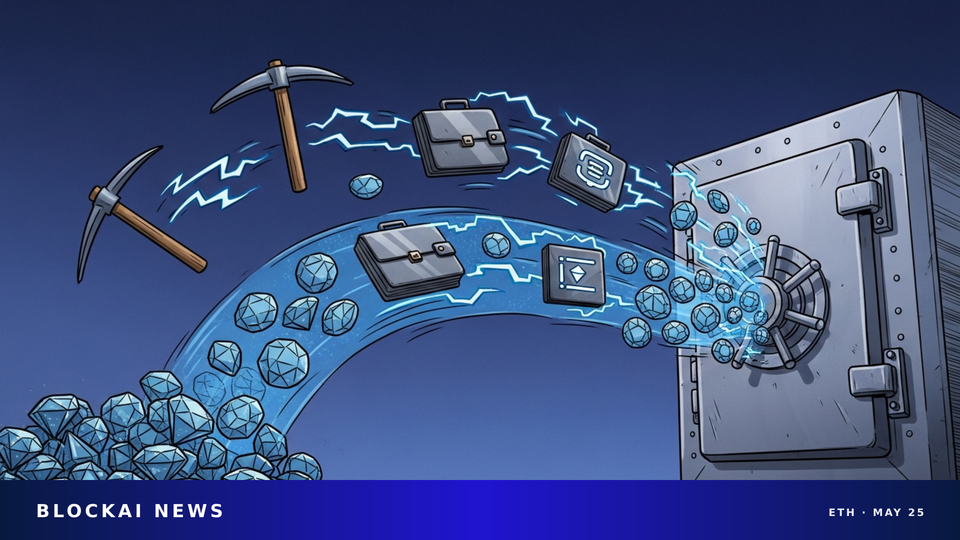
Base currently operates as an optimistic rollup — it posts transactions to Ethereum with the assumption they are valid and relies on a fraud-proof challenge window to catch invalid state transitions. The challenge window currently runs seven days, meaning assets bridged from Ethereum to Base are subject to a seven-day withdrawal delay while the optimistic period clears. SP1 will allow Base to replace parts of this fraud-proof system with cryptographic proofs generated in near-real-time, collapsing the withdrawal window from seven days to approximately one day under the Azul upgrade.
Succinct's SP1 is an open-source zkVM (zero-knowledge virtual machine) that generates succinct proofs for arbitrary Rust-based computations. Rather than requiring circuits to be custom-written for each operation — which was the key engineering bottleneck in early ZK rollup designs — SP1 allows developers to write standard Rust code and generate ZK proofs automatically. Base's existing codebase is written in Rust, making the integration architecturally clean.
Why ZK, Why Now
The ZK landscape has matured significantly in the past 18 months. Proving costs — once prohibitively expensive for production rollups — have dropped more than 100x as hardware accelerators, improved prover algorithms, and competitive proving markets have commoditized proof generation. Succinct in 2025 delivered on its promise to make SP1 production-ready at scale; Base's adoption is the highest-profile validation of that maturity.
Base's approach is deliberately hybrid: rather than discarding the optimistic rollup structure and rebuilding as a ZK rollup, Base is layering ZK proofs on top of its existing architecture. This preserves the existing developer ecosystem and $7.4 billion in TVL without requiring a full migration, while delivering the security properties — cryptographic finality rather than economic finality — that institutional bridgers increasingly demand. Several large institutional DeFi protocols have cited the seven-day challenge window as a barrier to deploying significant capital on Base; one-day finality changes that calculus.
 Succinct Labs
BlockAI News' View
Base adopting SP1 is a strong signal that the ZK-proof market has reached the cost and performance threshold needed for production L2 deployment at scale. The more interesting consequence is what it does to the competitive dynamic between optimistic and ZK rollups. Arbitrum and Optimism — Base's closest competitors — are both working on ZK transitions, but Base's move accelerates the timeline. Within 18 months, every major L2 will have some form of ZK proving. The differentiation will shift from technology to ecosystem: developer tooling, DeFi liquidity depth, and institutional relationships will determine which L2 captures the institutional TVL that is currently on the sidelines waiting for better finality guarantees.
Daily Web3 + AI signal, straight to your inbox — subscribe →
How we report: This article cites primary sources, regulatory filings, and on-chain data where available. BlockAI News uses AI tools to assist with research and first-draft generation; every article is reviewed and edited by a human editor before publication. Read our full How We Report page, Editorial Policy, AI Use Policy, and Corrections Policy.