Anthropic Overtakes OpenAI in Enterprise AI: 40% Market Share, $30B Run Rate, 80x Growth
Anthropic now commands 40% of enterprise LLM spend versus OpenAI's 27%, per Menlo Ventures' 2025 report. Q1 2026 revenue grew 80x to a $30B run rate. A $1.8B Akamai deal and 300MW SpaceX Colossus contract race to fund the demand.


For the first time since the modern generative AI race began, Anthropic has overtaken OpenAI in the place that actually pays the bills: enterprise spend. According to Menlo Ventures' 2025 State of Generative AI in the Enterprise report, Anthropic now controls 40% of enterprise large language model spend — up from 12% in 2023 and 24% a year ago — while OpenAI has slid from 50% to 27%. Three weeks into Q2, the gap is widening, and Anthropic's biggest problem is no longer winning customers but finding enough compute to serve them.
TL;DR
- Anthropic now leads OpenAI in enterprise AI spend (40% vs 27%) per Menlo Ventures' 2025 report, and in business-customer count (34.4% vs 32.3%) per the May 2026 Ramp AI Index.
- Q1 2026 annualized revenue grew 80x — from a $9B run rate at end-2025 to $30B by April — driven by Claude Code's 54% coding-workload share and 300,000+ enterprise customers.
- To serve demand, Anthropic signed a $1.8B seven-year Akamai contract (May 8) and took all 300MW of SpaceX's Colossus 1 data center (May 6), on top of existing Google and AWS capacity.
How a 12% underdog became a 40% market leader
The Menlo Ventures report, released in December 2025 and updated with Q1 2026 data, tracks enterprise spending across an $8.4 billion API and platform market. Anthropic's 40% share is the largest single position any vendor has held in the segment since OpenAI's 50% peak in 2023. Two data points explain the swing.
First, coding became the most defensible enterprise workload in 2025-2026, and Anthropic owns it. The Menlo report estimates Claude commands 54% of enterprise coding spend versus 21% for OpenAI's ChatGPT and Codex — up from 42% six months ago. Claude Code, the company's CLI agent, has become the default automation surface inside Fortune 500 engineering organizations, and Anthropic doubled its five-hour rate limits for Pro, Max, Team, and Enterprise plans at Code with Claude on May 6, 2026.
Second, the Ramp AI Index — a separate dataset tracking corporate card spending across 35,000+ U.S. businesses — confirmed in its May 2026 release that Anthropic's adoption rose to 34.4% of paying businesses, while OpenAI fell to 32.3%. A year ago those numbers were under 8% and 32%. Anthropic's adoption quadrupled in twelve months. OpenAI's grew 0.3%.
The pattern matches what Anthropic's revenue trajectory has been telegraphing for two quarters. In CNBC's coverage of his Code with Claude keynote on May 6, CEO Dario Amodei disclosed that the company's annualized revenue and usage grew 80-fold in Q1 2026 — a number he called "just crazy" and "too hard to handle." Annualized revenue run rate moved from $9 billion at the end of 2025 to $30 billion by April, a 233% jump in four months. Salesforce, by comparison, took roughly 20 years to reach $30 billion.
What's striking is the source of the growth. Anthropic now serves more than 300,000 business customers, and per disclosures at the conference, enterprise accounts contribute roughly 80% of revenue. That's the inverse of OpenAI, where ChatGPT consumer subscriptions still dominate the top line and weekly active users have reportedly crossed 900 million. Two companies, two business models — and one of them has now decided who pays the AI economy's enterprise bill.
The compute scramble and why $1.8B with Akamai matters
Demand has outrun supply. To handle the 80x Q1 surprise, Anthropic spent May 2026 stitching together compute from places no one expected the company to land.
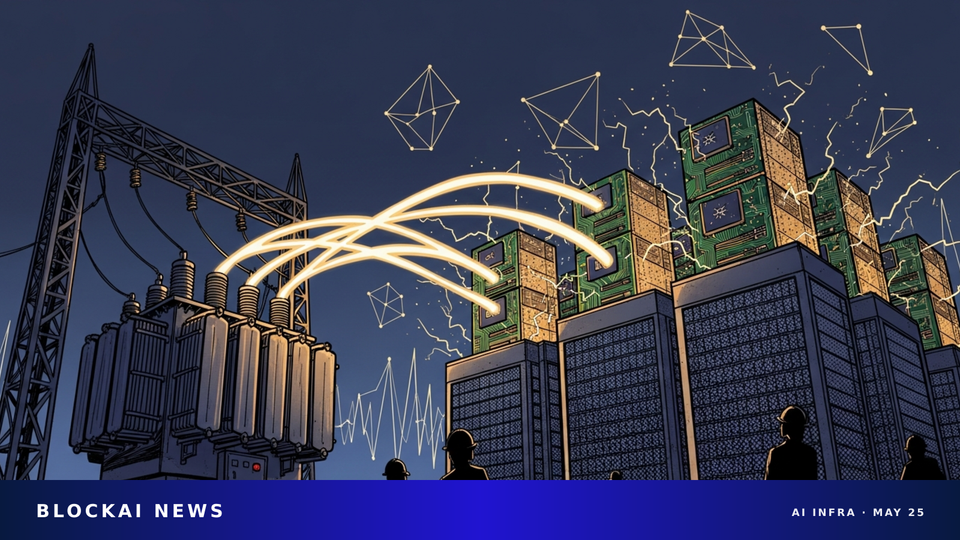
On May 6 at Code with Claude in San Francisco, Anthropic announced it had taken all of the capacity at Elon Musk's SpaceX-owned Colossus 1 data center in Memphis — more than 220,000 NVIDIA GPUs and 300 megawatts of power, online within a month of the announcement, per CNBC. The deal is notable both for size and politics: Anthropic, the AI lab most explicitly identified with safety-first alignment research, is now renting infrastructure from a Musk facility that two months earlier was being used to train Grok. SpaceXAI — the post-restructure successor to xAI as of May 6, 2026 — gets a customer. Anthropic gets electrons.
Two days later, Bloomberg broke a second, larger deal: a $1.8 billion, seven-year cloud computing contract with Akamai Technologies. The contract is the largest in Akamai's history and averages $257 million per year. It also marks Akamai's pivot from a content delivery network into an AI inference provider, leveraging the company's roughly 4,300 edge points of presence to serve Claude API requests with lower latency than hyperscaler-region deployments can deliver. Akamai stock rose 27% on May 8, its biggest single-day rally in more than two decades.
The 300MW Colossus 1 capacity is the more strategically interesting of the two deals. At roughly 220,000 NVIDIA H100-class GPUs, the facility represents a meaningful slice of total global H100 deployment, and Anthropic's exclusive access closes a door that until April was open to multiple bidders. The cost math is brutal: at current rental rates of roughly $2-3 per GPU-hour, full utilization of Colossus 1 implies an annualized compute bill of $4-6 billion, on top of the $1.8 billion Akamai commitment and undisclosed AWS and Google obligations. Anthropic's recent $13 billion Series F closed at the end of 2025; at this burn rate, the next round is a necessity, not an option.
Combined with existing commitments to Google Cloud (Anthropic's longtime TPU partner) and Amazon Web Services (its largest financial backer, with $8 billion invested as of late 2024), Anthropic now operates one of the most diversified compute footprints in frontier AI. That diversification is strategic: it reduces vendor lock-in risk, lets Anthropic arbitrage GPU shortages across providers, and — as one investor told VentureBeat — turns compute capacity itself into a defensible moat at exactly the moment when most new enterprise AI deals are being decided on latency and availability rather than raw model quality.
The financial implication is harder to dismiss. Even at Anthropic's announced $30 billion run rate, a $1.8 billion seven-year commitment, plus the SpaceX Colossus deal (estimated by sector trackers at roughly $5 billion over the contract's life), plus existing AWS and Google obligations, represents compute spending in the same order of magnitude as full-year revenue. The company is reportedly in talks to raise between $30 billion and $50 billion at a valuation approaching $950 billion, per a Fortune report dated May 13. The math only works if 80x growth — or a meaningful fraction of it — continues.
Three threats that could erase the lead
For all the velocity, Anthropic's enterprise lead remains structurally fragile. VentureBeat's coverage of the Menlo report flagged three threats that should temper the celebration.
First, GPT-5.5 reset the model-quality conversation. OpenAI's April 23, 2026 release pushed the Artificial Analysis Intelligence Index to 59 — two points ahead of Gemini 3.1 Pro and within striking distance of Claude Opus 4.7. Enterprise switching costs are real, but in coding evaluations published after GPT-5.5 shipped, the gap narrowed materially. If Claude's coding lead compresses, the largest single line item in enterprise AI spend becomes contestable again.
Second, Google's Gemini Intelligence — set to be previewed at Google I/O on May 19 — bundles agentic AI directly into Android and Workspace at no marginal cost to existing G Suite customers. For mid-market buyers already paying for Workspace, switching from a separate Claude API line item to a bundled Gemini agent removes both a procurement contract and a vendor relationship. Bundling has historically been the playbook that breaks open API-led markets.
Third, Microsoft's first in-house foundation models — MAI-Voice-1, MAI-Image-2, and the multimodal MAI series — shipped in April 2026 and are being woven into Azure OpenAI Service as fallback options. Even if MAI models are not best-in-class, their presence inside the same enterprise contract OpenAI customers already sign creates a glide path away from the OpenAI dependency. Anthropic does not have an equivalent hyperscaler-native distribution channel.
The compute story cuts both ways too. If GPU prices stabilize and the supply shortage ends, Anthropic's diversified-provider moat thins. If they tighten further, the $1.8B Akamai and roughly $5B-estimated SpaceX commitments could prove either prescient or ruinous, depending on whether private capital remains willing to underwrite the gap between contracted compute and realized revenue.
The IPO clock is the fourth, quieter threat. Multiple reports through April and May 2026 have Anthropic targeting a late-2026 public listing, potentially at a $950 billion valuation — a number that requires Q2 and Q3 revenue to grow into a roughly $50 billion run rate to justify on any defensible multiple. If 80x slows to 20x, the IPO can still happen but at a meaningfully lower valuation. If it slows to 10x — closer to the company's own original 2026 plan — the public-market math forces a delay. Either outcome shifts negotiating leverage with both customers and compute providers, and would be the first real test of whether Anthropic's enterprise lead is a business model or just a moment.
Key Takeaways
- Enterprise leadership has flipped. Anthropic 40% / OpenAI 27% on Menlo Ventures' spend data; 34.4% / 32.3% on Ramp's adoption data. Two independent datasets, same direction.
- Compute is the constraint, not demand. $1.8B Akamai + 300MW SpaceX Colossus + Google + AWS — Anthropic is buying GPU access in every form it can find, betting growth continues.
- The lead is real but contestable. GPT-5.5 narrowed coding evals, Gemini Intelligence bundles agentic AI into Workspace, and MAI gives Azure customers a graceful exit ramp. Q3 2026 numbers will decide if 40% holds.
Beyond the Headlines: The "Anthropic overtakes OpenAI" story is being read as a horse race, but the more interesting question is what the data says about how enterprises actually buy AI in 2026. The 80x growth is partly Anthropic's own execution, partly a rejection of OpenAI's consumer-first sprawl, and partly a Claude Code-shaped tail wagging the entire enterprise dog. Watch three signals over the next quarter: whether OpenAI's enterprise revenue accelerates after GPT-5.5 maturation, whether Akamai's stock holds its 27% gain as inference deployment proves out, and whether Anthropic can close its rumored $30-50B round at a $950B valuation without the IPO clock forcing a premature decision. Whichever way those land, the era when "the AI company" was synonymous with one name is over.
Frequently Asked Questions
Why is Anthropic now ahead of OpenAI in enterprise AI?
Anthropic now holds 40% of enterprise LLM spend versus OpenAI's 27%, per Menlo Ventures' 2025 State of Generative AI in the Enterprise report. The shift is driven by Anthropic's 54% market share in coding workloads (anchored by Claude Code), 80x Q1 2026 annualized revenue growth, and a $30 billion annual revenue run rate, with roughly 80% of revenue from enterprise customers.
What does the $1.8 billion Akamai deal mean for Anthropic?
The seven-year, $1.8 billion contract is the largest in Akamai's history and gives Anthropic edge inference capacity across roughly 4,300 points of presence — meaning lower latency Claude API responses than hyperscaler-region deployments. It also signals Anthropic's strategic shift toward diversifying compute providers, with parallel deals at SpaceX's Colossus 1 data center (300MW), Google Cloud, and Amazon Web Services.
Can OpenAI catch back up to Anthropic in the enterprise market?
Three potential catalysts could narrow the gap: OpenAI's GPT-5.5 (released April 23, 2026) reset coding benchmarks closer to Claude Opus 4.7; Google's Gemini Intelligence, previewing at I/O on May 19, bundles agentic AI into Workspace at no marginal cost to existing customers; and Microsoft's MAI foundation models give Azure OpenAI Service customers a glide path away from OpenAI dependency. Anthropic's lead is real but structurally contestable.
Reviewed by Jason Lee, Founder & Editor-in-Chief, BlockAI News.
Sources
Primary sources and prior BlockAI News coverage referenced in this article.
Primary sources
- Menlo Ventures — 2025 State of Generative AI in the Enterprise
- CNBC — Anthropic CEO Dario Amodei on 80x Q1 growth at Code with Claude
- Bloomberg — Anthropic Inks $1.8 Billion Computing Deal With Akamai (AKAM)
- Anthropic — Code with Claude developer conference page
- TechTimes — Ramp AI Index May 2026: Claude overtakes ChatGPT in U.S. business payments
- Fortune — Anthropic's $30-50B raise and $950B valuation talks (May 13, 2026)
- VentureBeat — Three threats that could erase Anthropic's lead
From BlockAI News
How we report: This article cites primary sources, regulatory filings, and on-chain data where available. BlockAI News uses AI tools to assist with research and first-draft generation; every article is reviewed and edited by a human editor before publication. Read our full How We Report page, Editorial Policy, AI Use Policy, and Corrections Policy.