Anthropic Ships Election Safeguards for Claude Ahead of US Midterms: 95–96% Neutrality, 100% Compliance on Opus 4.7
Anthropic deployed automated detection, election-information banners and stress-tested usage-policy enforcement on Claude ahead of the 2026 US midterms — reporting 100% appropriate-response rates on Opus 4.7 against a 600-prompt benchmark and 95–96% political neutrality scores.

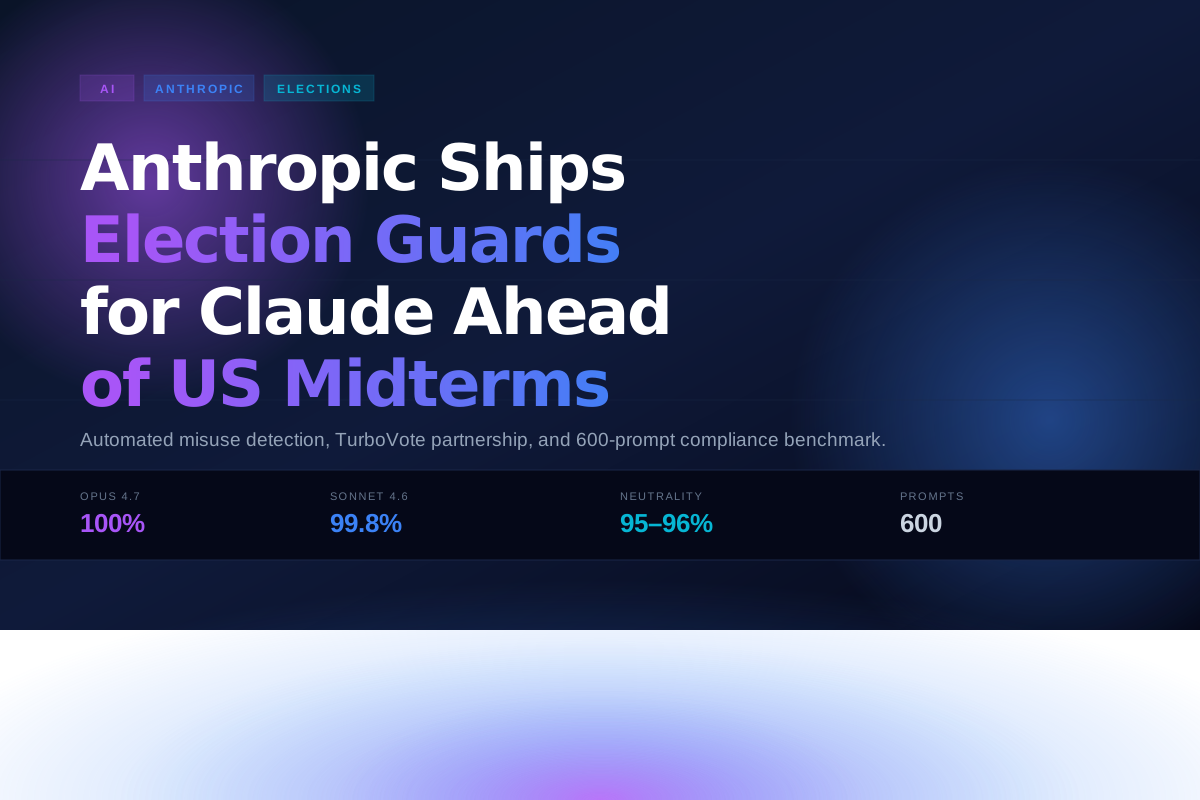
Anthropic rolled out a multi-layer election safeguard for Claude ahead of the 2026 US midterm elections and Brazil's general election later this year. The package combines policy enforcement, partner-routed information, and published benchmarks.
What the safeguards include
The release covers automated detection systems for election-related misuse, red-team stress testing against influence-operation scenarios, and election-information banners that route users to TurboVote — operated by nonpartisan nonprofit Democracy Works — for voter registration and polling-location data. Anthropic's usage policy explicitly prohibits deceptive campaigns, synthetic election content, voter-fraud assistance, voting-infrastructure interference, and voting misinformation.
The benchmark numbers
Anthropic published results from a 600-prompt evaluation suite (300 designed-harmful prompts, 300 legitimate prompts). Claude Opus 4.7 responded appropriately 100% of the time; Claude Sonnet 4.6 hit 99.8%. On political neutrality, Opus 4.7 scored 95% and Sonnet 4.6 scored 96%. On multi-turn influence-operation simulations — closer to how real adversarial use unfolds — Sonnet 4.6 succeeded 90% and Opus 4.7 succeeded 94% at refusing or steering away. The numbers are unusual in the AI-safety disclosure category for the level of methodological detail.
What to Watch
Two follow-on signals matter. First: whether OpenAI, Google, and xAI publish equivalent benchmark methodologies — Anthropic just put a measurable bar in the public record, and the others now choose to match it or stay silent. Second: the multi-turn influence-operation gap between 90% and 94%. Real adversaries iterate; the lower number is closer to the actual risk surface during peak election cycles. If Anthropic continues to disclose multi-turn metrics quarterly, this becomes the de facto industry standard for political-content evaluation. If they don't, expect external researchers to fill the gap.
Want every AI × Web3 signal the moment it breaks? Subscribe to the BlockAI News daily brief.
How we report: This article cites primary sources, regulatory filings, and on-chain data where available. BlockAI News uses AI tools to assist with research and first-draft generation; every article is reviewed and edited by a human editor before publication. Read our full How We Report page, Editorial Policy, AI Use Policy, and Corrections Policy.